


Molecular imaging in atherosclerosis: FDG PET
- PMID: 22872371
- PMCID: PMC3576137
- DOI: 10.1007/s11883-012-0264-x
Molecular imaging in atherosclerosis: FDG PET
Abstract
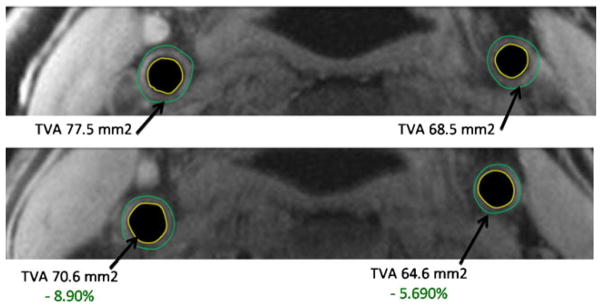
18F-FDG PET is a new noninvasive tool for inflammation functional imaging. Low spatial resolution is now compensated by coregistration with CT or MRI. New mechanistic insights have emerged from animal and histology to explain the obtained signals by hypoxia, macrophage infiltration, and differentiation. Mixed results have been found in biomarkers studies. Interesting data have come recently linking plaque anatomy and function in carotids and in aortic aneurysms as well as inflammation and events. In coronary arteries, plaque assessment is still hampered by myocardium uptake but developments are being made. 18-FDG PET has been able to monitor inflammation before and after several therapies in animals and humans but to date the lack of standardization and the absence of prospective event-driven studies prevent this promising technique to be used in clinical practice.
Conflict of interest statement
Figures
References
-
- Ogawa M, Nakamura S, Saito Y, Kosugi M, Magata Y. What can be seen by 18F-FDG PET in atherosclerosis imaging? The effect of foam cell formation on 18F-FDG uptake to macrophages in vitro. Society of Nuclear Medicine official publication. J Nucl Med. 2012;53:55–8. In this study, authors look at the very cause of FDG uptake and show the different role of macrophages and foam cells. - PubMed
-
- Folco EJ, Sheikine Y, Rocha VZ, et al. Hypoxia but not inflammation augments glucose uptake in human macrophages. Implications for imaging atherosclerosis with 18fluorine-labeled 2-deoxy-D-glucose positron emission tomography. J Am Coll Cardiol. 2011;58:603–14. Inflammation is not the only trigger for FDG uptake, in this study, various stimuli are overlooked and hypoxia seems to be the most important one. - PubMed
-
- Derlin T, Habermann CR, Lengyel Z, et al. Feasibility of 11C-acetate PET/CT for imaging of fatty acid synthesis in the atherosclerotic vessel wall. J Nucl Med. 2011;52:1848–54. - PubMed
-
- Worthley SG, Zhang ZY, Machac J, et al. In vivo noninvasive serial monitoring of FDG-PET progression and regression in a rabbit model of atherosclerosis. Int J Cardiovasc Imaging. 2009;25:251–7. - PubMed
-
- Zhao QM, Feng TT, Zhao X, et al. Imaging of atherosclerotic aorta of rabbit model by detection of plaque inflammation with fluorine-18 fluorodeoxyglucose positron emission tomography/computed tomography. Chin Med J. 2011;124:911–7. - PubMed
Publication types
MeSH terms
Substances
Grants and funding
LinkOut - more resources
Full Text Sources
Medical
