


Current interventions to reduce sexual risk behaviors and crack cocaine use among HIV-infected individuals
- PMID: 22872433
- PMCID: PMC4180174
- DOI: 10.1007/s11904-012-0131-y
Current interventions to reduce sexual risk behaviors and crack cocaine use among HIV-infected individuals
Abstract
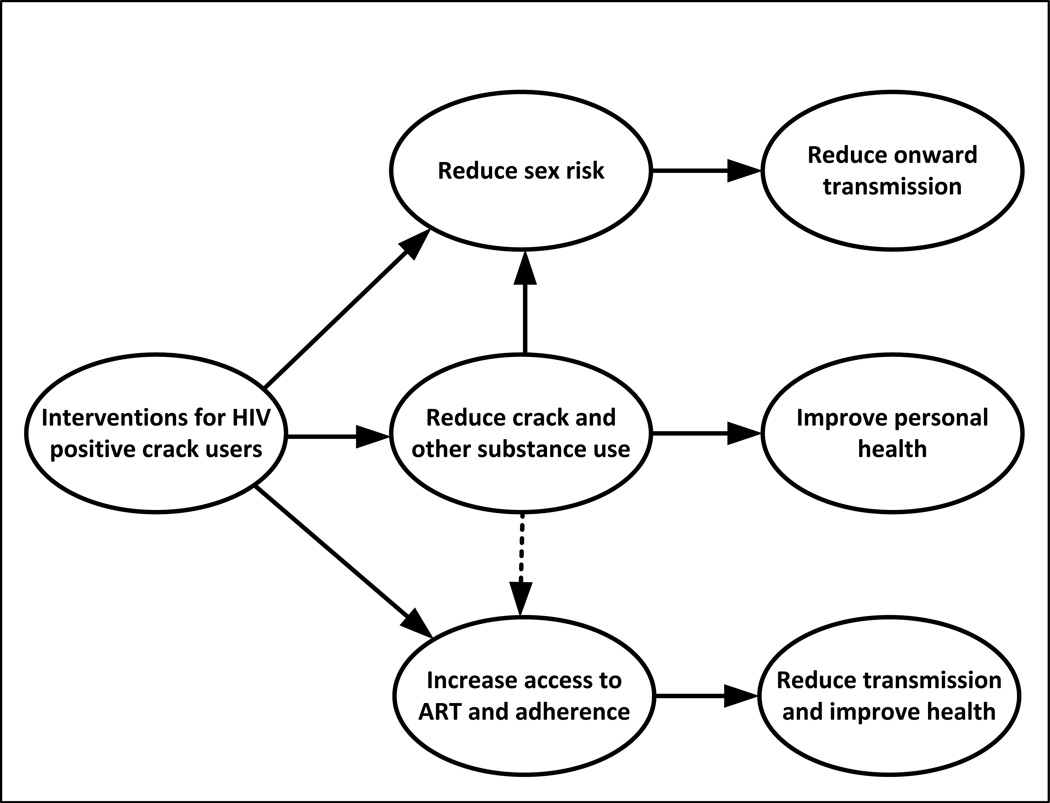
The dual global epidemics of crack cocaine use and HIV have resulted in a large number of people living with HIV who use crack cocaine, many of whom continue to engage in unprotected sex. Crack use also increases the rate of HIV progression. Consequently, there is an urgent need for effective interventions to decrease crack use and unprotected sex and to improve antiretroviral therapy (ART) adherence in this population. This article reviews the recent published literature on interventions for reducing crack use and unprotected sex among people living with HIV. Only a few intervention outcome studies targeting exclusively HIV positive crack cocaine users were identified, whereas other studies used a mixed sample. Some interventions focused on reducing crack use and several focused on reducing sex-risk behaviors. Consequently, there is a critical need for efficacious interventions that address crack use, risky sex and ART adherence among people living with HIV.
Figures
Similar articles
-
Correlates of antiretroviral utilization among hospitalized HIV-infected crack cocaine users.AIDS Res Hum Retroviruses. 2012 Sep;28(9):1007-14. doi: 10.1089/AID.2011.0329. Epub 2012 Mar 2. AIDS Res Hum Retroviruses. 2012. PMID: 22214200 Free PMC article.
-
Age and HIV risk in a national sample of injection drug and crack cocaine users.Subst Use Misuse. 2000 Aug;35(10):1385-404. doi: 10.3109/10826080009148221. Subst Use Misuse. 2000. PMID: 10921430
-
Demographic, HIV risk behavior, and health status characteristics of "crack" cocaine injectors compared to other injection drug users in three New England cities.Drug Alcohol Depend. 2006 Feb 28;81(3):221-9. doi: 10.1016/j.drugalcdep.2005.07.011. Epub 2005 Sep 19. Drug Alcohol Depend. 2006. PMID: 16171952
-
Effectiveness of secondary prevention and treatment interventions for crack-cocaine abuse: a comprehensive narrative overview of English-language studies.Int J Drug Policy. 2015 Apr;26(4):352-63. doi: 10.1016/j.drugpo.2015.01.002. Epub 2015 Jan 14. Int J Drug Policy. 2015. PMID: 25662894 Review.
-
Profile of cocaine and crack users in Brazil.Cad Saude Publica. 2008;24 Suppl 4:s545-57. doi: 10.1590/s0102-311x2008001600007. Cad Saude Publica. 2008. PMID: 18797730 Review.
Cited by
-
Sexual risk reduction for HIV-infected persons: a meta-analytic review of "positive prevention" randomized clinical trials.PLoS One. 2014 Sep 22;9(9):e107652. doi: 10.1371/journal.pone.0107652. eCollection 2014. PLoS One. 2014. PMID: 25243404 Free PMC article.
-
Predicting antiretroviral medication adherence among substance-using people with HIV: test and extension of the information-motivation-behavioral skills model.J Behav Med. 2025 Jun;48(3):403-413. doi: 10.1007/s10865-025-00557-y. Epub 2025 Feb 9. J Behav Med. 2025. PMID: 39924604
-
Factors associated with optimal pharmacy refill adherence for antiretroviral medications and plasma HIV RNA non-detectability among HIV-positive crack cocaine users: a prospective cohort study.BMC Infect Dis. 2016 Aug 27;16(1):455. doi: 10.1186/s12879-016-1749-y. BMC Infect Dis. 2016. PMID: 27568002 Free PMC article.
-
Improving the Adherence to Antiretroviral Therapy, a Difficult but Essential Task for a Successful HIV Treatment-Clinical Points of View and Practical Considerations.Front Pharmacol. 2017 Nov 23;8:831. doi: 10.3389/fphar.2017.00831. eCollection 2017. Front Pharmacol. 2017. PMID: 29218008 Free PMC article. Review.
-
Epidemiological HIV infection surveillance among subjects with risk behaviours in the city of Messina (Sicily) from 1992 to 2015.J Prev Med Hyg. 2017 Sep;58(3):E211-E218. J Prev Med Hyg. 2017. PMID: 29123367 Free PMC article.
References
-
- Inciardi JA. Editor's introduction. The crack epidemic revisited. J Psychoactive Drugs. 1992;24(4):305–306. - PubMed
-
- Washton AM, Gold MS. Crack. JAMA. 1986;256(6):711. - PubMed
-
- Fischer B, Coghlan M. Crack use in North American cities: the neglected 'epidemic'. Addiction. 2007;102(9):1340–1341. - PubMed
-
- Draus PJ, Carlson RG. Change in the scenery: an ethnographic exploration of crack cocaine use in rural Ohio. J Ethn Subst Abuse. 2007;6(1):81–107. - PubMed
-
- Ilse J, Prinzleve M, Zurhold H, et al. Cocaine and crack use and dependence in Europe—Experts view on an increasing public health problem. Addiction Research and Theory. 2006;14(5):437–452.
Publication types
MeSH terms
Substances
Grants and funding
LinkOut - more resources
Full Text Sources
Medical
