Non-coding RNAs as therapeutic targets in hepatocellular cancer
- PMID: 22873215
- PMCID: PMC3916140
Non-coding RNAs as therapeutic targets in hepatocellular cancer
Abstract
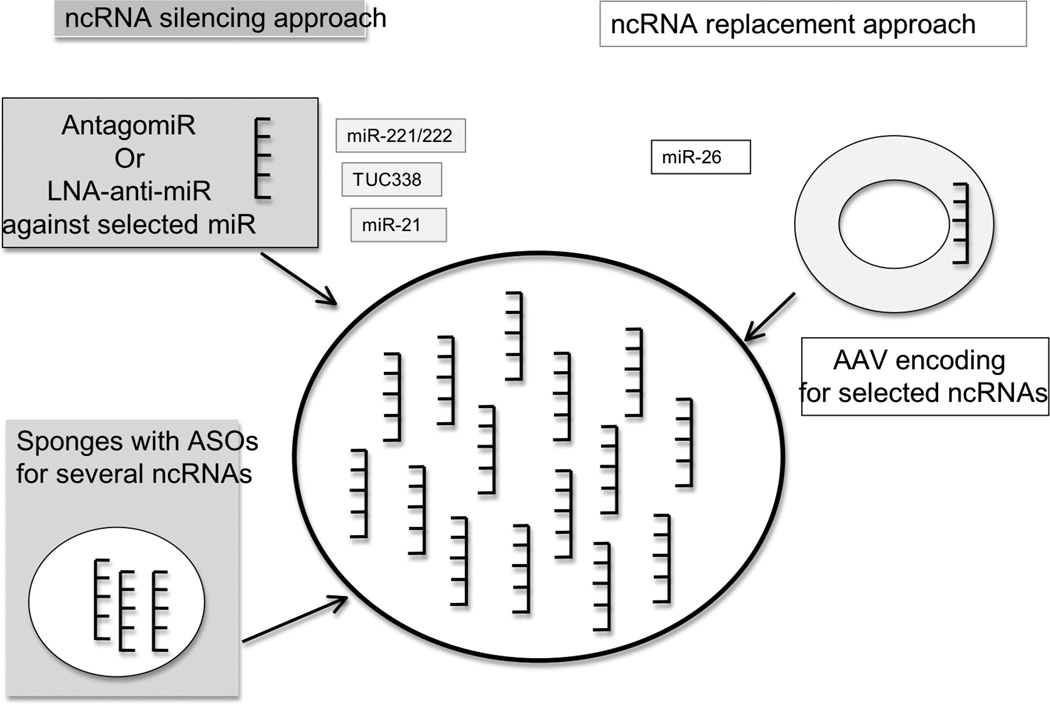
Hepatocellular carcinoma (HCC) is a common malignancy that affects a large number of patients worldwide, with an increasing incidence in the United States and Europe. The therapies that are currently available for patients with inoperable HCC have limited benefits. Although molecular targeted therapies against selected cell signaling pathways have shown some promising results, their impact has been minimal. There is a need to identify and explore other targets for the development of novel therapeutics. Several non-protein coding RNAs (ncRNA) have recently been implicated in hepatocarcinogenesis and tumor progression. These ncRNA genes represent promising targets for cancer. However, therapeutic targeting of ncRNA genes has not been employed for HCC. The use of antisense oligonucleotides and viral vector delivery approaches have been shown to be feasible approaches to modulate ncRNA expression. HCC is an optimal cancer to evaluate novel RNA based therapeutic approaches because of the potential of effective delivery and uptake of therapeutic agents to the liver. In this review, we discuss selected ncRNA that could function as potential targets in HCC treatment and outline approaches to target ncRNA expression. Future challenges include the need to achieve site-specific targeting with acceptable safety and efficacy.
Conflict of interest statement
None of the authors have anything to disclose.
Figures
References
-
- Llovet JM, Ricci S, Mazzaferro V, Hilgard P, Gane E, Blanc JF, de Oliveira AC, Santoro A, Raoul JL, Forner A, Schwartz M, Porta C, Zeuzem S, Bolondi L, Greten TF, Galle PR, Seitz JF, Borbath I, Haussinger D, Giannaris T, Shan M, Moscovici M, Voliotis D, Bruix J. Sorafenib in advanced hepatocellular carcinoma. N. Engl. J. Med. 2008;359(4):378–390. - PubMed
-
- Louro R, Smirnova AS, Verjovski-Almeida S. Long intronic noncoding RNA transcription: expression noise or expression choice? Genomics. 2009;93(4):291–298. - PubMed
-
- Mercer TR, Dinger ME, Mattick JS. Long non-coding RNAs: insights into functions. Nat. Rev. Genet. 2009;10(3):155–159. - PubMed
Publication types
MeSH terms
Substances
Grants and funding
LinkOut - more resources
Full Text Sources
Medical