


DEXA measures of body fat percentage and acute phase proteins among breast cancer survivors: a cross-sectional analysis
- PMID: 22873489
- PMCID: PMC3500231
- DOI: 10.1186/1471-2407-12-343
DEXA measures of body fat percentage and acute phase proteins among breast cancer survivors: a cross-sectional analysis
Abstract
Background: C-reactive protein (CRP) and Serum amyloid A protein (SAA) increases with systemic inflammation and are related to worse survival for breast cancer survivors. This study examines the association between percent body fat and SAA and CRP and the potential interaction with NSAID use and weight change.
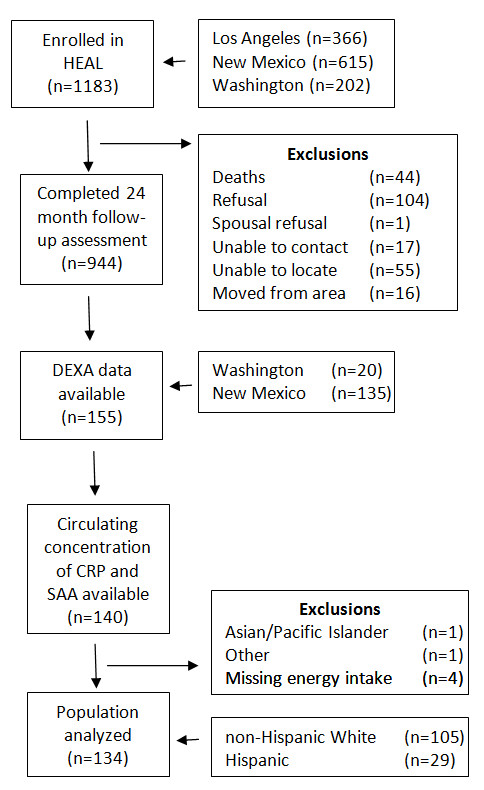
Methods: Participants included 134 non-Hispanic white and Hispanic breast cancer survivors from the Health, Eating, Activity, and Lifestyle Study. Body fat percentage, measured with Dual Energy X-ray Absorptiometer (DEXA), and circulating levels of CRP and SAA were obtained 30 months after breast cancer diagnosis.
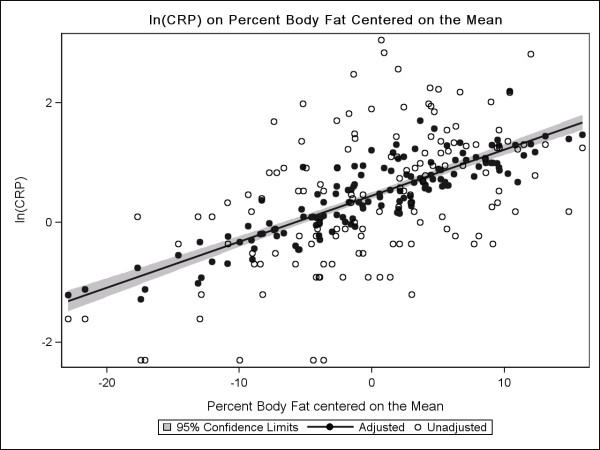
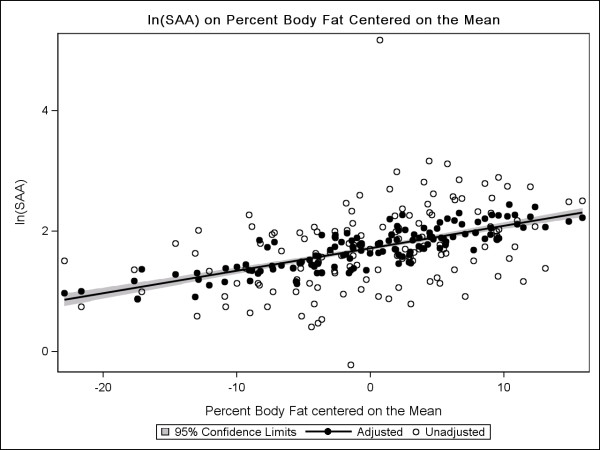
Results: Circulating concentrations of CRP and SAA were associated with increased adiposity as measured by DEXA after adjustment for age at 24-months, race/ethnicity, dietary energy intake, weight change, and NSAID use. Survivors with higher body fat ≥35% had significantly higher concentrations of CRP (2.01 mg/l vs. 0.85 mg/l) and SAA (6.21 mg/l vs. 4.21 mg/l) compared to non-obese (body fat < 35%). Women who had gained more than 5% of their body weight since breast cancer diagnosis had non-statistically significant higher geometric mean levels of CRP and SAA. Mean levels of CRP and SAA were higher among obese women who were non-users of NSAIDs compared to current users; the association with SAA reached statistical significance (Mean SAA = 7.24, 95%CI 6.13-8.56 for non-NSAID; vs. 4.87; 95%CI 3.95-6.0 for NSAID users respectively).
Conclusions: Breast cancer survivors with higher body fat had higher mean concentrations of CRP and SAA than women with lower body fat. Further assessment of NSAID use and weight control in reducing circulating inflammatory markers among survivors may be worthwhile to investigate in randomized intervention trials as higher inflammatory markers are associated with worse survival.
Figures
Similar articles
-
Elevated biomarkers of inflammation are associated with reduced survival among breast cancer patients.J Clin Oncol. 2009 Jul 20;27(21):3437-44. doi: 10.1200/JCO.2008.18.9068. Epub 2009 May 26. J Clin Oncol. 2009. PMID: 19470939 Free PMC article.
-
Dietary fiber is associated with circulating concentrations of C-reactive protein in breast cancer survivors: the HEAL study.Breast Cancer Res Treat. 2011 Sep;129(2):485-94. doi: 10.1007/s10549-011-1474-6. Epub 2011 Apr 1. Breast Cancer Res Treat. 2011. PMID: 21455669 Free PMC article.
-
Correlates of circulating C-reactive protein and serum amyloid A concentrations in breast cancer survivors.Breast Cancer Res Treat. 2009 Mar;114(1):155-67. doi: 10.1007/s10549-008-9985-5. Epub 2008 Apr 10. Breast Cancer Res Treat. 2009. PMID: 18401703 Free PMC article.
-
Visceral adiposity and inflammatory bowel disease.Int J Colorectal Dis. 2021 Nov;36(11):2305-2319. doi: 10.1007/s00384-021-03968-w. Epub 2021 Jun 9. Int J Colorectal Dis. 2021. PMID: 34104989 Review.
-
C-Reactive Protein and Breast Cancer: New Insights from Old Molecule.Int J Breast Cancer. 2015;2015:145647. doi: 10.1155/2015/145647. Epub 2015 Nov 26. Int J Breast Cancer. 2015. PMID: 26693355 Free PMC article. Review.
Cited by
-
Loss of oxidative defense and potential blockade of satellite cell maturation in the skeletal muscle of patients with cancer but not in the healthy elderly.Aging (Albany NY). 2016 Aug;8(8):1690-702. doi: 10.18632/aging.101006. Aging (Albany NY). 2016. PMID: 27454226 Free PMC article.
-
Percentage of body fat assessment using bioelectrical impedance analysis and dual-energy X-ray absorptiometry in a weight loss program for obese or overweight Chinese adults.PLoS One. 2013;8(4):e58272. doi: 10.1371/journal.pone.0058272. Epub 2013 Apr 1. PLoS One. 2013. PMID: 23573189 Free PMC article.
-
Erythrocyte Long-Chain ω-3 Fatty Acids Are Positively Associated with Lean Mass and Grip Strength in Women with Recent Diagnoses of Breast Cancer.J Nutr. 2021 Aug 7;151(8):2125-2133. doi: 10.1093/jn/nxab109. J Nutr. 2021. PMID: 34036350 Free PMC article.
-
Association between dietary inflammatory index and body fat percentage among newly diagnosed breast cancer patients.Ann Med. 2023;55(2):2303399. doi: 10.1080/07853890.2024.2303399. Epub 2024 Jan 19. Ann Med. 2023. PMID: 38242100 Free PMC article.
-
The relationship between distribution of body fat mass and carotid artery intima-media thickness in Korean older adults.J Phys Ther Sci. 2015 Oct;27(10):3141-6. doi: 10.1589/jpts.10.3141. Epub 2015 Oct 30. J Phys Ther Sci. 2015. PMID: 26633917 Free PMC article.
References
-
- Das UN. Is obesity an inflammatory condition? Nutrition. 2001;17(11–12):953–966. - PubMed
-
- Bullo M, Garcia-Lorda P, Peinado-Onsurbe J, Hernandez M, Del Castillo D, Argiles JM, Salas-Salvado J. TNFalpha expression of subcutaneous adipose tissue in obese and morbid obese females: relationship to adipocyte LPL activity and leptin synthesis. Int J Obes Relat Metab Disord. 2002;26(5):652–658. doi: 10.1038/sj.ijo.0801977. - DOI - PubMed
Publication types
MeSH terms
Substances
Grants and funding
- N01-PC-67010/PC/NCI NIH HHS/United States
- P30 CA015704/CA/NCI NIH HHS/United States
- N01-PC-35139/PC/NCI NIH HHS/United States
- M01-RR-00037/RR/NCRR NIH HHS/United States
- UL1 TR001449/TR/NCATS NIH HHS/United States
- N01-CN-75036-20/CN/NCI NIH HHS/United States
- CA 116848/CA/NCI NIH HHS/United States
- UL1 TR000041/TR/NCATS NIH HHS/United States
- K05 CA136967/CA/NCI NIH HHS/United States
- R25-CA94880/CA/NCI NIH HHS/United States
- U54-CA116847/CA/NCI NIH HHS/United States
- N01-CN-05228/CN/NCI NIH HHS/United States
- M01-RR-0997/RR/NCRR NIH HHS/United States
- N01-HD-3-3175/HD/NICHD NIH HHS/United States
LinkOut - more resources
Full Text Sources
Medical
Research Materials
Miscellaneous
