


Canadian population risk of radon induced lung cancer: a re-assessment based on the recent cross-Canada radon survey
- PMID: 22874897
- PMCID: PMC3509926
- DOI: 10.1093/rpd/ncs147
Canadian population risk of radon induced lung cancer: a re-assessment based on the recent cross-Canada radon survey
Abstract
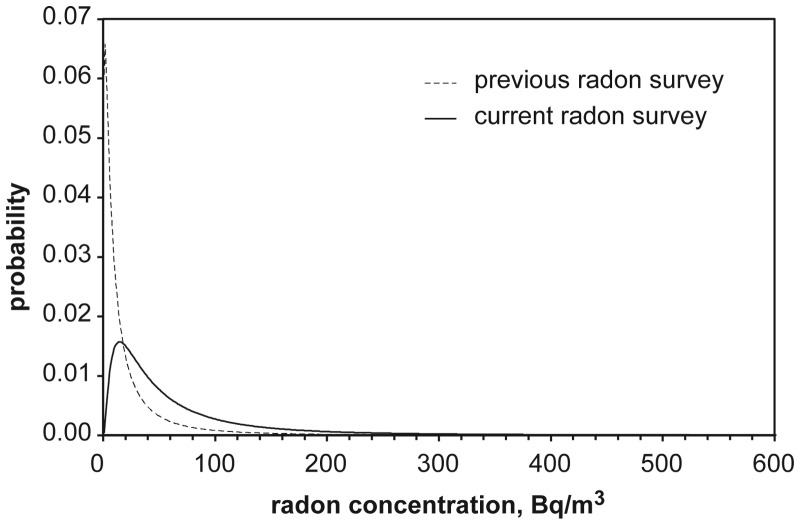
Exposure to indoor radon has been determined to be the second leading cause of lung cancer after tobacco smoking. Canadian population risk of radon induced lung cancer was assessed in 2005 with the radon distribution characteristics determined from a radon survey carried out in the late 1970s in 19 cities. In that survey, a grab sampling method was used to measure radon levels. The observed radon concentration in 14,000 Canadian homes surveyed followed a log-normal distribution with a geometric mean (GM) of 11.2 Bq m(-3) and a geometric standard deviation (GSD) of 3.9. Based on the information from that survey, it was estimated that ∼10 % of lung cancers in Canada resulted from indoor radon exposure. To gain a better understanding of radon concentrations in homes across the country, a national residential radon survey was launched in April 2009. In the recent survey, long-term (3 month or longer) indoor radon measurements were made in roughly 14 000 homes in 121 health regions across Canada. The observed radon concentrations follow, as expected, a log-normal distribution with a GM of 41.9 Bq m(-3) and a GSD of 2.8. Based on the more accurate radon distribution characteristics obtained from the recent cross-Canada radon survey, a re-assessment of Canadian population risk for radon induced lung cancer was undertaken. The theoretical estimates show that 16 % of lung cancer deaths among Canadians are attributable to indoor radon exposure. These results strongly suggest the ongoing need for the Canadian National Radon Program. In particular, there is a need for a focus on education and awareness by all levels of government, and in partnership with key stakeholders, to encourage Canadians to take action to reduce the risk from indoor radon exposure.
Figures
References
-
- The World Health Organization (WHO) WHO Handbook on Indoor Radon. . 2009 ISBN 978-92-4-154767-3. Available at http://whqlibdoc.who.int/publications/2009/9789241547673_eng.pdf .
-
- Chen J., Tracy B. Canadian population risk of radon induced lung cancer. Can. J. Respir. Ther. 2005;41:19–27.
-
- McGregor R. G., Vasudev P., Letourneau E. G., McCullough R. S., Prantl F. A., Taniguchi H. Background concentration of radon daughters in Canadian homes. Health Phys. 1980;39:285–289. - PubMed
-
- Health Canada. Cross-Canada survey of radon concentrations in homes . Available at: http://www.hc-sc.gc.ca/ewh-semt/radiation/radon/survey-sondage-eng.php. (22 accessed December 2011)
-
- Lubin J. H., Boice J. D. Estimating Rn-induced lung cancer in the United States. Health Phys. 1989;57:417–427. - PubMed
MeSH terms
Substances
LinkOut - more resources
Full Text Sources
Medical
Miscellaneous
