. 2012 Aug 8;4(146):146ra107.
doi: 10.1126/scitranslmed.3004241.

A Hendra virus G glycoprotein subunit vaccine protects African green monkeys from Nipah virus challenge

Affiliations

A Hendra virus G glycoprotein subunit vaccine protects African green monkeys from Nipah virus challenge

Katharine N Bossart et al. Sci Transl Med. .

Abstract

In the 1990s, Hendra virus and Nipah virus (NiV), two closely related and previously unrecognized paramyxoviruses that cause severe disease and death in humans and a variety of animals, were discovered in Australia and Malaysia, respectively. Outbreaks of disease have occurred nearly every year since NiV was first discovered, with case fatality ranging from 10 to 100%. In the African green monkey (AGM), NiV causes a severe lethal respiratory and/or neurological disease that essentially mirrors fatal human disease. Thus, the AGM represents a reliable disease model for vaccine and therapeutic efficacy testing. We show that vaccination of AGMs with a recombinant subunit vaccine based on the henipavirus attachment G glycoprotein affords complete protection against subsequent NiV infection with no evidence of clinical disease, virus replication, or pathology observed in any challenged subjects. Success of the recombinant subunit vaccine in nonhuman primates provides crucial data in supporting its further preclinical development for potential human use.


Figures
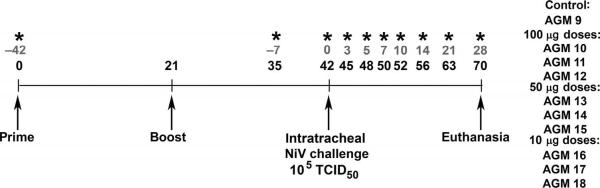
Fig. 1
Fig. 1
Schematic diagram of sGHeV vaccination and NiV challenge schedule. Dates of sGHeV vaccination, NiV challenge, and euthanasia are indicated by arrows. Blood and swab specimens were collected on days −42, −7, 0, 3, 5, 7, 10, 14, 21, and 28 after challenge as indicated (*). Gray text denotes challenge timeline; black text denotes vaccination timeline. AGM numbers for subjects in each vaccine dose group and one control subject are shown.
Fig. 2
Fig. 2
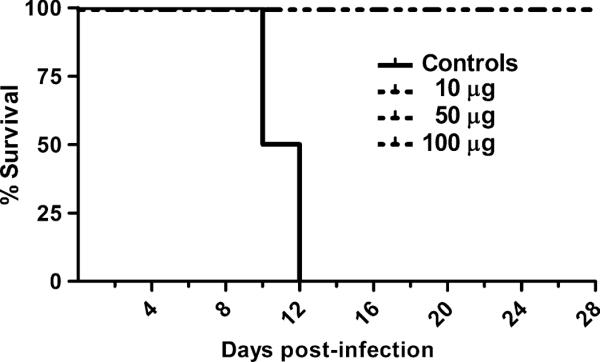
Survival curve of NiV-infected subjects. Data from control subjects (n = 2) and sGHeV-vaccinated subjects (n = 9) were used to generate the Kaplan-Meier survival curve. Control included data from one additional historical control subject. Vaccinated subjects received 10, 50, or 100 μg of sGHeV administered subcutaneously twice. Average time to end-stage disease was 11 days in control subjects, whereas all vaccinated subjects survived until euthanasia at the end of the study.
Fig. 3
Fig. 3
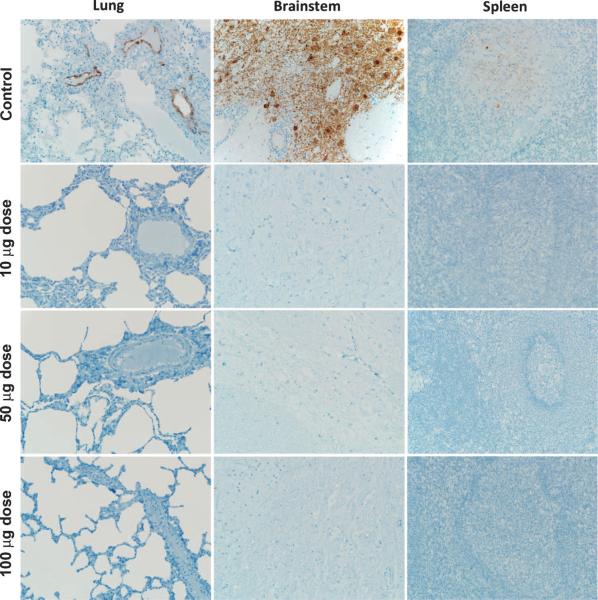
Absence of NiV antigen in sGHeV-vaccinated subjects. Lung, brainstem, and spleen tissue sections were stained with an N protein-specific polyclonal rabbit antibody, and images were obtained at an original magnification of 20×.
Fig. 4
Fig. 4
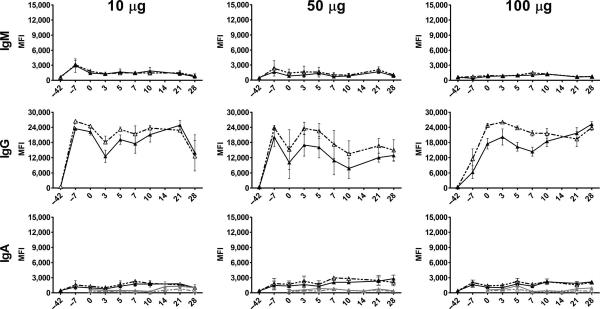
NiV- and HeV-specific Ig in vaccinated subjects. Serum and nasal swabs were collected from vaccinated subjects, and IgG, IgA, and IgM responses were evaluated using sGHeV and sGNiV multiplexed microsphere assays. Sera or swabs from subjects in the same vaccine dose group (n = 3) were assayed individually, and the mean of microsphere MFIs was calculated, which is shown on the y axis. Error bars represent the SEM. Serum sG-specific IgM, IgG, and IgA are shown in black (sGHeV and sGNiV), and mucosal sG-specific IgA is shown in gray (sGHeV and sGNiV).

References

    1. Eaton BT, Broder CC, Middleton D, Wang L-F. Hendra and Nipah viruses: Different and dangerous. Nat. Rev. Microbiol. 2006;4:23–35. - PMC - PubMed
    1. Eaton BT, Mackenzie JS, Wang L-F. Henipaviruses. In: Knipe DM, Howley PM, editors. Fields Virology. Lippincott Williams & Wilkins; Philadelphia: 2007. pp. 1587–1600.
    1. Halpin K, Hyatt AD, Fogarty R, Middleton D, Bingham J, Epstein JH, Rahman SA, Hughes T, Smith C, Field HE, Daszak P, Henipavirus Ecology Research Group Pteropid bats are confirmed as the reservoir hosts of henipaviruses: A comprehensive experimental study of virus transmission. Am. J. Trop. Med. Hyg. 2011;85:946–951. - PMC - PubMed
    1. Field HE, Mackenzie JS, Daszak P. Henipaviruses: Emerging paramyxoviruses associated with fruit bats. Curr. Top. Microbiol. Immunol. 2007;315:133–159. - PMC - PubMed
    1. Wong KT, Ong KC. Pathology of acute henipavirus infection in humans and animals. Patholog. Res. Int. 2011;2011:567248. - PMC - PubMed

Publication types

MeSH terms

LinkOut - more resources