Alternative protein-protein interfaces are frequent exceptions
- PMID: 22876170
- PMCID: PMC3410849
- DOI: 10.1371/journal.pcbi.1002623
Alternative protein-protein interfaces are frequent exceptions
Abstract
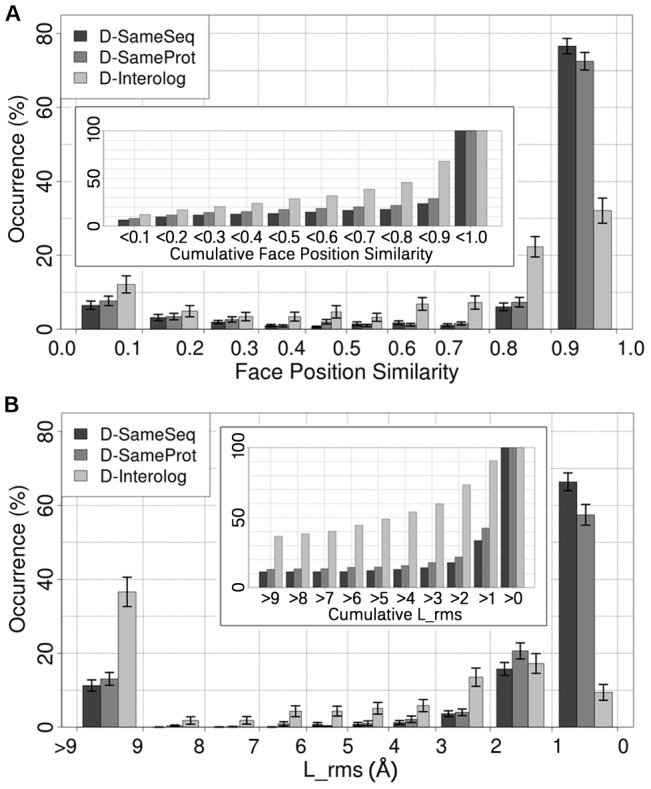
The intricate molecular details of protein-protein interactions (PPIs) are crucial for function. Therefore, measuring the same interacting protein pair again, we expect the same result. This work measured the similarity in the molecular details of interaction for the same and for homologous protein pairs between different experiments. All scores analyzed suggested that different experiments often find exceptions in the interfaces of similar PPIs: up to 22% of all comparisons revealed some differences even for sequence-identical pairs of proteins. The corresponding number for pairs of close homologs reached 68%. Conversely, the interfaces differed entirely for 12-29% of all comparisons. All these estimates were calculated after redundancy reduction. The magnitude of interface differences ranged from subtle to the extreme, as illustrated by a few examples. An extreme case was a change of the interacting domains between two observations of the same biological interaction. One reason for different interfaces was the number of copies of an interaction in the same complex: the probability of observing alternative binding modes increases with the number of copies. Even after removing the special cases with alternative hetero-interfaces to the same homomer, a substantial variability remained. Our results strongly support the surprising notion that there are many alternative solutions to make the intricate molecular details of PPIs crucial for function.
Conflict of interest statement
The authors have declared that no competing interests exist.
Figures

References
-
- Kendrew JC, Dickerson RE, Strandberg BE, Hart RJ, Davies DR, et al. (1960) Structure of Myoglobin: A Three-Dimensional Fourier Synthesis at 2 Å Resolution. Nature 185: 422–427. - PubMed
-
- Perutz MF, Rossmann MG, Cullis AF, Muirhead G, Will G, et al. (1960) Structure of Haemoglobin: A Three-Dimensional Fourier Synthesis at 5.5 Å Resolution, Obtained by X-ray Analysis. Nature 185: 416–422. - PubMed
-
- Dutta S, Berman HM (2005) Large Macromolecular Complexes in the Protein Data Bank: A Status Report. Structure 13: 381–388. - PubMed
-
- Taylor IW, Linding R, Warde-Farley D, Liu YM, Pesquita C, et al. (2009) Dynamic Modularity in Protein Interaction Networks Predicts Breast Cancer Outcome. Nat Biotechnol 27: 199–204. - PubMed
Publication types
MeSH terms
Substances
LinkOut - more resources
Full Text Sources