


Neurofeedback for the treatment of children and adolescents with ADHD: a randomized and controlled clinical trial using parental reports
- PMID: 22877086
- PMCID: PMC3441233
- DOI: 10.1186/1471-244X-12-107
Neurofeedback for the treatment of children and adolescents with ADHD: a randomized and controlled clinical trial using parental reports
Abstract
Background: A randomized and controlled clinical study was performed to evaluate the use of neurofeedback (NF) to treat attention-deficit/hyperactivity disorder (ADHD) in children and adolescents.
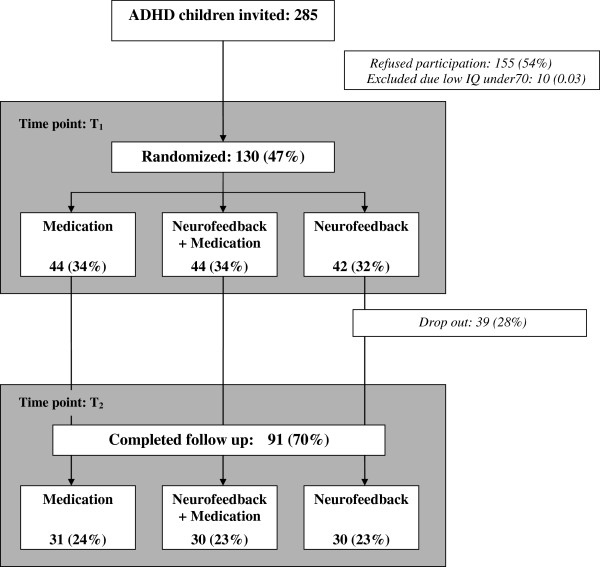
Methods: The ADHD population was selected from an outpatient clinic for Child and Adolescent Mental Health in Norway. Ninety-one of the 275 children and adolescents ranging in age from 6 to 18 years (10.5 years) participated in 30 sessions of an intensive NF program. The reinforcement contingency was based on the subjects' production of cortical beta1 activity (15-18 Hz). The ADHD participants were randomized into three groups, with 30 in the NF group, 31 controls in a group that was given methylphenidate, and 30 in a group that received NF and methylphenidate. ADHD core symptoms were reported by parents using the parent form of the Clinician's Manual for Assessment by Russell A. Barkley.
Results: Ninety-one children and adolescents were effectively randomized by age, sex, intelligence and distribution of ADHD core symptoms. The parents reported significant effects of the treatments, but no significant differences between the treatment groups were observed.
Conclusions: NF was as effective as methylphenidate at treating the attentional and hyperactivity symptoms of ADHD, based on parental reports.
Trial registration: Current Controlled Trials NCT01252446.
Figures
References
-
- Barkley RA. Attention-deficit hyperactivity disorder: A handbood for diagnosis and treatment (2nd ed.) Guilford Press, New York; 1998.
-
- Safren SA, Sprich S, Mimiaga MJ, Surman C, Knouse L, Groves M, Otto MW. Cognitive behavioral therapy vs relaxation with educational support for medication-treated adults with ADHD and persistent symptoms: a randomized controlled trial. JAMA. 2010;304(8):875–880. doi: 10.1001/jama.2010.1192. - DOI - PMC - PubMed
-
- Langberg JM, Arnold LE, Flowers AM, Epstein JN, Altaye M, Hinshaw SP, Swanson JM, Kotkin R, Simpson S, Molina BS. et al. Parent-reported homework problems in the MTA study: evidence for sustained improvement with behavioral treatment. J Clin Child Adolesc Psychol. 2010;39(2):220–233. doi: 10.1080/15374410903532700. - DOI - PMC - PubMed
Publication types
MeSH terms
Substances
Associated data
LinkOut - more resources
Full Text Sources
Other Literature Sources
Medical
