


Genome-wide mapping of NBS-LRR genes and their association with disease resistance in soybean
- PMID: 22877146
- PMCID: PMC3493331
- DOI: 10.1186/1471-2229-12-139
Genome-wide mapping of NBS-LRR genes and their association with disease resistance in soybean
Abstract
Background: R genes are a key component of genetic interactions between plants and biotrophic bacteria and are known to regulate resistance against bacterial invasion. The most common R proteins contain a nucleotide-binding site and a leucine-rich repeat (NBS-LRR) domain. Some NBS-LRR genes in the soybean genome have also been reported to function in disease resistance. In this study, the number of NBS-LRR genes was found to correlate with the number of disease resistance quantitative trait loci (QTL) that flank these genes in each chromosome. NBS-LRR genes co-localized with disease resistance QTL. The study also addressed the functional redundancy of disease resistance on recently duplicated regions that harbor NBS-LRR genes and NBS-LRR gene expression in the bacterial leaf pustule (BLP)-induced soybean transcriptome.
Results: A total of 319 genes were determined to be putative NBS-LRR genes in the soybean genome. The number of NBS-LRR genes on each chromosome was highly correlated with the number of disease resistance QTL in the 2-Mb flanking regions of NBS-LRR genes. In addition, the recently duplicated regions contained duplicated NBS-LRR genes and duplicated disease resistance QTL, and possessed either an uneven or even number of NBS-LRR genes on each side. The significant difference in NBS-LRR gene expression between a resistant near-isogenic line (NIL) and a susceptible NIL after inoculation of Xanthomonas axonopodis pv. glycines supports the conjecture that NBS-LRR genes have disease resistance functions in the soybean genome.
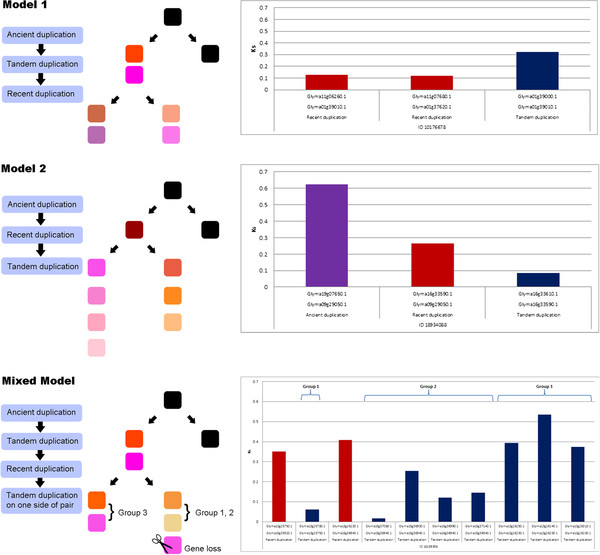
Conclusions: The number of NBS-LRR genes and disease resistance QTL in the 2-Mb flanking regions of each chromosome was significantly correlated, and several recently duplicated regions that contain NBS-LRR genes harbored disease resistance QTL for both sides. In addition, NBS-LRR gene expression was significantly different between the BLP-resistant NIL and the BLP-susceptible NIL in response to bacterial infection. From these observations, NBS-LRR genes are suggested to contribute to disease resistance in soybean. Moreover, we propose models for how NBS-LRR genes were duplicated, and apply Ks values for each NBS-LRR gene cluster.
Figures

References
-
- Flor HH. Host-Parasite Interaction in Flax Rust - Its Genetics and Other Implications. Phytopathology. 1955;45(12):680–685.
-
- Ashfield T, Bocian A, Held D, Henk AD, Marek LF, Danesh D, Penuela S, Meksem K, Lightfoot DA, Young ND. et al. Genetic and physical localization of the soybean Rpg1-b disease resistance gene reveals a complex locus containing several tightly linked families of NBS-LRR genes. Mol Plant Microbe In. 2003;16(9):817–826. doi: 10.1094/MPMI.2003.16.9.817. - DOI - PubMed
Publication types
MeSH terms
Substances
LinkOut - more resources
Full Text Sources
Other Literature Sources
Research Materials
Miscellaneous
