


Randomized trial of lottery-based incentives to improve warfarin adherence
- PMID: 22877814
- PMCID: PMC4738867
- DOI: 10.1016/j.ahj.2012.05.005
Randomized trial of lottery-based incentives to improve warfarin adherence
Abstract
Background: Poor adherence to medications is a major cause of morbidity and inadequate drug effectiveness. Efforts to improve adherence have typically been either ineffective or too complex to implement in clinical practice. Lottery-based incentive interventions could be a scalable approach to improving adherence.
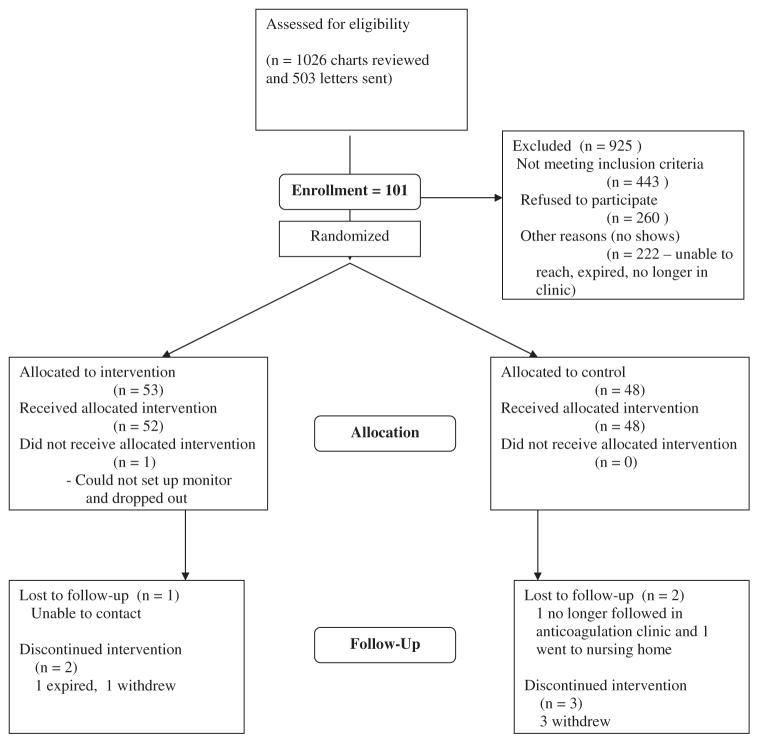
Methods: This was a randomized, controlled clinical trial of a daily lottery-based incentive in patients on warfarin stratified by baseline international normalized ratio (INR). The trial randomized 100 patients to either a lottery-based incentive or no lottery intervention. Main outcome was out-of-range INRs.
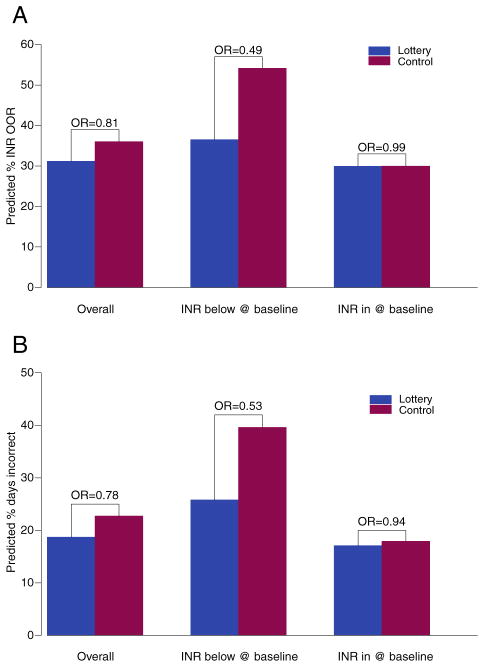
Results: Over 6 months, the overall percentage of out-of-range INRs did not differ between the 2 arms (mean 23.0% in lottery arm and 25.9% in control arm, adjusted odds ratio [OR] 0.93, 95% CI 0.62-1.41). However, among the a priori subgroup with a baseline INR below therapeutic range, there was a significant reduction in out-of-range INR in the lottery arm versus the control arm (adjusted OR 0.39, 95% CI 0.25-0.62), whereas there was no such effect among those with therapeutic INRs at baseline (adjusted OR 1.26, 95% CI, 0.76-2.09, P value for interaction = .0016). Among those with low INR at baseline, there was a nonsignificant 49% reduction in the odds of nonadherence with the intervention (OR 0.51, 95% CI 0.23-1.14).
Conclusions: Although a lottery-based intervention was not associated with a significant improvement in anticoagulation control among all study participants, it improved control among an a priori group of patients at higher risk for poor adherence.
Trial registration: ClinicalTrials.gov NCT00904982.
Copyright © 2012 Mosby, Inc. All rights reserved.
Figures
References
-
- Peterson AM, Takiya L, Finley R, et al. Meta-analysis of trials of interventions to improve medication adherence. Am J Health Syst Pharm. 2003;60:657–65. - PubMed
-
- Haynes RB. Improving patient adherence: state of the art, with a special focus on medication taking for cardiovascular disorders. In: Burke LE, Ockene IS, editors. Compliance in Healthcare and Research. Armonk, NY: Futura Publishing Company, Inc; 2001. pp. 3–21.
-
- Kimmel SE, Chen Z, Price M, et al. The influence of patient adherence on anticoagulation control with warfarin. Arch Intern Med. 2007;167:229–35. - PubMed
-
- Go AS, Hylek EM, Borowsky LH, et al. Warfarin use among ambulatory patients with nonvalvular atrial fibrillation: the Anticoagulation and risk factors in atrial fibrillation (ATRIA) study. Ann Intern Med. 1999;131:927–34. - PubMed
