


Transient hypothyroidism at 3-year follow-up among cases of congenital hypothyroidism detected by newborn screening
- PMID: 22878110
- PMCID: PMC3529757
- DOI: 10.1016/j.jpeds.2012.06.050
Transient hypothyroidism at 3-year follow-up among cases of congenital hypothyroidism detected by newborn screening
Abstract
Objective: To investigate the rate of transient thyroid deficiency and treatment compliance among cases with congenital hypothyroidism diagnosed and followed-up after age 3 years by newborn screening (NBS).
Study design: Cases detected by Michigan NBS between October 1, 2003, and December 31, 2007, and followed-up after age 3 years were included. The χ(2) and Fisher exact tests were used to test differences among followed and lost cases. Logistic regression models were used to investigate predictors of treatment cessation.
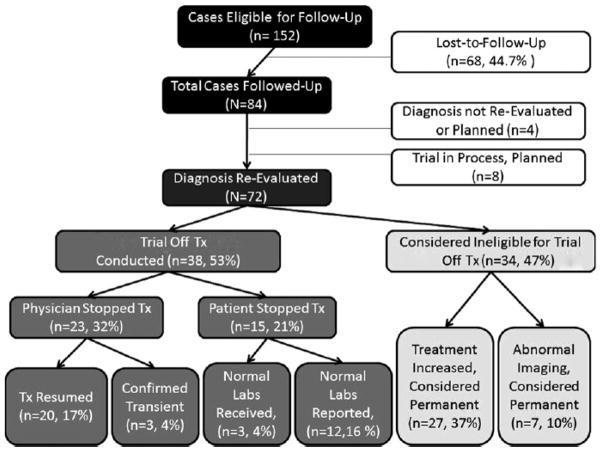
Results: Roughly 45% of eligible cases were lost to follow-up, and disease state (transient or permanent congenital hypothyroidism) could not be determined for 12 cases (7.9%). Of the 72 followed cases, 34 (47%) were considered permanent congenital hypothyroidism based on thyroid imaging findings (n = 7) or an increase in medication dosage over time (n = 27). One-quarter of followed cases with congenital hypothyroidism were no longer being treated, and of these, just over 83% stopped treatment without medical supervision. Of 23 cases that underwent a medically supervised trial without thyroid hormone medication, treatment was reinstated in 20. Laboratory confirmation of euthyroidism was available for 6 of 18 cases clinically deemed transient. After adjustment, black race was the strongest predictor of treatment cessation (OR, 9.86; 95% CI, 1.82-53.31). Treatment cessation was also more common among low birth weight infants and those admitted to the neonatal intensive care unit at birth.
Conclusion: We recommend that NBS programs include long-term follow-up through at least age 3 years to determine treatment compliance and disease permanence. Further research is needed to determine ideal follow-up program operations and reassessment methods for congenital hypothyroidism disease permanence. Guidelines that provide evidence-based reassessment methods would be beneficial for the healthcare providers of children with congenital hypothyroidism.
Copyright © 2013 Mosby, Inc. All rights reserved.
Conflict of interest statement
The authors declare no conflicts of interest.
Figures
References
-
- Berry SA, Lloyd-Puryear MA, Watson MS. Long-term follow-up of newborn screening patients. Genet Med. 2010;12:S267–8. - PubMed
-
- Kemper AR, Boyle CA, Aceves J, Dougherty D, Figge J, Fisch JL, et al. Long-term follow-up after diagnosis resulting from newborn screening: Statement of the US Secretary of Health and Human Services’ Advisory Committee on Heritable Disorders and Genetic Diseases in Newborns and Children. Genet Med. 2008;10:259–61. - PubMed
-
- Hinton CF, Feuchtbaum L, Kus CA, Kemper AR, Berry SA, Levy-Fisch J, et al. What questions should newborn screening long-term follow-up be able to answer? A statement of the US Secretary for Health and Human Services’ Advisory Committee on Heritable Disorders in Newborns and Children. Genet Med. 2011;13:861–5. - PubMed
-
- Hoff T, Hoyt A, Therrell B, Ayoob M. Exploring barriers to long-term follow-up in newborn screening programs. Genet Med. 2006;8:563–70. - PubMed
-
- Horn S, Heuer H. Thyroid hormone action during brain development: more questions than answers. Mol Cell Endocrinol. 2010;315:19–26. - PubMed
Publication types
MeSH terms
Grants and funding
LinkOut - more resources
Full Text Sources
Other Literature Sources
Medical
Research Materials
Miscellaneous
