


Decreased serum levels of mature brain-derived neurotrophic factor (BDNF), but not its precursor proBDNF, in patients with major depressive disorder
- PMID: 22880079
- PMCID: PMC3411809
- DOI: 10.1371/journal.pone.0042676
Decreased serum levels of mature brain-derived neurotrophic factor (BDNF), but not its precursor proBDNF, in patients with major depressive disorder
Erratum in
- PLoS One. 2013;8(2). doi:10.1371/annotation/85a3fa48-980b-4f95-bb43-b33b1c3e0ac6
Abstract
Background: Meta-analyses have identified serum levels of brain-derived neurotrophic factor (BDNF) as a potential biomarker for major depressive disorder (MDD). However, at the time, commercially available human ELISA kits are unable to distinguish between proBDNF (precursor of BDNF) and mature BDNF because of limited BDNF antibody specificity. In this study, we examined whether serum levels of proBDNF, mature BDNF, and matrix metalloproteinase-9 (MMP-9), which converts proBDNF to mature BDNF, are altered in patients with MDD.
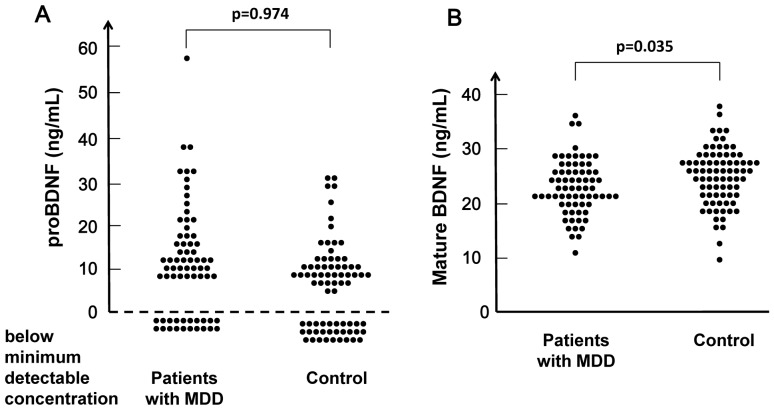
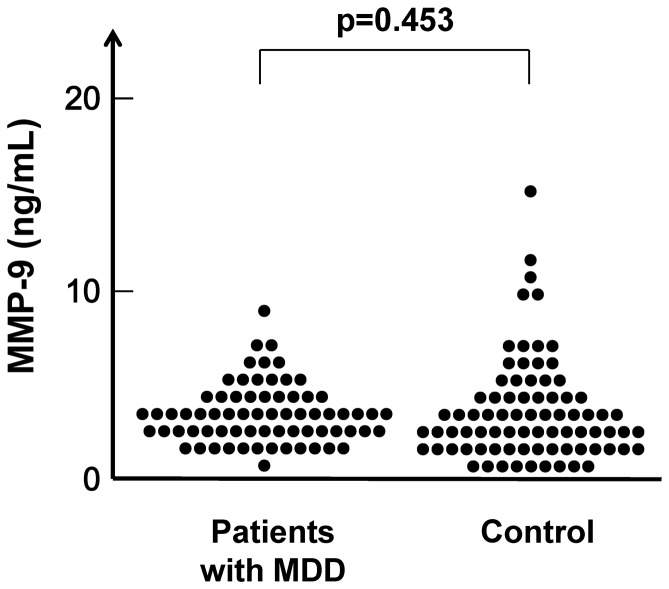
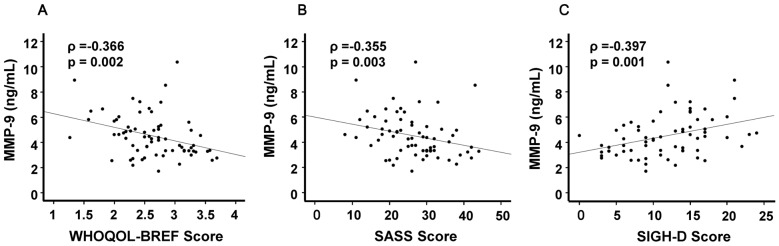
Methodology/principal findings: Sixty-nine patients with MDD and 78 age- and gender-matched healthy subjects were enrolled. Patients were evaluated using 17 items on the Structured Interview Guide for the Hamilton Depression Rating Scale. Cognitive impairment was evaluated using the CogState battery. Serum levels of proBDNF, mature BDNF, and MMP-9 were measured using ELISA kits. Serum levels of mature BDNF in patients with MDD were significantly lower than those of normal controls. In contrast, there was no difference in the serum levels of proBDNF and MMP-9 between patients and normal controls. While neither proBDNF nor mature BDNF serum levels was associated with clinical variables, there were significant correlations between MMP-9 serum levels and the severity of depression, quality of life scores, and social function scores in patients.
Conclusions/significance: These findings suggest that mature BDNF may serve as a biomarker for MDD, and that MMP-9 may play a role in the pathophysiology of MDD. Further studies using larger sample sizes will be needed to investigate these results.
Conflict of interest statement
Figures
References
-
- Duman RS, Heninger GR, Nestler EJ (1997) A molecular and cellular theory of depression. Arch Gen Psychiatry 54: 597–606. - PubMed
-
- Altar CA (1999) Neurotrophins and depression. Trends Pharmacol Sci 20: 59–61. - PubMed
-
- Nestler EJ, Barrot M, DiLeone RJ, Eisch AJ, Gold SJ, et al. (2002) Neurobiology of depression. Neuron 34: 13–25. - PubMed
-
- Martinowich K, Manji H, Lu B (2007) New insights into BDNF function in depression and anxiety. Nat Neurosci 10: 1089–1093. - PubMed
-
- Hashimoto K, Shimizu E, Iyo M (2004) Critical role of brain-derived neurotrophic factor in mood disorders. Brain Res Brain Res Rev 45: 104–114. - PubMed
Publication types
MeSH terms
Substances
LinkOut - more resources
Full Text Sources
Other Literature Sources
Miscellaneous
