


Seroprevalence of measles-, mumps- and rubella-specific IgG antibodies in German children and adolescents and predictors for seronegativity
- PMID: 22880124
- PMCID: PMC3412821
- DOI: 10.1371/journal.pone.0042867
Seroprevalence of measles-, mumps- and rubella-specific IgG antibodies in German children and adolescents and predictors for seronegativity
Abstract
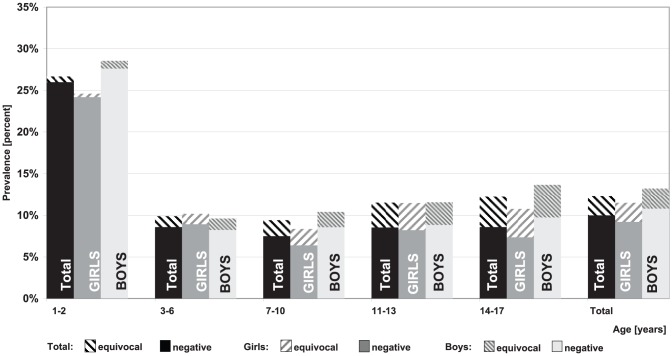
We have undertaken a seroprevalence study with more than 13,000 children, who had been included in the German KIGGS survey, a representative sample of children and adolescents 0-17 years of age. The IgG titres against measles, mumps and rubella were determined in 1 to 17 year olds While 88.8% of the children were MMR-vaccinated at least once, 76.8% of children aged 1 to 17 years showed prevalence of antibodies to MMR. The highest seronegativity was seen with respect to mumps. Gender differences were most pronounced with regard to rubella IgG titres: girls aged 14 to 17 years were best protected, although seronegativity in 6.8% of this vulnerable group still shows the need of improvement. Search for predictors of missing seroprevalence identified young age to be the most important predictor. Children living in the former West and children born outside of Germany had a higher risk of lacking protection against measles and rubella, while children with a migration background but born in Germany were less often seronegative to measles antibodies than their German contemporaries. An association of seronegativity and early vaccination was seen for measles but not for mumps and rubella. A high maternal educational level was associated with seronegativity to measles and rubella. In vaccinated children, seronegativity was highest for mumps and lowest for rubella. For mumps, high differences were observed for seronegativity after one-dose and two-dose vaccination, respectively. Seronegativity increases as time since last vaccination passes thus indicating significant waning effects for all three components of MMR.
Conflict of interest statement
Figures



References
-
- WHO (2009) Measles vaccines: WHO position paper. Wkly Epidemiol Rec 84: 349–360. - PubMed
-
- Campbell H, Andrews N, Brown KE, Miller E (2007) Review of the effect of measles vaccination on the epidemiology of SSPE. Int J Epidemiol 36: 1334–1348. - PubMed
-
- Siedler A, Tischer A, Mankertz A, Santibanez A (2006) Two outbreaks of measles in Germany 2005. Euro Surveill 11: 131–134. - PubMed
-
- Koch-Institut: R (2012) SurvStat. http://www3rkide/SurvStat, Accessed: 2012 January 04.
Publication types
MeSH terms
Substances
LinkOut - more resources
Full Text Sources
Medical
