Vascular effects of dietary nitrate (as found in green leafy vegetables and beetroot) via the nitrate-nitrite-nitric oxide pathway
- PMID: 22882425
- PMCID: PMC3575935
- DOI: 10.1111/j.1365-2125.2012.04420.x
Vascular effects of dietary nitrate (as found in green leafy vegetables and beetroot) via the nitrate-nitrite-nitric oxide pathway
Abstract
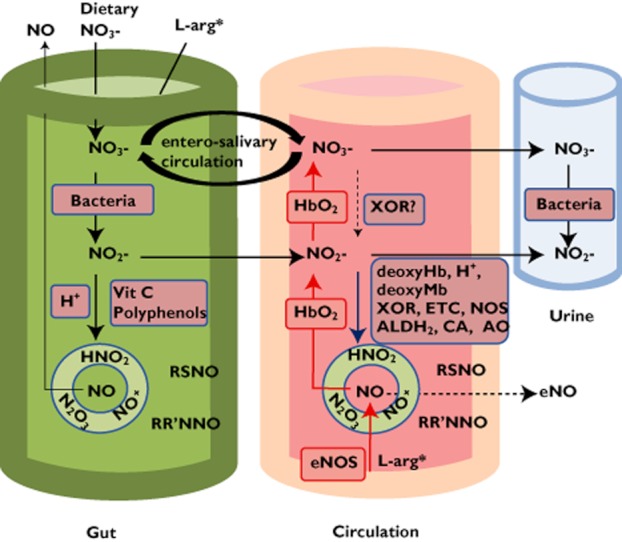
The discovery that dietary (inorganic) nitrate has important vascular effects came from the relatively recent realization of the 'nitrate-nitrite-nitric oxide (NO) pathway'. Dietary nitrate has been demonstrated to have a range of beneficial vascular effects, including reducing blood pressure, inhibiting platelet aggregation, preserving or improving endothelial dysfunction, enhancing exercise performance in healthy individuals and patients with peripheral arterial disease. Pre-clinical studies with nitrate or nitrite also show the potential to protect against ischaemia-reperfusion injury and reduce arterial stiffness, inflammation and intimal thickness. However, there is a need for good evidence for hard endpoints beyond epidemiological studies. Whilst these suggest reduction in cardiovascular risk with diets high in nitrate-rich vegetables (such as a Mediterranean diet), others have suggested possible small positive and negative associations with dietary nitrate and cancer, but these remain unproven. Interactions with other nutrients, such as vitamin C, polyphenols and fatty acids may enhance or inhibit these effects. In order to provide simple guidance on nitrate intake from different vegetables, we have developed the Nitrate 'Veg-Table' with 'Nitrate Units' [each unit being 1 mmol of nitrate (62 mg)] to achieve a nitrate intake that is likely to be sufficient to derive benefit, but also to minimize the risk of potential side effects from excessive ingestion, given the current available evidence. The lack of data concerning the long term effects of dietary nitrate is a limitation, and this will need to be addressed in future trials.
© 2012 The Authors. British Journal of Clinical Pharmacology © 2012 The British Pharmacological Society.
Figures
Comment in
-
Reply to comments on 'vascular effects of dietary nitrate (as found in green leafy vegetables and beetroot) via the nitrate-nitrite-nitric oxide pathway'.Br J Clin Pharmacol. 2013 Jun;75(6):1543-4. doi: 10.1111/bcp.12037. Br J Clin Pharmacol. 2013. PMID: 23163339 Free PMC article. No abstract available.
-
Comments on 'vascular effects of dietary nitrate (as found in green leafy vegetables and beetroot) via the nitrate-nitrite-nitric oxide pathway'.Br J Clin Pharmacol. 2013 Jun;75(6):1541-2. doi: 10.1111/bcp.12039. Br J Clin Pharmacol. 2013. PMID: 23163510 Free PMC article. No abstract available.
References
-
- Lundberg JO, Weitzberg E, Gladwin MT. The nitrate‐nitrite‐nitric oxide pathway in physiology and therapeutics. Nat Rev Drug Discov. 2008;7:156–167. - PubMed
-
- Palmer RM, Ashton DS, Moncada S. Vascular endothelial cells synthesize nitric oxide from L‐arginine. Nature. 1988;333:664–666. - PubMed
-
- Moncada S, Palmer RM, Higgs EA. The discovery of nitric oxide as the endogenous nitrovasodilator. Hypertension. 1988;12:365–372. - PubMed
-
- Modin A, Bjorne H, Herulf M, Alving K, Weitzberg E, Lundberg JO. Nitrite‐derived nitric oxide: a possible mediator of ‘acidic‐metabolic’ vasodilation. Acta Physiol Scand. 2001;171:9–16. - PubMed
-
- Demoncheaux EA, Higenbottam TW, Foster PJ, Borland CD, Smith AP, Marriott HM, Bee D, Akamine S, Davies MB. Circulating nitrite anions are a directly acting vasodilator and are donors for nitric oxide. Clin Sci. 2002;102:77–83. - PubMed
MeSH terms
Substances
LinkOut - more resources
Full Text Sources
Other Literature Sources
Medical