


Total protein, albumin and low-molecular-weight protein excretion in HIV-positive patients
- PMID: 22883485
- PMCID: PMC3444380
- DOI: 10.1186/1471-2369-13-85
Total protein, albumin and low-molecular-weight protein excretion in HIV-positive patients
Abstract
Background: Chronic kidney disease is common in HIV positive patients and renal tubular dysfunction has been reported in those receiving combination antiretroviral therapy (cART). Tenofovir (TFV) in particular has been linked to severe renal tubular disease as well as proximal tubular dysfunction. Markedly elevated urinary concentrations of retinal-binding protein (RBP) have been reported in patients with severe renal tubular disease, and low-molecular-weight proteins (LMWP) such as RBP may be useful in clinical practice to assess renal tubular function in patients receiving TFV. We analysed 3 LMWP as well as protein and albumin in the urine of a sample of HIV positive patients.
Methods: In a cross-sectional fashion, total protein, albumin, RBP, cystatin C, and neutrophil gelatinase-associated lipocalin (NGAL) were quantified in random urine samples of 317 HIV positive outpatients and expressed as the ratio-to-creatinine (RBPCR, CCR and NGALCR). Exposure to cART was categorised as none, cART without TFV, and cART containing TFV and a non-nucleoside reverse-transcriptase-inhibitor (TFV/NNRTI) or TFV and a protease-inhibitor (TFV/PI).
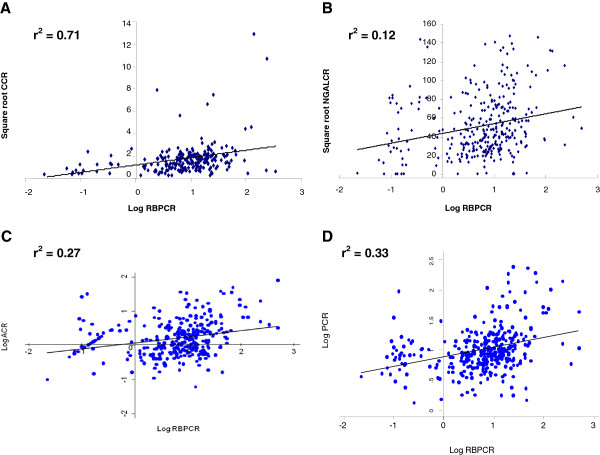
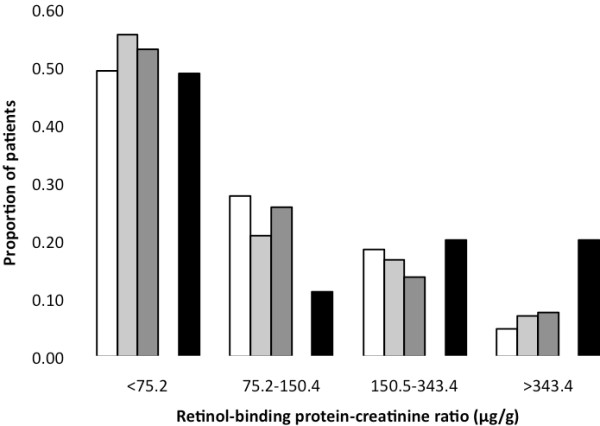
Results: Proteinuria was present in 10.4 % and microalbuminuria in 16.7 % of patients. Albumin accounted for approximately 10 % of total urinary protein. RBPCR was within the reference range in 95 % of patients while NGALCR was elevated in 67 % of patients. No overall differences in urine protein, albumin, and LMWP levels were observed among patients stratified by cART exposure, although a greater proportion of patients exposed to TFV/PI had RBPCR >38.8 μg/mmol (343 μg/g) (p = 0.003). In multivariate analyses, black ethnicity (OR 0.43, 95 % CI 0.24, 0.77) and eGFR <75 mL/min/1.73 m2 (OR 3.54, 95 % CI 1.61, 7.80) were independently associated with upper quartile (UQ) RBPCR. RBPCR correlated well to CCR (r2 = 0.71), but not to NGALCR, PCR or ACR.
Conclusions: In HIV positive patients, proteinuria was predominantly of tubular origin and microalbuminuria was common. RBPCR in patients without overt renal tubular disease was generally within the reference range, including those receiving TFV. RBP therefore appears a promising biomarker for monitoring renal tubular function in patients receiving TFV and for distinguishing patients with normal tubular function or mild tubular dysfunction from those with severe renal tubular disease or Fanconi syndrome.
Figures
References
-
- Szczech LA, Gupta SK, Habash R, Guasch A, Kalayjian R, Appel R, Fields TA, Svetkey LP, Flanagan KH, Klotman PE. et al.The clinical epidemiology and course of the spectrum of renal diseases associated with HIV infection. Kidney Int. 2004;66(3):1145–1152. doi: 10.1111/j.1523-1755.2004.00865.x. - DOI - PubMed
Publication types
MeSH terms
Substances
LinkOut - more resources
Full Text Sources
Medical
Research Materials
Miscellaneous
