. 2012 Nov 15;63(3):1038-53.
doi: 10.1016/j.neuroimage.2012.07.037. Epub 2012 Aug 2.

Investigating white matter development in infancy and early childhood using myelin water faction and relaxation time mapping

Affiliations

Investigating white matter development in infancy and early childhood using myelin water faction and relaxation time mapping

Sean C L Deoni et al. Neuroimage. .

Abstract

The elaboration of the myelinated white matter is essential for normal neurodevelopment, establishing and mediating rapid communication pathways throughout the brain. These pathways facilitate the synchronized communication required for higher order behavioral and cognitive functioning. Altered neural messaging (or 'disconnectivity') arising from abnormal white matter and myelin development may underlie a number of neurodevelopmental psychiatric disorders. Despite the vital role myelin plays, few imaging studies have specifically examined its maturation throughout early infancy and childhood. Thus, direct investigations of the relationship(s) between evolving behavioral and cognitive functions and the myelination of the supporting neural systems have been sparse. Further, without knowledge of the 'normative' developmental time-course, identification of early abnormalities associated with developmental disorders remains challenging. In this work, we examined the use of longitudinal (T(1)) and transverse (T(2)) relaxation time mapping, and myelin water fraction (MWF) imaging to investigate white matter and myelin development in 153 healthy male and female children, 3 months through 60 months in age. Optimized age-specific acquisition protocols were developed using the DESPOT and mcDESPOT imaging techniques; and mean T(1), T(2) and MWF trajectories were determined for frontal, temporal, occipital, parietal and cerebellar white matter, and genu, body and splenium of the corpus callosum. MWF results provided a spatio-temporal pattern in-line with prior histological studies of myelination. Comparison of T(1), T(2) and MWF measurements demonstrates dissimilar sensitivity to tissue changes associated with neurodevelopment, with each providing differential but complementary information.


Figures

Fig. 1
Fig. 1
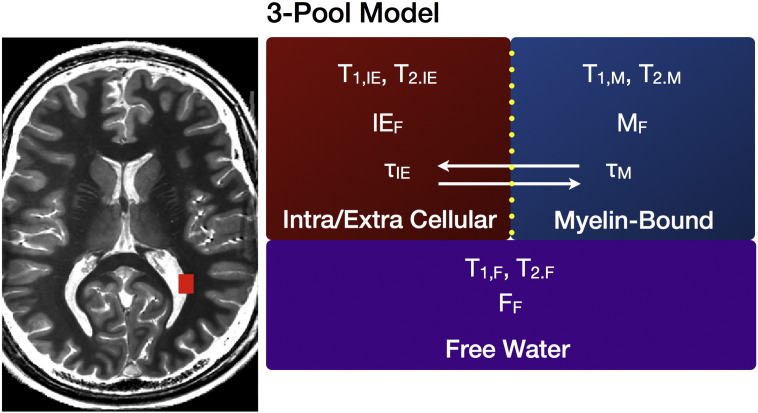
Graphical description of the three-pool tissue model used to fit the mcDESPOT data. The model comprises two exchange water pools (intra/extra cellular or axonal water, and the myelin-bound water) and a third non-exchange free water pool (broadly corresponding to cerebral spinal fluid).
Fig. 2
Fig. 2
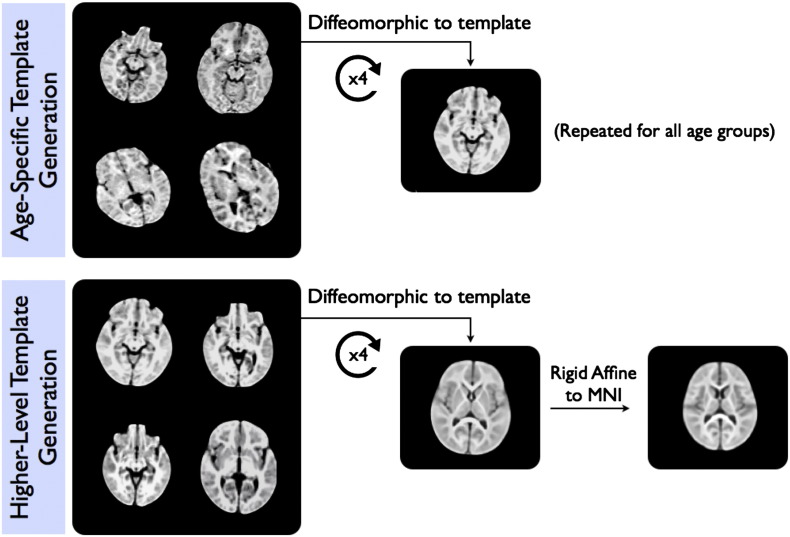
Illustration of the process used to calculate the age-specific and overall study-specific T1-weighted image templates.
Fig. 3
Fig. 3
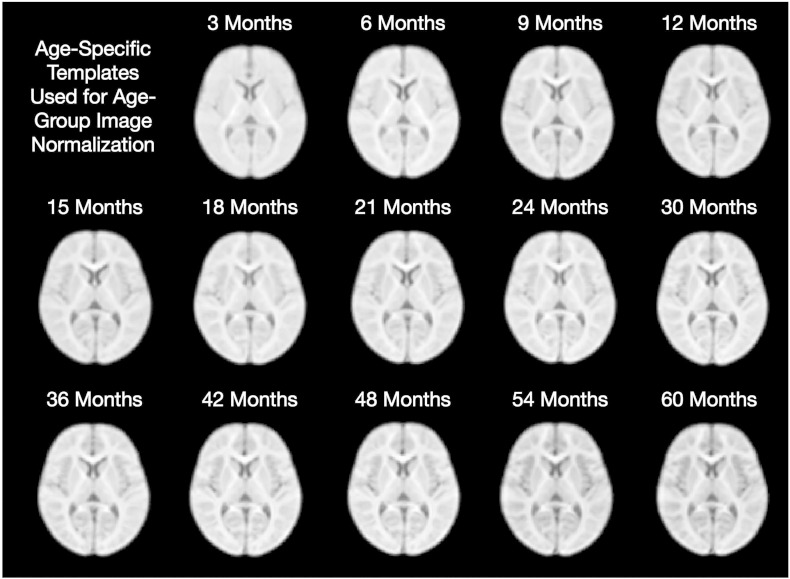
Matched axially-oriented slices from each of the age templates in approximate MNI space.
Fig. 4
Fig. 4
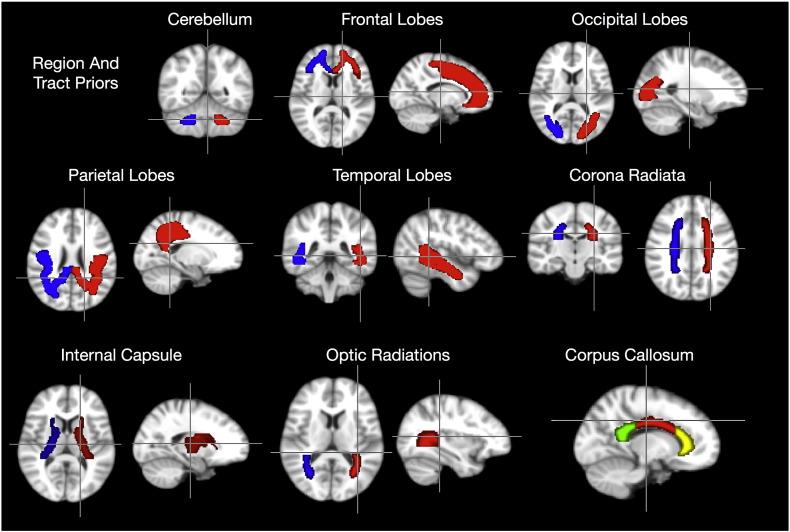
Brain region and tract overlays used for regional analysis and comparisons. Red = right, blue = left.
Fig. 5
Fig. 5
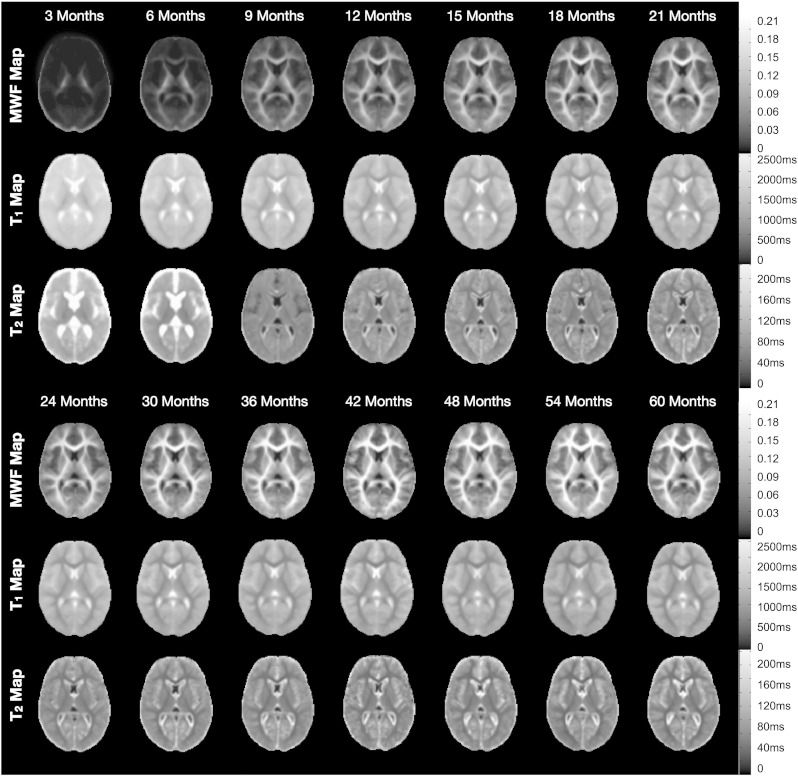
Matched axially-oriented slices through the mean MWF, T1 and T2 maps from each age-group. For the 3 and 6 month data, T2 values were calculated for all voxels. For 9 months and above, T2 was only calculated in voxels with a corresponding T1 less than 3500 ms.
Fig. 6
Fig. 6
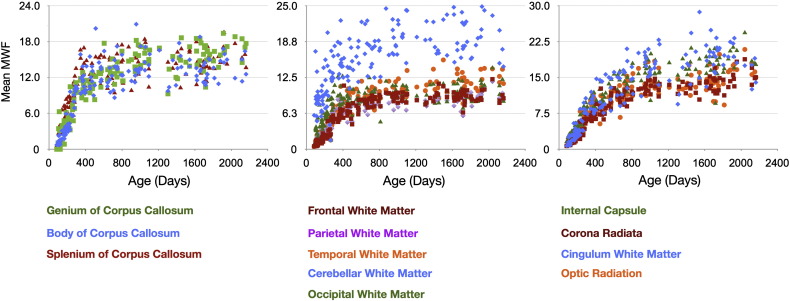
Gender-combined myelination trajectories for each white matter region and pathway spanning 83 through 2040 days of age. Points represent the mean values with error bars corresponding to the measurement standard deviation.
Fig. 7
Fig. 7
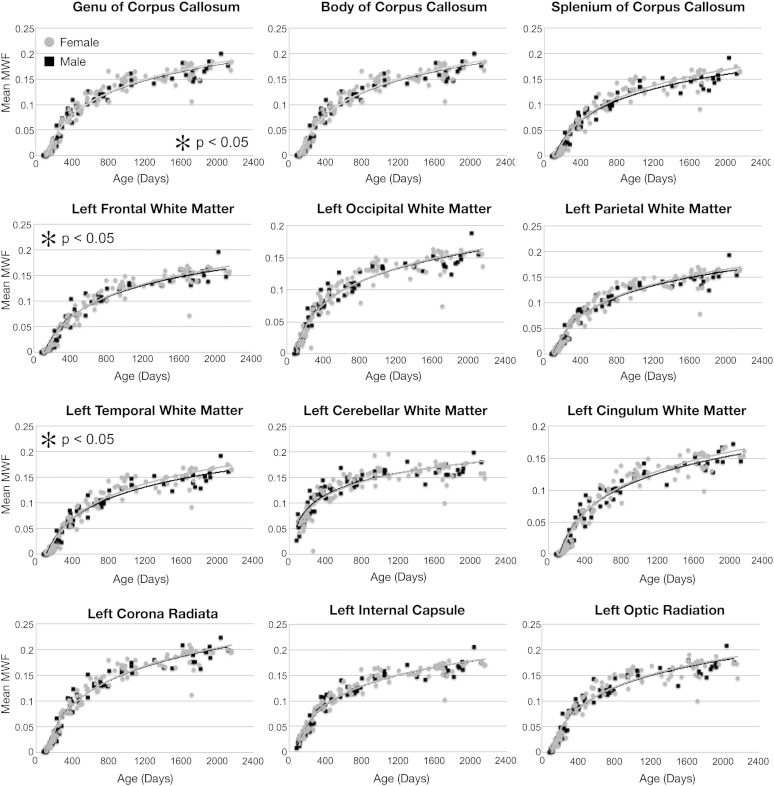
Myelination trajectories, separated by gender, for each left hemisphere and midline white matter region and pathway spanning 83 through 2040 days of age. Points represent the mean value obtained from each region. Female values are denoted by gray circles. Plots marked with an asterisk correspond to those regions were a significant (p < 0.05) male–female difference was found.
Fig. 8
Fig. 8
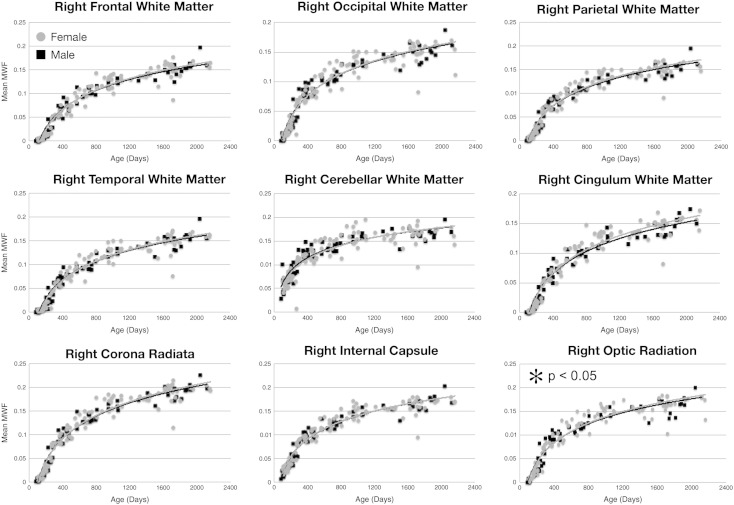
Myelination trajectories, separated by gender, for each right hemisphere white matter region and pathway spanning 83 through 2040 days of age. Points represent the mean value obtained from each region. Female values are denoted by gray circles. Plots marked with an asterisk correspond to those regions were a significant (p < 0.05) male–female difference was found.
Fig. 9
Fig. 9
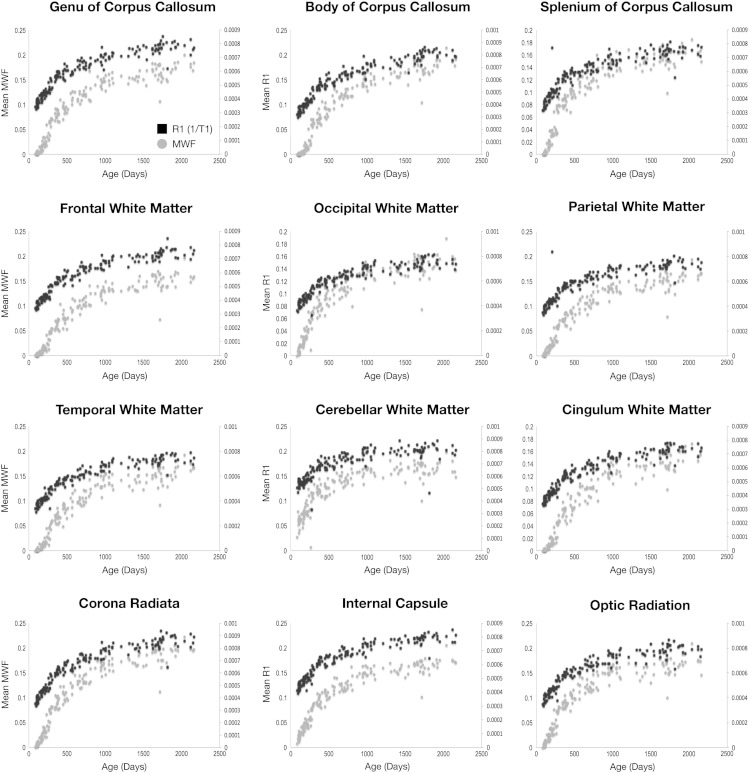
Comparison of MWF (gray circles) and R1 (1/T1) (black squares) trajectories for each white matter region and pathway across the age-span.
Fig. 10
Fig. 10
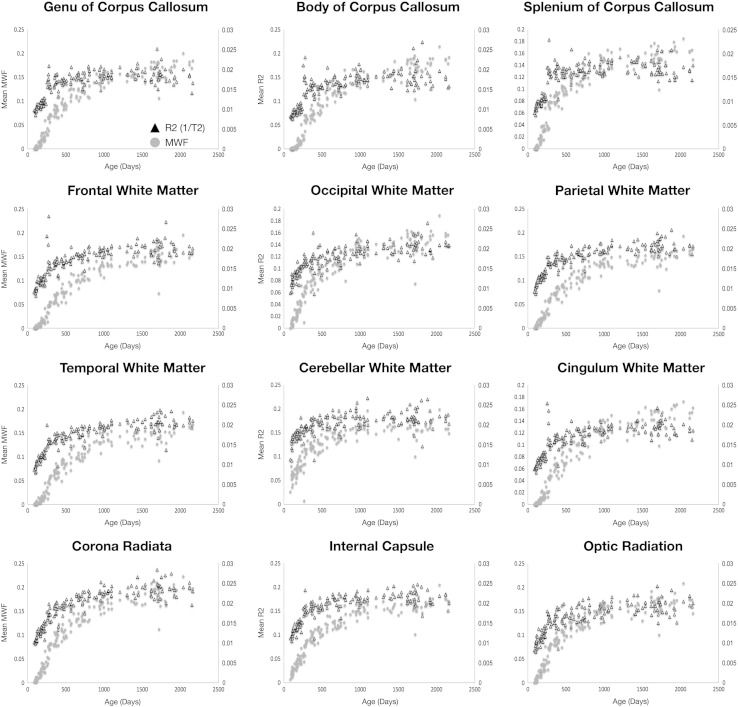
Comparison of MWF (gray circles) and R2 (1/T2) (black triangles) trajectories for each white matter region and pathway across the age-span.

References

    1. Almli C.R., Rivkin M.J., McKinstry R.C., Brain Development Cooperative Group The NIH MRI Study of Normal Brain Development (Objective 2): newborns, infants, toddlers and preschoolers. Neuroimage. 2007;35:308–325. - PubMed
    1. Avants B.B., Epstein C.L., Grossman M., Gee J.C. Symmetric diffeomorphic image registration with cross-correlation: evaluating automated labelling of elderly and neurodegenerative brain. Med. Image Anal. 2008;12:26–41. - PMC - PubMed
    1. Avants B.B., Yushkevich P., Pluta J., Minkoff D., Korczykowski M., Detre J., Gee J.C. The optimal template effect in hippocampus studies of diseased populations. Neuroimage. 2010;49:2457–2466. - PMC - PubMed
    1. Barkovich A.J., Kjos B.O., Jackson D.E., Jr., Norman D. Normal maturation of the neonatal and infant brain: MR imaging at 1.5 T. Radiology. 1988;166:173–180. - PubMed
    1. Bartzokis G., Lu P.H., Tingus K., Mendez M.F., Richard A., Peters D.G., Oluwadara B., Barrall K.A., Finn J.P., Villablanca P., Thompson O.M., Mintz J. Lifespan trajectory of myelin integrity and maximum motor speed. Neurobiol. Aging. 2010;31:1554–1562. - PMC - PubMed

Publication types