


Examining the influence of gender, education, social class and birth cohort on MMSE tracking over time: a population-based prospective cohort study
- PMID: 22889350
- PMCID: PMC3542122
- DOI: 10.1186/1471-2318-12-45
Examining the influence of gender, education, social class and birth cohort on MMSE tracking over time: a population-based prospective cohort study
Abstract
Background: Whilst many studies have analysed predictors of longitudinal cognitive decline, few have described their impact on population distributions of cognition by age cohort. The aim of this paper was to examine whether gender, education, social class and birth cohort affect how mean population cognition changes with age.
Methods: The Medical Research Council Cognitive Function and Ageing Study (MRC CFAS) is a multi-centre population based longitudinal study of 13,004 individuals in England and Wales. Using ten years of follow-up data, mean Mini-mental State Examination (MMSE) scores were modelled by age and birth cohort adjusting for non-random drop-out. The model included terms to estimate cohort effects. Results are presented for five year age bands between 65-95 years.
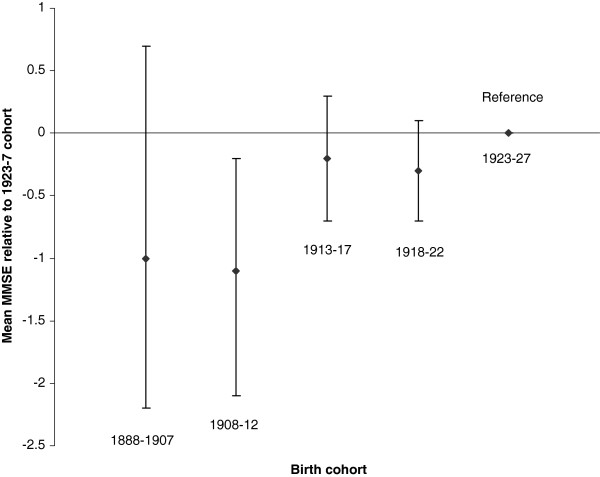
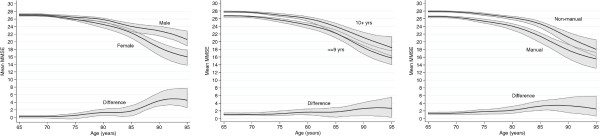
Results: At a population level, women show greater change in MMSE scores with age than men. Populations with lower education level and manual work also show similar effects. More recent birth cohorts have slightly higher scores.
Conclusion: Longitudinal data can allow examination of population patterns by gender, educational level, social class and cohort. Each of these major socio-demographic factors shows some effect on whole population change in MMSE with age.
Figures
References
-
- Valenzuela M, Sachdev P. Can cognitive exercise prevent the onset of dementia? Systematic review of randomized clinical trials with longitudinal follow-up. Am J Geriatr Psychiatry. 2009;17(3):179–187. - PubMed
-
- Prince M, Acosta D, Ferri CP, Guerra M, Huang Y, Rodriguez JJ, Salas A, Sosa AL, Williams JD, Dewey ME. et al.Dementia incidence and mortality in middle-income countries, and associations with indicators of cognitive reserve: a 10/66 Dementia Research Group population-based cohort study. Lancet. 2012;380(9836):50–58. - PMC - PubMed
-
- Marioni RE, van den Hout A, Valenzuela MJ, Brayne C, Matthews FE. Active cognitive lifestyle associates with cognitive recovery and a reduced risk of cognitive decline. J Alzheimers Dis. 2012;28(1):223–230. - PubMed
-
- Valenzuela MJ, Sachdev P. Brain reserve and dementia: a systematic review. Psychol Med. 2006;36(4):441–454. - PubMed
-
- Valenzuela MJ, Sachdev P. Brain reserve and cognitive decline: a non-parametric systematic review. Psychol Med. 2006;36(8):1065–1073. - PubMed
Publication types
MeSH terms
Grants and funding
LinkOut - more resources
Full Text Sources
