


Two action systems in the human brain
- PMID: 22889467
- PMCID: PMC4311762
- DOI: 10.1016/j.bandl.2012.07.007
Two action systems in the human brain
Abstract
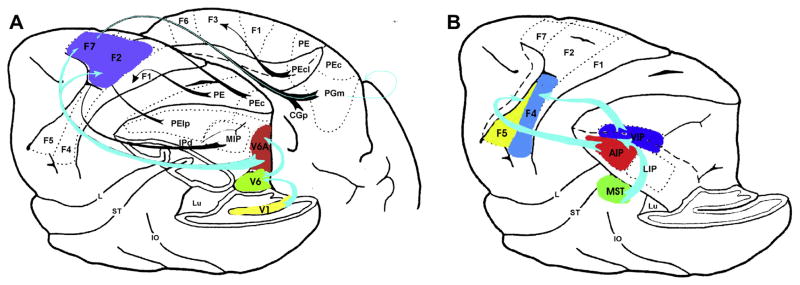
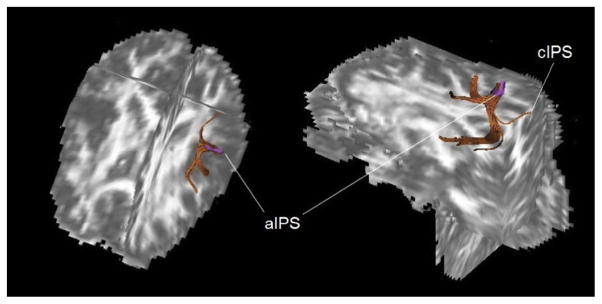
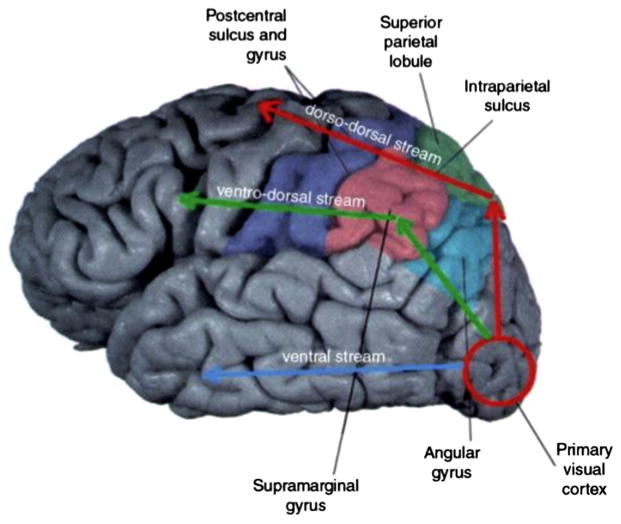
The distinction between dorsal and ventral visual processing streams, first proposed by Ungerleider and Mishkin (1982) and later refined by Milner and Goodale (1995) has been elaborated substantially in recent years, spurred by two developments. The first was proposed in large part by Rizzolatti and Matelli (2003) and is a more detailed description of the multiple neural circuits connecting the frontal, temporal, and parietal cortices. Secondly, there are a number of behavioral observations that the classic "two visual systems" hypothesis is unable to accommodate without additional assumptions. The notion that the Dorsal stream is specialized for "where" or "how" actions and the Ventral stream for "What" knowledge cannot account for two prominent disorders of action, limb apraxia and optic ataxia, that represent a double dissociation in terms of the types of actions that are preserved and impaired. A growing body of evidence, instead, suggests that there are at least two distinct Dorsal routes in the human brain, referred to as the "Grasp" and "Use" systems. Both of these may be differentiated from the Ventral route in terms of neuroanatomic localization, representational specificity, and time course of information processing.
Keywords: Ventral stream; Ventro-dorsal and dorso-dorsal stream; “Use” and “Grasp” systems.
Copyright © 2012 Elsevier Inc. All rights reserved.
Figures

References
-
- Allport A. Visual attention: Foundations of cognitive science. Cambridge, MA, US: The MIT Press; 1989.
-
- Allport A. Selection for action: Some behavioral and neurophysiological considerations of attention and action. In: Heuer H, Sanders AF, editors. Perspectives on perception and action. NJ, Erlbaum: Hillsdale; 1987. pp. 395–419.
-
- Balint R. Seelenhamung des, Schauens, optische Ataxie, raümlische Störung der Aufmeirsamkeit. Monatsschr Psychiatr Neurol. 1909;25:51–81.
-
- Bekkering H, Neggers SFW. Visual search is modulated by action intentions. Psychological Science. 2002;13(4):370–374. - PubMed
-
- Barbieri C, De Renzi E. The executive and ideational components of apraxia. Cortex. 1988;24:535–544. - PubMed
MeSH terms
Grants and funding
LinkOut - more resources
Full Text Sources
Other Literature Sources
