


An evaluation of mother-centered anticipatory guidance to reduce obesogenic infant feeding behaviors
- PMID: 22891225
- PMCID: PMC3428754
- DOI: 10.1542/peds.2011-3027
An evaluation of mother-centered anticipatory guidance to reduce obesogenic infant feeding behaviors
Abstract
Objective: To evaluate the effect of 2 anticipatory guidance styles (maternal focused [MOMS] and infant focused [Ounce of Prevention]) directed at mothers of infants aged newborn to 6 months on their infant feeding behaviors at 1 year compared with routine advice as outlined in Bright Futures (BF).
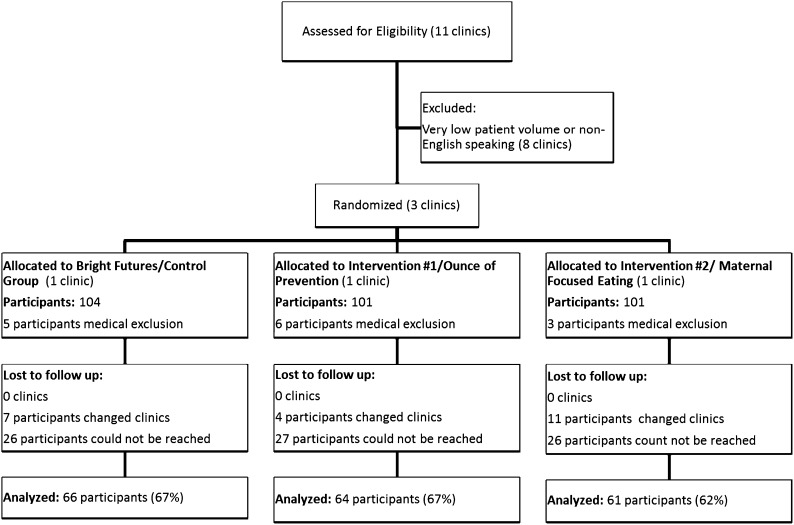
Methods: This is a cluster randomized trial. A total of 292 mother/infant dyads were enrolled at their first well-child visit to 3 urban pediatric clinics in Columbus, Ohio. Intervention-specific brief advice and 1-page handouts were given at each well visit. In addition to infant weights and lengths, surveys about eating habits and infant feeding practices were completed at baseline and 12 months.
Results: Baseline data revealed a group with high rates of maternal overweight (62%) and obesogenic habits. At 12 months, the maternal-focused group gave their infants less juice (8.97 oz vs 14.37 oz, P < .05), and more daily servings of fruit (1.40 vs 0.94, P < .05) and vegetables (1.41 vs 1.03, P < .05) compared with BF mothers. Ounce of Prevention mothers also gave less juice (9.3 oz, P < .05) and more fruit servings (1.26 P < .05) than BF.
Conclusions: Brief specific interventions added to well-child care may affect obesogenic infant feeding behaviors of mothers and deserves further study as an inexpensive approach to preventing childhood obesity.
Trial registration: ClinicalTrials.gov NCT01565525.
Figures



Comment in
-
What do we do with our 15 minutes?Pediatrics. 2012 Sep;130(3):e683-4. doi: 10.1542/peds.2012-1519. Epub 2012 Aug 13. Pediatrics. 2012. PMID: 22891228 No abstract available.
References
-
- Freedman DS, Srinivasan SR, Valdez RA, Williamson DF, Berenson GS. Secular increases in relative weight and adiposity among children over two decades: the Bogalusa Heart Study. Pediatrics. 1997;99(3):420–426 - PubMed
-
- Flegal KM. The obesity epidemic in children and adults: current evidence and research issues. Med Sci Sports Exerc. 1999;31(suppl 11):S509–S514 - PubMed
-
- Dwyer JT, Stone EJ, Yang M, et al. Prevalence of marked overweight and obesity in a multiethnic pediatric population: findings from the Child and Adolescent Trial for Cardiovascular Health (CATCH) study. J Am Diet Assoc. 2000;100(10):1149–1156 - PubMed
-
- Kimm SY, Obarzanek E. Childhood obesity: a new pandemic of the new millennium. Pediatrics. 2002;110(5):1003–1007 - PubMed
-
- Lobstein T, Frelut ML. Prevalence of overweight among children in Europe. Obes Rev. 2003;4(4):195–200 - PubMed
Publication types
MeSH terms
Associated data
Grants and funding
LinkOut - more resources
Full Text Sources
Medical
Miscellaneous
