Review
doi: 10.1200/JCO.2012.41.6768.
Epub 2012 Aug 13.
Monoclonal antibody-based therapies: a new dawn in the treatment of acute lymphoblastic leukemia
Affiliations
- PMID: 22891271
- PMCID: PMC3478578
- DOI: 10.1200/JCO.2012.41.6768
Item in Clipboard
Review
Monoclonal antibody-based therapies: a new dawn in the treatment of acute lymphoblastic leukemia
J Clin Oncol.
.
No abstract available
Conflict of interest statement
Authors' disclosures of potential conflicts of interest and author contributions are found at the end of this article.
Figures
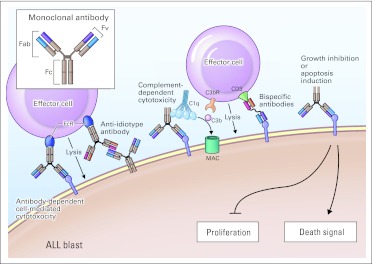
Mechanisms of action of monoclonal antibodies. Monoclonal antibodies consist of two heavy chains and two light chains. The amino acid sequence of the variable (v) ends of each of the four chains determines the specificity of antigen binding. The other end of the molecule (Fc; crystallizable or complement fixing fragment) activates complement and engages immune effector cells through Fc-receptor (FcR) binding. Antibody-dependent cell-mediated cytotoxicity (ADCC): Immune effector cells lyse target cells coated with antibodies. Binding of the Fc portion of immunoglobulin (Ig) molecules by FcRs on effector cells leads to activation of effector cell functions and cytotoxicity. Anti-idiotype antibodies directed against unique regions of the Ig variable domains expressed on blasts can also activate ADCC. Complement-dependent cytotoxicity (CDC): IgM and IgG antibodies bind the first component of complement (C1q) initiating the complement cascade, which terminates in the generation of the membrane attack complex (MAC) and cell lysis. Intermediate components of the complement cascade function as opsonins facilitating CDC and ADCC. The third component of complement (C3b) binds directly to C3b receptors (C3bR) on effector cells, which leads to complement-dependent cell-mediated cytoxicity. Bispecific antibodies: Monoclonal antibody constructs with dual specificity can facilitate direct cell-mediated cytotoxicity through linkage of immune effector cells and leukemic blasts. Direct effects of unconjgated monoclonal antibodies: Monoclonal antibodies that bind surface receptors can inhibit cell proliferation or induce apoptosis through effects on intracellular signaling pathways. ALL, acute lymphoblastic leukemia; CD3, cluster designation 3; Fab, antigen binding fragment; Fv, variable fragment.
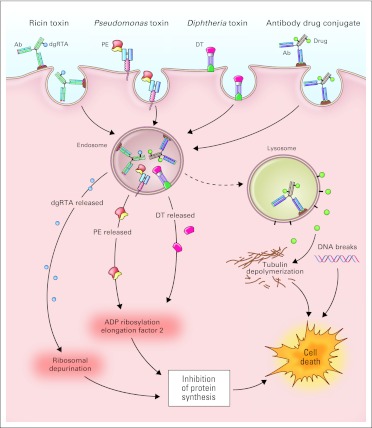
Mechanisms of action of monoclonal antibody (Ab) conjugates. Monoclonal antibodies and their fragments can be conjugated or linked to cytotoxic agents. Chemotherapy and toxin conjugates must be internalized via receptor-mediated endocytosis, whereas internalization is not required for radioisotope conjugates. After internalization, the active cytotoxic component is released and mediates cell death. Ricin-based immunotoxins depurinate ribosomal RNA and inhibit protein synthesis. Pseudomonas (PE)- and diphtheria (DT) -derived immunotoxins ADP ribosylate elongation factor-2 and inhibit protein synthesis. Antibody drug conjugates mediate cytotoxicity by drug-specific actions (eg, targeting tubulin by maytansin and auristatin, and induction of DNA breaks by calicheamicin). dgRTA, deglycosylated ricin A chain.
References
-
- Pui CH, Evans WE. Treatment of acute lymphoblastic leukemia. N Engl J Med. 2006;354:166–178. - PubMed
-
- Gaynon PS, Trigg ME, Heerema NA, et al. Children's Cancer Group trials in childhood acute lymphoblastic leukemia: 1983-1995. Leukemia. 2000;14:2223–2233. - PubMed
-
- Bassan R, Hoelzer D. Modern therapy of acute lymphoblastic leukemia. J Clin Oncol. 2011;29:532–543. - PubMed
Publication types
MeSH terms
Substances
Grants and funding
LinkOut - more resources
Full Text Sources
Other Literature Sources