


doi: 10.1021/bi3009664.
Epub 2012 Aug 22.
A picomolar transition state analogue inhibitor of MTAN as a specific antibiotic for Helicobacter pylori
Affiliations
- PMID: 22891633
- PMCID: PMC3437630
- DOI: 10.1021/bi3009664
Item in Clipboard
A picomolar transition state analogue inhibitor of MTAN as a specific antibiotic for Helicobacter pylori
Biochemistry.
.
Abstract
Campylobacter and Helicobacter species express a 6-amino-6-deoxyfutalosine N-ribosylhydrolase (HpMTAN) proposed to function in menaquinone synthesis. BuT-DADMe-ImmA is a 36 pM transition state analogue of HpMTAN, and the crystal structure of the enzyme-inhibitor complex reveals the mechanism of inhibition. BuT-DADMe-ImmA has a MIC(90) value of <8 ng/mL for Helicobacter pylori growth but does not cause growth arrest in other common clinical pathogens, thus demonstrating potential as an H. pylori-specific antibiotic.
Figures
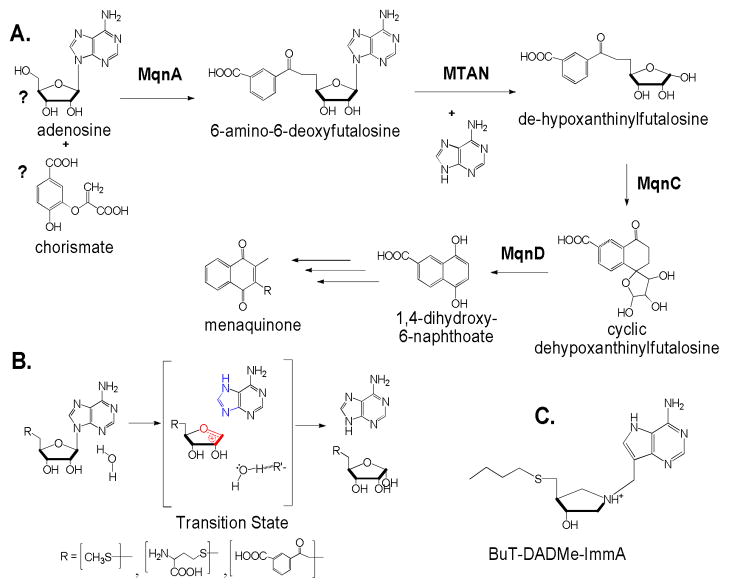
Reactions catalyzed by MTANs, their proposed transition states and a transition state analogue inhibitor, BuT-DADMe-ImmA. A. Proposed early steps of the menaquinone pathway in H. pylori. The proposed substrates of MqnA reaction are labeled with question marks. B. Reaction catalyzed by HpMTAN and the proposed transition state. R′ is a proton abstracting group leading to the formation of hydroxide from water after the transition state is passed. Candidates are Glu13 and Glu175 (Fig. 2). Features of the transition state (blue and red) are represented in the BuT-DADMe-ImmA inhibitor in C.
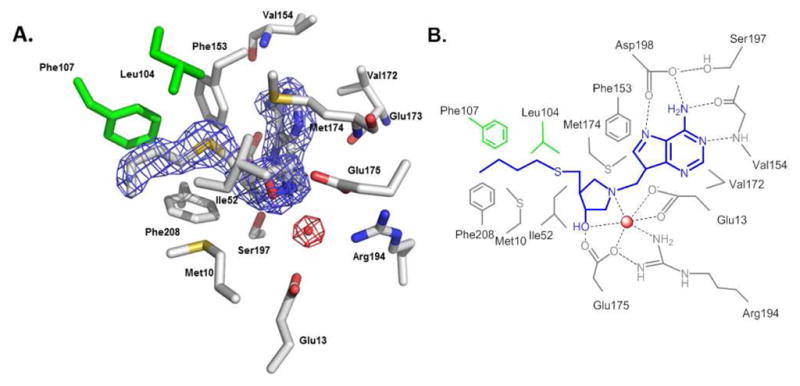
Active site of HpMTAN in complex with BuT-DADMe-ImmA. A. Crystal structure of the active site of HpM-TAN with bound BuT-DADMe-ImmA. The figure shows a 2Fo − Fc map around the inhibitor (blue grid) and catalytic water molecule (red grid) contoured at 1.5 σ. The graph was generated using Pymol. B. Schematic representation of interactions between BuT-DADMe-ImmA (blue), a water molecule (red sphere) and residues of HpMTAN. The residues shown in green belong to the neighboring monomer of HpMTAN dimer. Dashed lines represent hydrogen bonds. All hydrogen bonds are 3 Å or less except for three shown to water (3′-OH 3.1 Å; Glu175 3.3 Å; Glu13 3.2 Å).
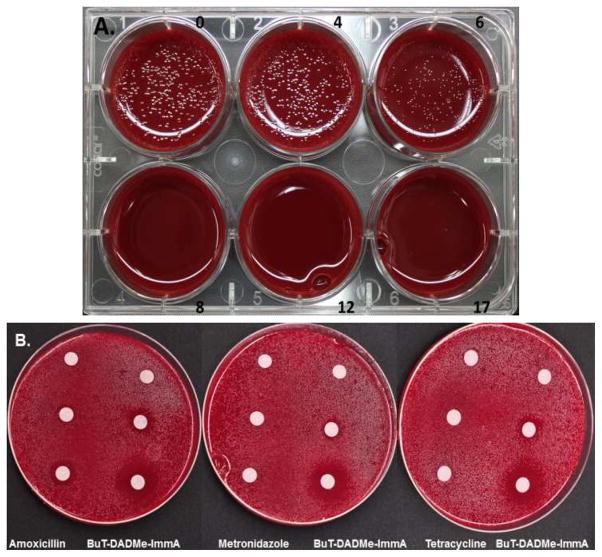
The effects of BuT-DADMe-ImmA on H. pylori growth. A. The effects of increasing the concentration of BuT-DADMe-ImmA (ng/ml) on growth on blood agar (one of five experiments in triplicate). B. The inhibitory effects of BuT-DADMe-ImmA are compared with amoxicillin, metronidazole and tetracyclin in zone of inhibition studies. Drug quantities per disk were: 0 (top disc), 10 ng (middle disc) or 20 ng (bottom disc). Each specified antibiotic was applied to the disc in the same manner. Small zones of inhibition were seen with 10 ng BuT-DADMe-ImmA (middle right), and large zones at 20 ng (lower right).
References
Publication types
MeSH terms
Substances
Associated data
- Actions
Grants and funding
LinkOut - more resources
Full Text Sources
Other Literature Sources
Medical
Molecular Biology Databases
Research Materials
