


Progression of cutaneous melanoma: implications for treatment
- PMID: 22892755
- PMCID: PMC4311146
- DOI: 10.1007/s10585-012-9521-1
Progression of cutaneous melanoma: implications for treatment
Erratum in
- Clin Exp Metastasis. 2012 Oct;29(7):797-9
Abstract
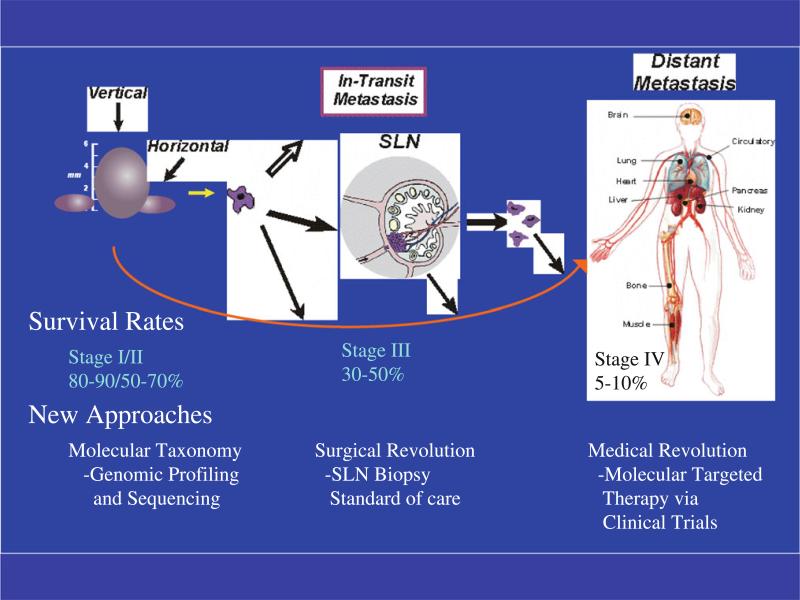
The survival rates of melanoma, like any type of cancer, become worse with advancing stage. Spectrum theory is most consistent with the progression of melanoma from the primary site to the in-transit locations, regional or sentinel lymph nodes and beyond to the distant sites. Therefore, early diagnosis and surgical treatment before its spread is the most effective treatment. Recently, new approaches have revolutionized the diagnosis and treatment of melanoma. Genomic profiling and sequencing will form the basis for molecular taxonomy for more accurate subgrouping of melanoma patients in the future. New insights of molecular mechanisms of metastasis are summarized in this review article. Sentinel lymph node biopsy has become a standard of care for staging primary melanoma without the need for a more morbid complete regional lymph node dissection. With recent developments in molecular biology and genomics, novel molecular targeted therapy is being developed through clinical trials.
Figures
References
-
- Murphy MJ. Diagnostic and prognostic biomarkers and therapeutic targets in melanoma. Springer; New York: 2012.
-
- Becker D, Mihm MC, Hewitt SM, et al. Markers and tissue resources for melanoma: meeting report. Cancer Res. 2006;66:10652–10657. - PubMed
-
- Beecher C. The human metabolome. In: Harrigan G, Goodacre R, editors. Metabolic profilings: its role in biomarker discovery and gene function analysis. Kluwer Academic Publishers; Boston: 2003. pp. 311–319.
-
- Flaherty KT. BRAF inhibitors and melanoma. Cancer J. 2011;17:505–511. - PubMed
Publication types
MeSH terms
Substances
Grants and funding
LinkOut - more resources
Full Text Sources
Medical
Molecular Biology Databases
