. 2012:3:1002.
doi: 10.1038/ncomms2002.

Ambient fabrication of flexible and large-area organic light-emitting devices using slot-die coating

Affiliations
Free PMC article

Ambient fabrication of flexible and large-area organic light-emitting devices using slot-die coating

Andreas Sandström et al. Nat Commun. 2012.
Free PMC article

Abstract

The grand vision of manufacturing large-area emissive devices with low-cost roll-to-roll coating methods, akin to how newspapers are produced, appeared with the emergence of the organic light-emitting diode about 20 years ago. Today, small organic light-emitting diode displays are commercially available in smartphones, but the promise of a continuous ambient fabrication has unfortunately not materialized yet, as organic light-emitting diodes invariably depend on the use of one or more time- and energy-consuming process steps under vacuum. Here we report an all-solution-based fabrication of an alternative emissive device, a light-emitting electrochemical cell, using a slot-die roll-coating apparatus. The fabricated flexible sheets exhibit bidirectional and uniform light emission, and feature a fault-tolerant >1-μm-thick active material that is doped in situ during operation. It is notable that the initial preparation of inks, the subsequent coating of the constituent layers and the final device operation all could be executed under ambient air.


Figures
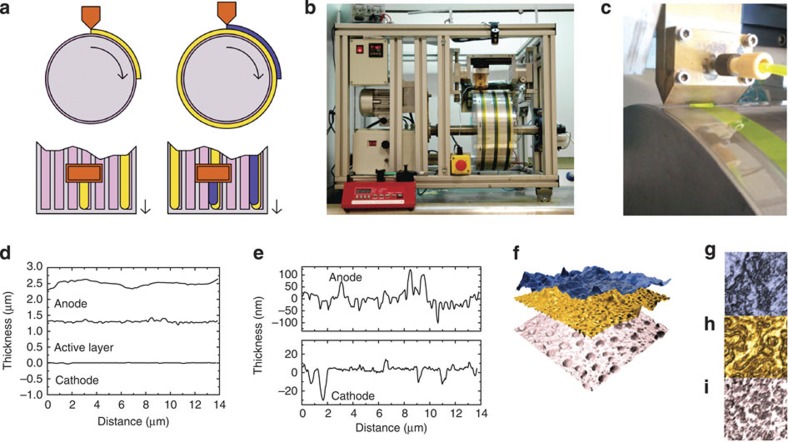
Figure 1
Figure 1. Coating process and morphology and thickness of the coated films.
(a) Schematic view of the slot-die roll coating of the (yellow) active layer and the (blue) semitransparent anode on top of a (pink) flexible cathode-coated substrate. The ink is transferred from an external container via a pump to the slot-die head (orange). (b) Photograph of the roll coater during the deposition of the active layer. (c) Close-up photograph of the slot-die head during coating of an active layer stripe. (d) Atomic force microscopy (AFM) data indicating the thickness of the anodic, active and cathodic layers in the LEC device stack. (e) Enlarged AFM data indicating the roughness of the anodic and the cathodic interfaces. (f) Exploded view of 10×10 μm2 AFM height maps of the three constituent layers. (gi) 2×2 μm2 AFM phase-contrast images of (g) the PEDOT-PSS anode, (h) the active layer and (i) the ZnO cathode.
Figure 2
Figure 2. Key aspects of LEC operation.
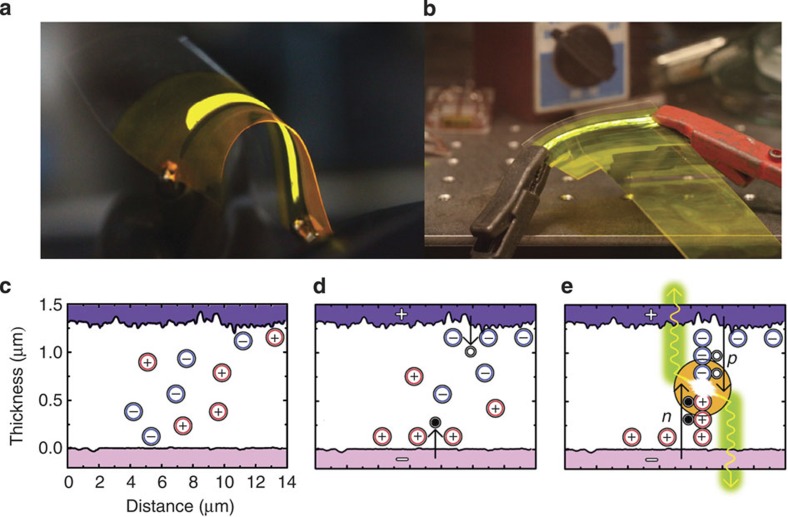
(a) Photograph of a slot-die–coated LEC, illustrating the bidirectional light emission and the device conformability. (b) Light emission from a semitransparent slot-die–coated LEC following >6 months storage in a glove box. The devices depicted in a and b were driven at V=7 V. (c) Schematic structure of a pristine LEC device, indicating the existence of mobile (red) cations and (blue) anions in the active layer and the rough (blue) anodic and (purple) cathodic interfaces. (d) The electric double-layer formation and the initial electron (solid circles) and hole (open circles) injection within the same device following the application of a voltage bias. (e) The light emission (yellow-green) from the in-situ formed p–n junction at steady state.
Figure 3
Figure 3. Performance of roll-coated devices.
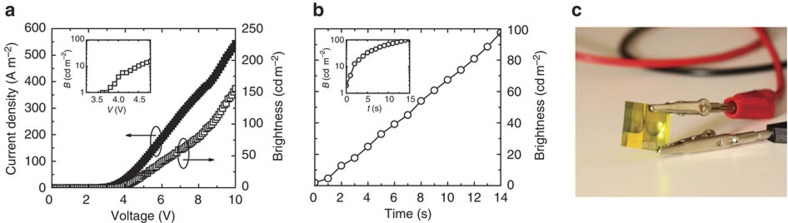
(a) Optoelectronic data recorded on a roll-coated poly(ethylene terephthalate)/indium-tin-oxide/ZnO/{SY+PEO+KCF3SO3}/PEDOT:PSS device during a voltage sweep at 0.1 V s−1. Inset: the brightness data plotted on a logarithmic scale. (b) The turn-on time for a nominally identical device driven in galvanostatic mode at j=770 A m−2. Inset: the brightness data plotted on a logarithmic scale. (c) Photograph of an encapsulated roll-coated device operating at V=7 V under ambient conditions. Note that the device had been stored under ambient air for 3 days before the voltage was applied.

References

    1. Sheats J. R. Manufacturing and commercialization issues in organic electronics. J. Mater. Res. 19, 1974–1989 (2004).
    1. Tang C. W. & Van Slyke S. A. Organic electroluminescent diodes. Appl. Phys. Lett. 51, 913–915 (1987).
    1. Burroughes J. H. et al.. Light-emitting-diodes based on conjugated polymers. Nature 347, 539–541 (1990).
    1. Mertens R. The OLED Handbook 1st edn (Metalgrass software, 2011).
    1. Sun Y. R. et al.. Management of singlet and triplet excitons for efficient white organic light-emitting devices. Nature 440, 908–912 (2006). - PubMed

Publication types