


Effect of cognitive-behavioral couple therapy for PTSD: a randomized controlled trial
- PMID: 22893167
- PMCID: PMC4404628
- DOI: 10.1001/jama.2012.9307
Effect of cognitive-behavioral couple therapy for PTSD: a randomized controlled trial
Abstract
Context: Posttraumatic stress disorder (PTSD) is a prevalent condition associated with intimate relationship problems, and intimate relationship factors have been shown to affect individual PTSD treatment outcomes.
Objective: To compare cognitive-behavioral conjoint therapy for PTSD (a manualized couple therapy delivered to patients with PTSD and their significant others to simultaneously treat PTSD symptoms and enhance relationship satisfaction) with a wait-list condition.
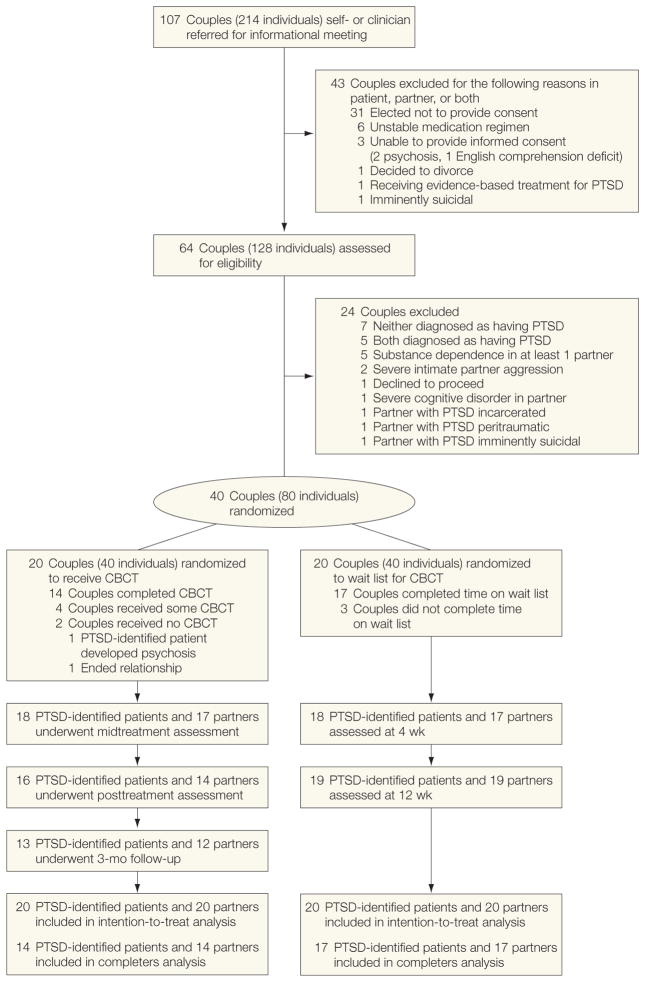
Design, setting, and participants: Randomized controlled trial of heterosexual and same-sex couples (n = 40 couples; n = 80 individuals) in which one partner met criteria for PTSD according to the Clinician-Administered PTSD Scale, conducted from 2008 to 2012 in a Department of Veterans Affairs outpatient hospital setting in Boston, Massachusetts, and a university-based research center in Toronto, Ontario, Canada. Symptoms of PTSD, comorbid conditions, and relationship satisfaction were collected by blinded assessors at baseline, at mid treatment (median, 8.00 weeks [range, 1.71-20.43 weeks] after baseline), and at posttreatment (median, 15.86 weeks [range, 7.14-38.57 weeks] after baseline). An uncontrolled 3-month follow-up (median, 38.21 weeks [range, 28.43-50.57 weeks] after baseline) was also completed.
Intervention: Couples were randomly assigned to take part in the 15-session cognitive-behavioral conjoint therapy for PTSD protocol immediately (n = 20) or were placed on a wait list for the therapy (n = 20).
Main outcome measures: Clinician-rated PTSD symptom severity was the primary outcome and was assessed with the Clinician-Administered PTSD Scale. Intimate relationship satisfaction, assessed with the Dyadic Adjustment Scale, patient- and partner-rated PTSD symptoms, and comorbid symptoms were secondary outcomes.
Results: PTSD symptom severity (score range, 0-136) was significantly more improved in the couple therapy condition than in the wait-list condition (mean change difference, -23.21; 95% CI, -37.87 to -8.55). Similarly, patients' intimate relationship satisfaction (score range, 0-151) was significantly more improved in couple therapy than in the wait-list condition (mean change difference, 9.43; 95% CI, 0.04-18.83). The time × condition interaction effect in the multilevel model predicting PTSD symptoms (t37.5 = -3.09; P = .004) and patient-reported relationship satisfaction (t68.5 = 2.00; P = .049) revealed superiority of the couple therapy compared with the wait list. Treatment effects were maintained at 3-month follow-up.
Conclusion: Among couples in which one partner was diagnosed as having PTSD, a disorder-specific couple therapy, compared with a wait list for the therapy, resulted in decreased PTSD symptom severity and patient comorbid symptom severity and increased patient relationship satisfaction.
Trial registration: clinicaltrials.gov Identifier: NCT00669981.
Conflict of interest statement
Figures
Comment in
-
Expanding the boundaries of PTSD treatment.JAMA. 2012 Aug 15;308(7):714-6. doi: 10.1001/2012.jama.10368. JAMA. 2012. PMID: 22893170 No abstract available.
-
Couple therapy for posttraumatic stress disorder.JAMA. 2012 Dec 19;308(23):2458; author reply 2458. doi: 10.1001/jama.2012.14558. JAMA. 2012. PMID: 23288147 No abstract available.
References
-
- Taft CT, Watkins LE, Stafford J, Street AE, Monson CM. Posttraumatic stress disorder and intimate relationship problems: a meta-analysis. J Consult Clin Psychol. 2011;79(1):22–33. - PubMed
-
- Caska CM, Renshaw KD. Perceived burden in spouses of National Guard/Reserve service members deployed during Operations Enduring and Iraqi Freedom. J Anxiety Disord. 2011;25(3):346–351. - PubMed
-
- Schnurr PP, Hayes AF, Lunney CA, McFall M, Uddo M. Longitudinal analysis of the relationship between symptoms and quality of life in veterans treated for posttraumatic stress disorder. J Consult Clin Psychol. 2006;74(4):707–713. - PubMed
-
- Tarrier N, Sommerfield C, Pilgrim H. Relatives’ expressed emotion (EE) and PTSD treatment outcome. Psychol Med. 1999;29(4):801–811. - PubMed
Publication types
MeSH terms
Associated data
Grants and funding
LinkOut - more resources
Full Text Sources
Medical
Miscellaneous
