


New strategies in acute myeloid leukemia: redefining prognostic markers to guide therapy
- PMID: 22893630
- PMCID: PMC3902112
- DOI: 10.1158/1078-0432.CCR-12-0313
New strategies in acute myeloid leukemia: redefining prognostic markers to guide therapy
Abstract
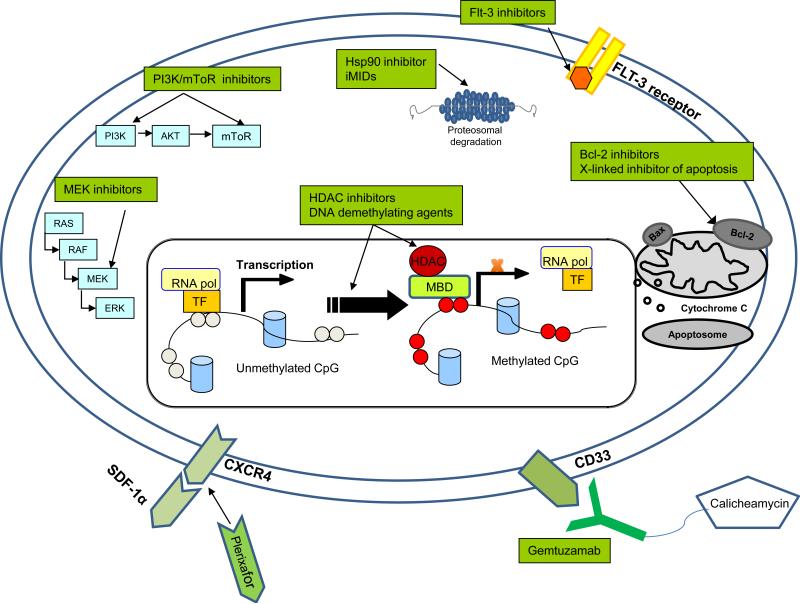
Although standard therapy for AML has been relatively constant over the past 2 decades, this may be changing with enhanced technologies allowing for the classification of acute myeloid leukemia (AML) into molecularly distinct subsets. Some specific subsets of AML have an excellent prognosis in response to standard therapy, whereas the poor prognosis of AML associated with specific sets of mutations or chromosomal anomalies requires the development of new therapies. Elucidation of the molecular pathogenesis of AML has led to the development of therapies that affect signaling, apoptosis, protein and intermediate metabolism, the surface of the leukemia cell, leukemia cell/stromal interaction, and epigenetic regulation of gene expression.
Figures
References
-
- Vardiman JW, Thiele J, Arber DA, Brunning RD, Borowitz MJ, Porwit A, et al. The 2008 revision of the World Health Organization (WHO) classification of myeloid neoplasms and acute leukemia: rationale and important changes. Blood. 2009;114:937–51. - PubMed
-
- Farag SS, Archer KJ, Mrozek K, Ruppert AS, Carroll AJ, Vardiman JW, et al. Pretreatment cytogenetics add to other prognostic factors predicting complete remission and long-term outcome in patients 60 years of age or older with acute myeloid leukemia: results from Cancer and Leukemia Group B 8461. Blood. 2006;108:63–73. - PMC - PubMed
-
- Byrd JC, Mrozek K, Dodge RK, Carroll AJ, Edwards CG, Arthur DC, et al. Pretreatment cytogenetic abnormalities are predictive of induction success, cumulative incidence of relapse, and overall survival in adult patients with de novo acute myeloid leukemia: results from Cancer and Leukemia Group B (CALGB 8461). Blood. 2002;100:4325–36. - PubMed
-
- Dohner H, Estey EH, Amadori S, Appelbaum FR, Buchner T, Burnett AK, et al. Diagnosis and management of acute myeloid leukemia in adults: recommendations from an international expert panel, on behalf of the European LeukemiaNet. Blood. 115:453–74. - PubMed
Publication types
MeSH terms
Substances
Grants and funding
LinkOut - more resources
Full Text Sources
Other Literature Sources
Medical
Miscellaneous
