


Effect of ancient population structure on the degree of polymorphism shared between modern human populations and ancient hominins
- PMID: 22893688
- PMCID: PMC3435202
- DOI: 10.1073/pnas.1200567109
Effect of ancient population structure on the degree of polymorphism shared between modern human populations and ancient hominins
Abstract
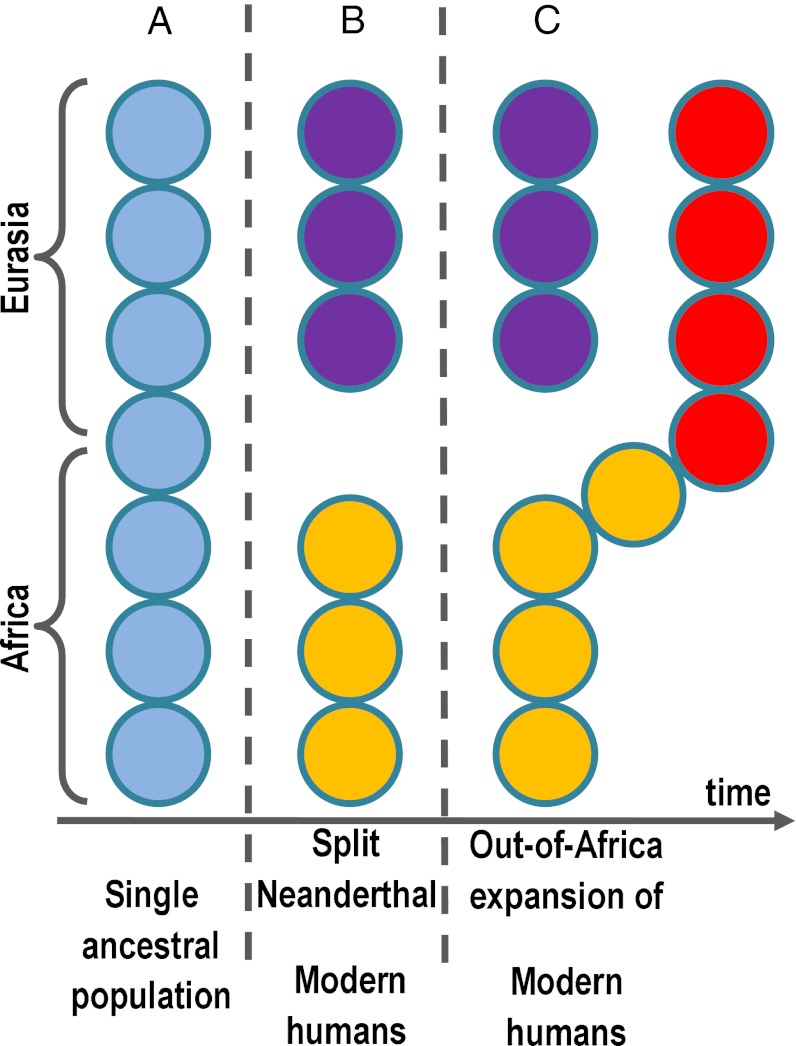
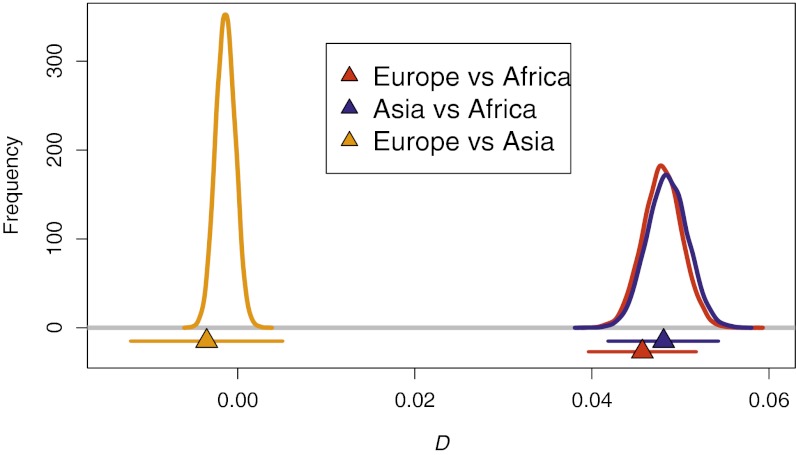
Recent comparisons between anatomically modern humans and ancient genomes of other hominins have raised the tantalizing, and hotly debated, possibility of hybridization. Although several tests of hybridization have been devised, they all rely on the degree to which different modern populations share genetic polymorphisms with the ancient genomes of other hominins. However, spatial population structure is expected to generate genetic patterns similar to those that might be attributed to hybridization. To investigate this problem, we take Neanderthals as a case study, and build a spatially explicit model of the shared history of anatomically modern humans and this hominin. We show that the excess polymorphism shared between Eurasians and Neanderthals is compatible with scenarios in which no hybridization occurred, and is strongly linked to the strength of population structure in ancient populations. Thus, we recommend caution in inferring admixture from geographic patterns of shared polymorphisms, and argue that future attempts to investigate ancient hybridization between humans and other hominins should explicitly account for population structure.
Conflict of interest statement
The authors declare no conflict of interest.
Figures
References
-
- Herrera KJ, Somarelli JA, Lowery RK, Herrera RJ. To what extent did Neanderthals and modern humans interact? Biol Rev Camb Philos Soc. 2009;84:245–257. - PubMed
-
- Hofreiter M. Drafting human ancestry: What does the Neanderthal genome tell us about hominid evolution? Commentary on Green et al. (2010) Hum Biol. 2011;83:1–11. - PubMed
Publication types
MeSH terms
Grants and funding
LinkOut - more resources
Full Text Sources
