


The Effect of Clinical Visual Stress on Stereoacuity Measured with the TNO Test
- PMID: 22893757
- PMCID: PMC3413646
The Effect of Clinical Visual Stress on Stereoacuity Measured with the TNO Test
Abstract
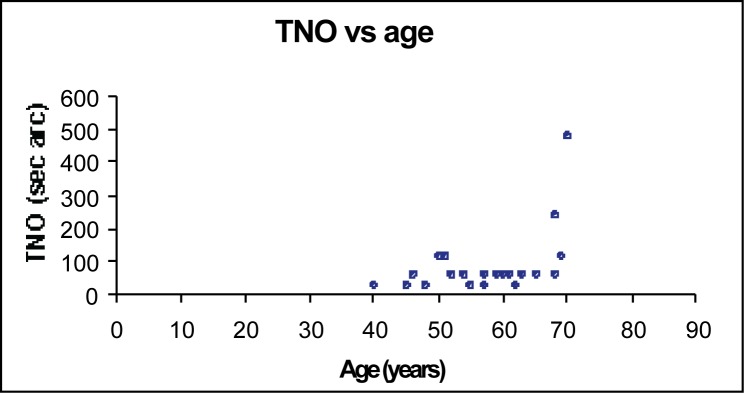
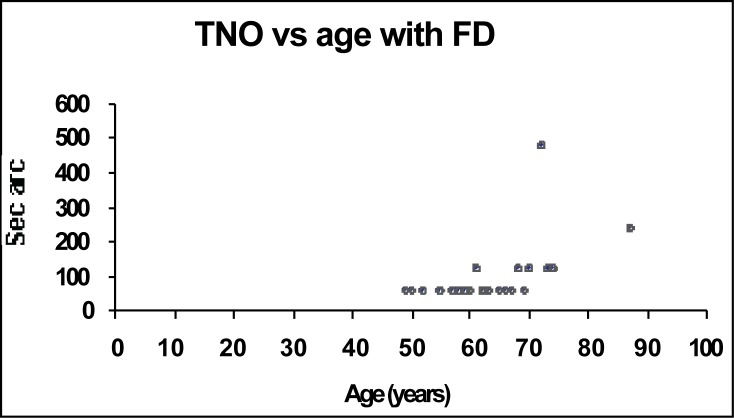
We measured stereoacuity using TNO test on 25 patients without fixation disparity (FD) and compared the result with other 25 patients exhibited FD related to visual stress. All patients were presbyopes of ages ranging from 40 to 80 years, with visual acuity 6/6 or better in each eye, free from ocular diseases and generally healthy. The results showed statistically significant difference in the stereoacuities measured between the groups (Mann-Whitney U = 181.0, p < 0.01), suggesting that FD significantly reduced stereoacuity. Although the correlation between the magnitudes of FD and stereothreshold is statistically not significant (Spearman's r(s) = 0.33, p>0.01), elimination of FD using prisms correction statistically improved stereoacuity (Wilcoxon's Z = 2.43, p<0.01). The findings conclude that visual stress manifested as FD causes deficit in stereoperformance measurable with the TNO test and can be improved by prism correction.
Keywords: Visual stress; fixation disparity; prism correction; stereoacuity; stereopsis.
Figures
References
-
- Walraven J. Amblyopia screening with random-dot stereograms. Am. J. Ophthal. 1975;80:893–900. - PubMed
-
- Rustein RP. Fixation disparity and stereopsis. Am. J. Optom. Physiol. Opt. 1977;54:550–555. - PubMed
-
- Sheedy JE, Saladin JJ. Phorias, vergences and fixation disparity in oculomtor problems. Am. J. Optom. Physiol. Opt. 1977;54:474–478. - PubMed
-
- Sheedy JE, Saladin JJ. Association of symptoms with measures of oculomotor deficiencies. Am. J. Optom. Physiol. Opt. 1978;55:670–676. - PubMed
LinkOut - more resources
Full Text Sources