


Predicting posttraumatic stress disorder symptoms and pain intensity following severe injury: the role of catastrophizing
- PMID: 22893804
- PMCID: PMC3402105
- DOI: 10.3402/ejpt.v2i0.5652
Predicting posttraumatic stress disorder symptoms and pain intensity following severe injury: the role of catastrophizing
Abstract
Background: A number of theories have proposed possible mechanisms that may explain the high rates of comorbidity between posttraumatic stress disorder (PTSD) and persistent pain; however, there has been limited research investigating these factors.
Objective: The present study sought to prospectively examine whether catastrophizing predicted the development of PTSD symptoms and persistent pain following physical injury.
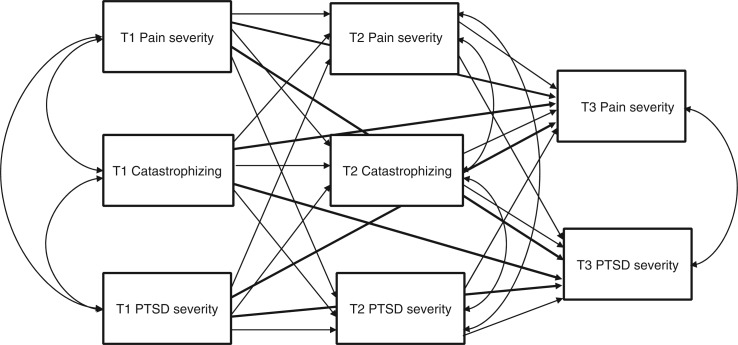
Design: Participants (N=208) completed measures of PTSD symptomatology, pain intensity and catastrophizing during hospitalization following severe injury, and 3 and 12 months postinjury. Cross-lagged path analysis explored the longitudinal relationship between these variables.
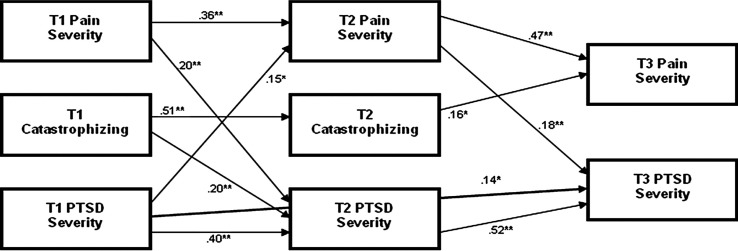
Results: Acute catastrophizing significantly predicted PTSD symptoms but not pain intensity 3 months postinjury. In turn, 3-month catastrophizing predicted pain intensity, but not PTSD symptoms 12 months postinjury. Indirect relations were also found between acute catastrophizing and 12-month PTSD symptoms and pain intensity. Relations were mediated via 3-month PTSD symptoms and 3-month catastrophizing, respectively. Acute symptoms did not predict 3-month catastrophizing and catastrophizing did not fully account for the relationship between PTSD symptoms and pain intensity.
Conclusions: Findings partially support theories that propose a role for catastrophizing processes in understanding vulnerability to pain and posttrauma symptomatology and, thus, a possible mechanism for comorbidity between these conditions.
Keywords: Posttraumatic stress; catastrophizing; comorbidity; injury; pain; path analysis; prospective.
Figures
References
-
- American Congress of Rehabilitation Medicine. Definition of mild traumatic brain injury. Journal of Head Trauma Rehabilitation. 1993;8(3):86–87. http://ovidsp.tx.ovid.com.ezp.lib.unimelb.edu.au/
-
- American Psychiatric Association. Diagnostic and statistical manual of mental disorders. (4th ed.)—Text revision. Arlington, VA: American Psychiatric Association; 2000.
-
- Arbuckle J. L. Amos 16.0 user's guide. Chicago: SPSS Inc; 2007.
-
- Asmundson G. J., Coons M. J., Taylor S., Katz J. PTSD and the experience of pain: Research and clinical implications of shared vulnerability and mutual maintenance models. The Canadian Journal of Psychiatry/La Revue canadienne de psychiatrie. 2002;47(10):930–937. https://ww1.cpa-apc.org/Publications/Archives/CJP/2002/december/asmundso.... - PubMed
-
- Asmundson G. J., Katz J. Understanding the co-occurrence of anxiety disorders and chronic pain: State-of-the-art. Depression & Anxiety. 2009;26(10):888–901. - PubMed
LinkOut - more resources
Full Text Sources
