


Immunoglobulin class-switch recombination deficiencies
- PMID: 22894609
- PMCID: PMC3580555
- DOI: 10.1186/ar3904
Immunoglobulin class-switch recombination deficiencies
Abstract
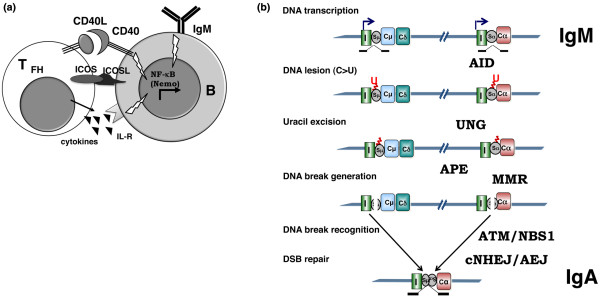
Immunoglobulin class-switch recombination deficiencies (Ig-CSR-Ds) are rare primary immunodeficiencies characterized by defective switched isotype (IgG/IgA/IgE) production. Depending on the molecular defect in question, the Ig-CSR-D may be combined with an impairment in somatic hypermutation (SHM). Some of the mechanisms underlying Ig-CSR and SHM have been described by studying natural mutants in humans. This approach has revealed that T cell-B cell interaction (resulting in CD40-mediated signaling), intrinsic B-cell mechanisms (activation-induced cytidine deaminase-induced DNA damage), and complex DNA repair machineries (including uracil-N-glycosylase and mismatch repair pathways) are all involved in class-switch recombination and SHM. However, several of the mechanisms required for full antibody maturation have yet to be defined. Elucidation of the molecular defects underlying the diverse set of Ig-CSR-Ds is essential for understanding Ig diversification and has prompted better definition of the clinical spectrum of diseases and the development of increasingly accurate diagnostic and therapeutic approaches.
Figures
References
Publication types
MeSH terms
Substances
LinkOut - more resources
Full Text Sources
Research Materials
Miscellaneous
