. 2012 Aug 29;134(34):13918-21.
doi: 10.1021/ja300984b. Epub 2012 Aug 20.

Probing spatial organization of DNA strands using enzyme-free hairpin assembly circuits

Affiliations

Probing spatial organization of DNA strands using enzyme-free hairpin assembly circuits

Bingling Li et al. J Am Chem Soc. .

Abstract

Catalyzed hairpin assembly (CHA) is a robust enzyme-free signal-amplification reaction that has a wide range of potential applications, especially in biosensing. Although most studies of the analytical applications of CHA have focused on the measurement of concentrations of biomolecules, we show here that CHA can also be used to probe the spatial organization of biomolecules such as single-stranded DNA. The basis of such detection is the fact that a DNA structure that brings a toehold and a branch-migration domain into close proximity can catalyze the CHA reaction. We quantitatively studied this phenomenon and applied it to the detection of domain reorganization that occurs during DNA self-assembly processes such as the hybridization chain reaction (HCR). We also show that CHA circuits can be designed to detect certain types of hybridization defects. This principle allowed us to develop a "signal on" assay that can simultaneously respond to multiple types of mutations in a DNA strand in one simple reaction, which is of great interest in genotyping and molecular diagnostics. These findings highlight the potential impacts of DNA circuitry on DNA nanotechnology and provide new tools for further development of these fields.


Figures
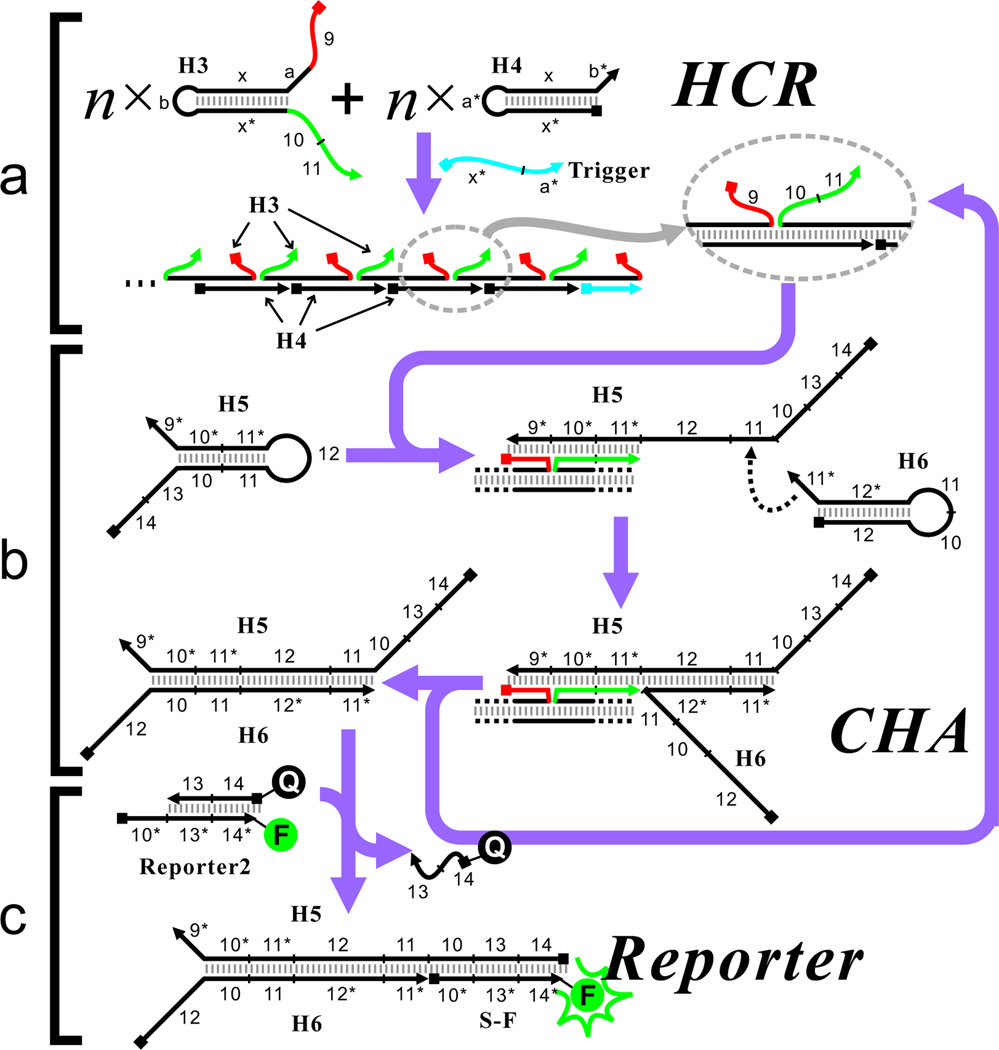
Figure 1
Figure 1
Scheme of the CHA-based circuit that detects the degree of HCR assembly, (a) Scheme of HCR with extended domains. (b) CHA reaction catalyzed by the correctly formed HCR product. (c) Fluorescent reporter that detects the product of the CHA reaction.
Figure 2
Figure 2
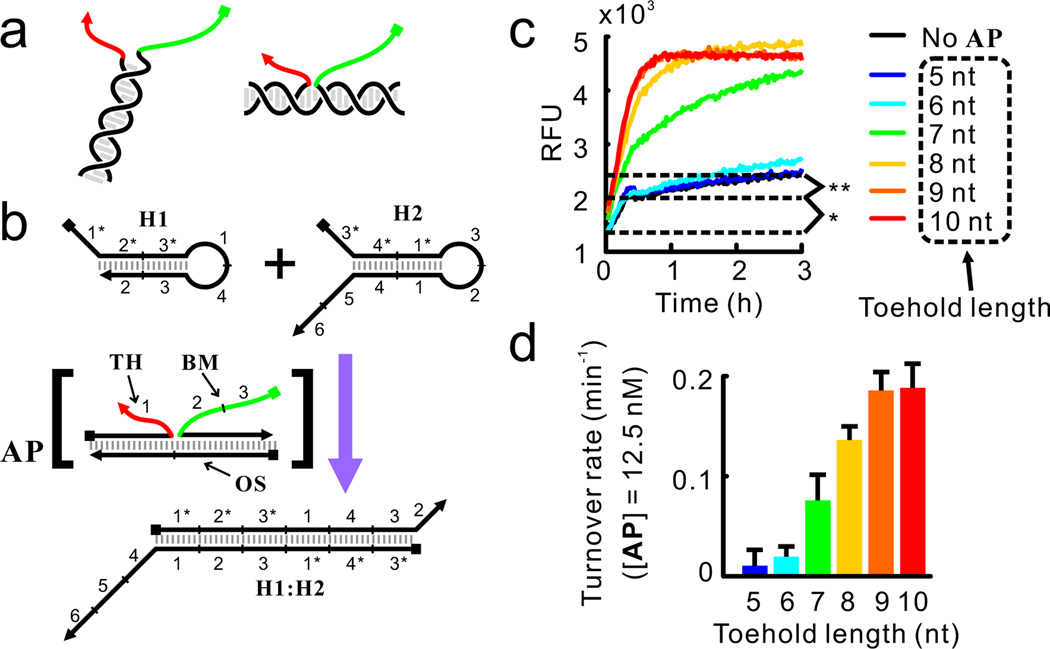
Feasibility of detecting HCR product using CHA-based circuits. (a) Toehold (red) and branch-migration domain (green) co-localized by direct (left) or indirect (right) hybridization. (b) Structure of the substrates (H1 and H2) and the catalyst (AP complex) of the CHA reaction. The toehold and branch-migration domain in the AP complex are shown in red and green, respectively. Detailed reaction pathway is shown in Figure S2. The fluorescent reporter for H1:H2, named Reporter, is similar to the Reporter2 complex shown in Figure 1c and is not shown here. (c) Kinetics of the CHA reaction catalyzed by the AP complex with different toehold length. In all reactions, [H1] = 75 nM, [H2] = [Reporter] = 50 nM, [TH] = [BM] = 15 nM, [OS] = 12.5 nM. Symbols * and ** denote two types of circuit leakage which are further discussed in Figure S1. (d) Turnover rates (rates of reaction divided by concentration of the catalyst) as function of toehold lengths.
Figure 3
Figure 3
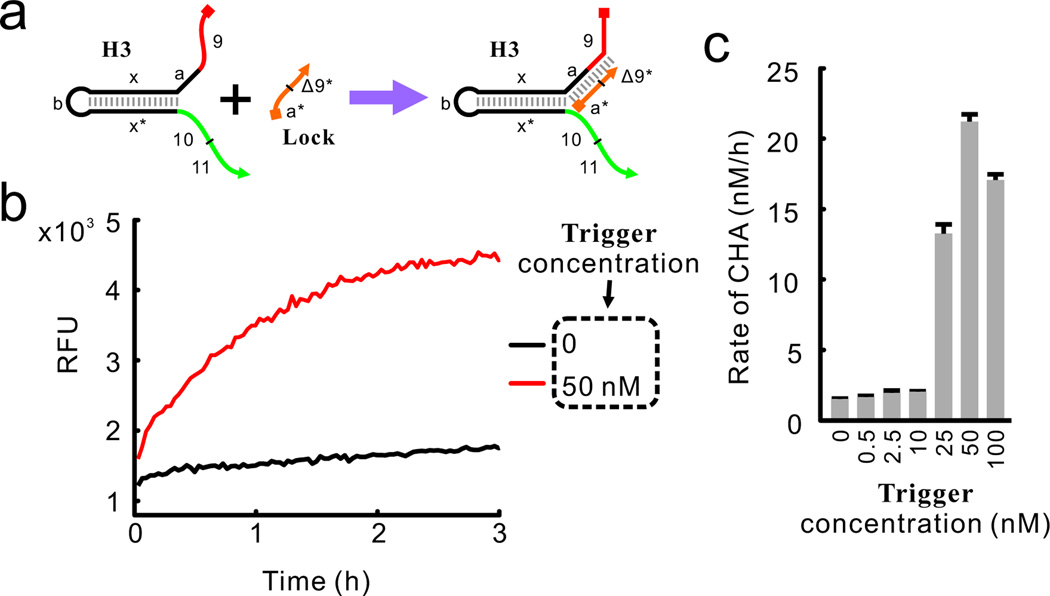
Detection of HCR product using CHA circuits. (a) The Lock strand which can terminate HCR reaction and abolish the activity of monomeric H3 in catalyzing the CHA reaction. Segment Δ9* is complementary to the 6 nt to the 3’ terminus of segment 9. (b and c) Kinetics of the CHA reactions catalyzed by HCR products with different concentrations of the Trigger strand.
Figure 4
Figure 4
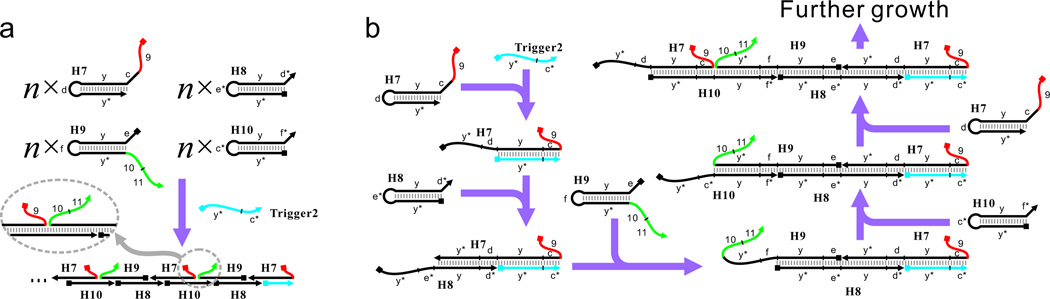
Sensing the assembly of a 4-hairpin HCR using a CHA circuit. (a) Overall reaction of the 4-hairpin HCR reaction, where unlike H3 (see Figure 1a), the toehold (red) and branch-migration domain (green) locate on two separate molecules (H7 and H9, respectively), (b) Detailed reaction mechanism of the 4-hairpin HCR.
Figure 5
Figure 5
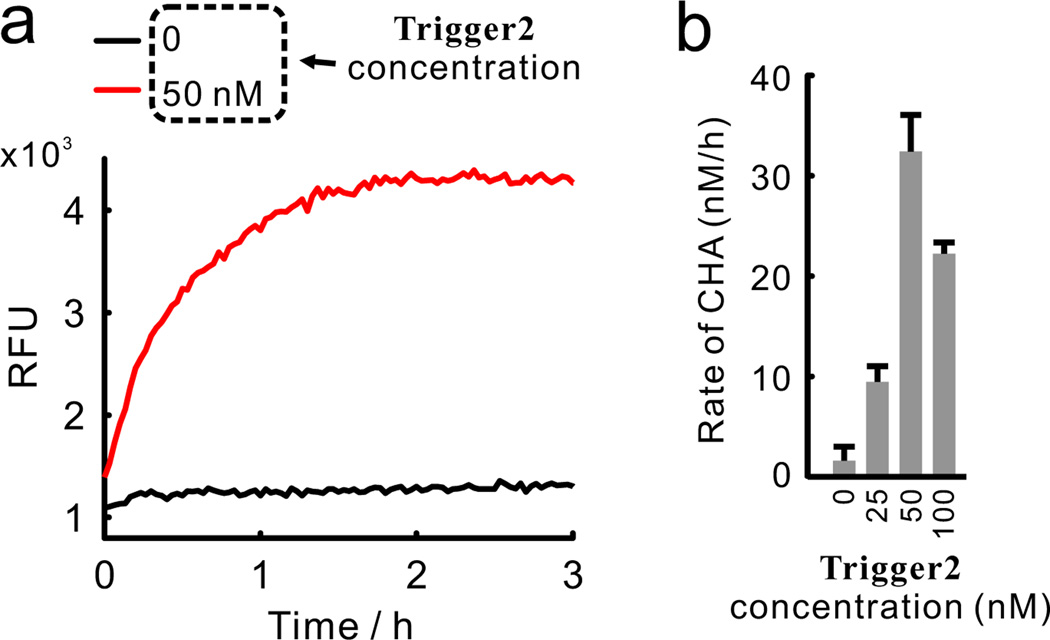
Real-time kinetics (a) and rates (b) of the CHA reactions catalyzed by 4-hairpin HCR products with different concentrations of the Trigger2 strand (See Figure S8 for gel image).
Figure 6
Figure 6
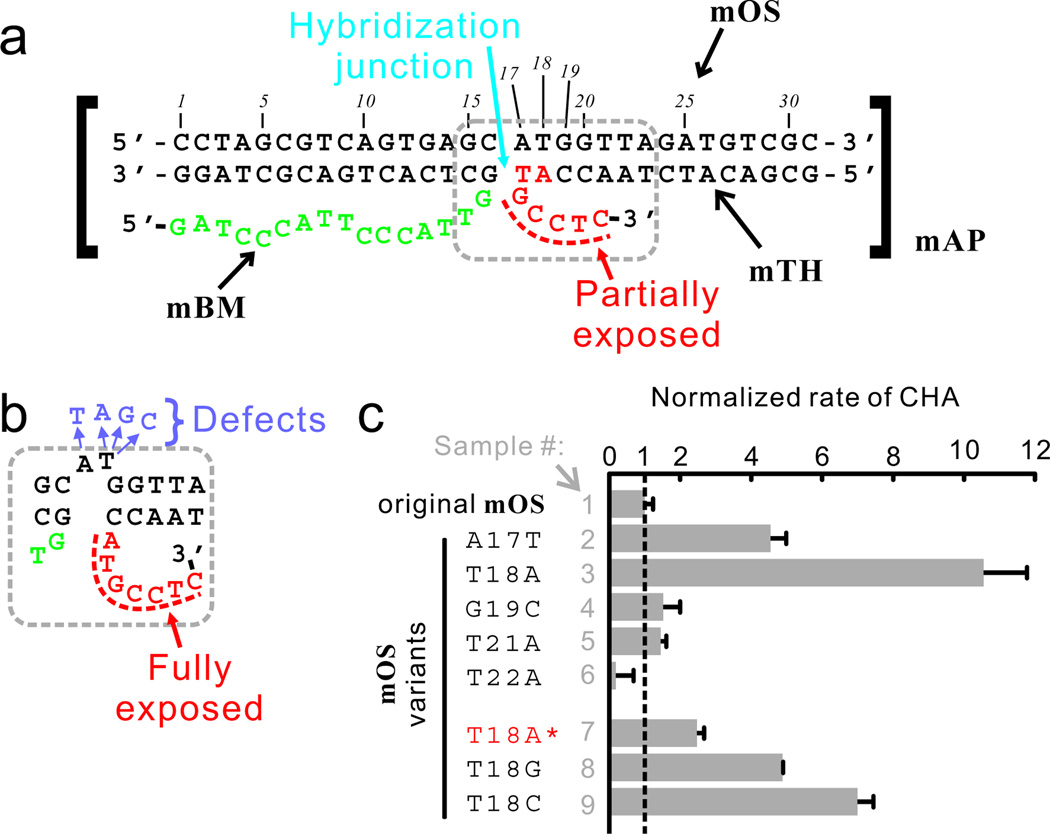
Detecting assembly defects using CHA circuits. In the perfectly formed mAP structure (a), the toehold (shown in red) is only partially exposed, whereas defects near the hybridization junction may fully expose the toehold (b). The hybridization defects can be mimicked by introducing point mutations on the mOS strand, which stimulate the activity of mAP to different extent (c). T18A* (Sample #7) denotes 1:5-diluted T18A variant of mOS.

Similar articles

Cited by

References

    1. Liu J, Cao Z, Lu Y. Chem. Rev. 2009;109:1948–1998. - PMC - PubMed
    2. Stojanovic MN, Landry DW. J. Am. Chem. Soc. 2002;124:9678–9679. - PubMed
    3. Cho EJ, Yang LT, Levy M, Ellington AD. J. Am. Chem. Soc. 2005;127:2022–2023. - PubMed
    4. Lubin AA, Plaxco KW. Accounts Chem. Res. 2010;43:496–505. - PMC - PubMed
    5. Stojanovic MN, Stefanovic D. Nat. Biotechnol. 2003;21:1069–1074. - PubMed
    6. Zhang L, Zhu J, Li T, Wang E. Anal. Chem. 2011;83:8871–8876. - PubMed
    1. Seeman NC. Nano. Lett. 2010;10:1971–1978. - PMC - PubMed
    2. Wilner OI, Willner I. Chem. Rev. 2012;112:2528–2556. - PubMed
    3. Torring T, Voigt NV, Nangreave J, Yan H, Gothelf KV. Chem. Soc. Rev. 2011;40:5636–5646. - PMC - PubMed
    4. Mao CD, LaBean TH, Reif JH, Seeman NC. Nature. 2000;407:493–496. - PubMed
    1. Dirks RM, Pierce NA. Proc. Natl. Acad. Sci. USA. 2004;101:15275–15278. - PMC - PubMed
    2. Qian L, Winfree E, Bruck J. Nature. 2011;475:368–372. - PubMed
    3. Zhang DY. Science. 2007;318:1121–1125. - PubMed
    4. Yin P, Choi HMT, Calvert CR, Pierce NA. Nature. 2008;451:318–322. - PubMed
    5. Liu QH, Wang LM, Frutos AG, Condon AE, Corn RM, Smith LM. Nature. 2000;403:175–179. - PubMed
    1. Seeman NC, Lukeman PS. Rep. Prog. Phys. 2005;68:237–270. - PMC - PubMed
    1. Li B, Ellington AD, Chen X. Nucleic Acids Res. 2011;39:e110. - PMC - PubMed
    2. Choi HMT, Chang JY, Trinh LA, Padilla JE, Fraser SE, Pierce NA. Nat. Biotechnol. 2010;28:1208–1212. - PMC - PubMed

Publication types

MeSH terms