


Chronic pain as a manifestation of potassium channel-complex autoimmunity
- PMID: 22895588
- PMCID: PMC3525306
- DOI: 10.1212/WNL.0b013e3182698cab
Chronic pain as a manifestation of potassium channel-complex autoimmunity
Abstract
Objective: Autoantibodies targeting voltage-gated potassium channel (VGKC) complexes cause a spectrum of neuronal hyperexcitability disorders. We investigated pain as a manifestation of VGKC-complex autoimmunity.
Methods: We reviewed the prevalence and characteristics of pain in VGKC-complex-immunoglobulin G (IgG)-seropositive patients in 25 months of comprehensive service testing for neural autoantibodies, subtyped positive sera for LGI1-IgG and CASPR2-IgG specificities, and reviewed pain prevalence in autoimmune control patients.
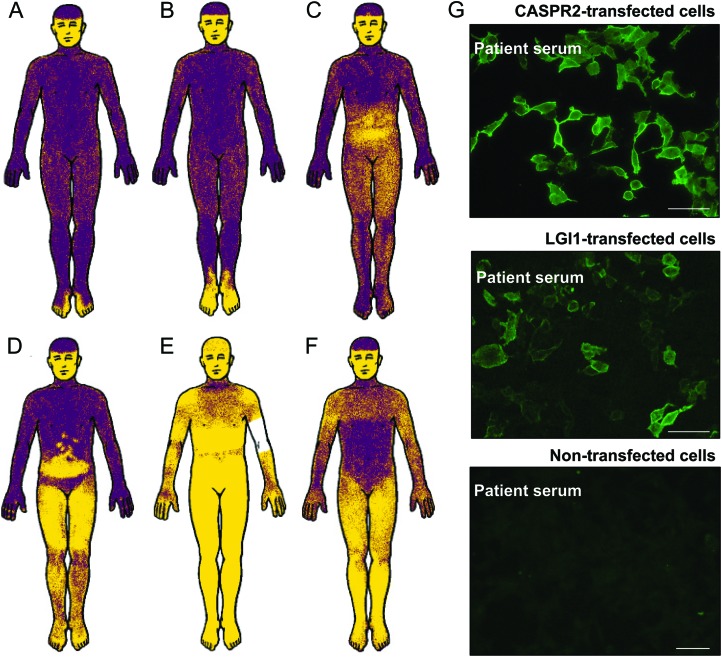
Results: VGKC-complex-IgG was identified in 1,992 patients of 54,853 tested (4%). Of 316 evaluated neurologically at Mayo Clinic, 159 (50%) had pain, in isolation (28%) or with accompanying neurologic manifestations (72%), and not attributable to alternative cause. Pain was subacute in onset, chronic in course, neuropathic, nociceptive, regional, or diffuse and sometimes attributed to fibromyalgia (6%) or psychogenic cause (13%). Most patients had normal peripheral nervous system function, measured by neuropathy impairment scores and nerve conduction. Evidence of neuronal hyperexcitability (hyperhidrosis, quantitative heat-pain hyperalgesia, or electromyographic excitability) was 25-fold more common in pain patients. Pain management required multiple medications in 70% (narcotics, 30%); 13 of 16 patients reported pain relief with immunotherapy. Pain was significantly associated with CASPR2-IgG-positivity (16% positive with pain, 7% without pain; p = 0.014) but not with LGI1-IgG. Less than 10% of 167 patients with neural autoantibodies other than VGKC-complex-IgG reported pain.
Conclusions: Chronic idiopathic pain is a syndromic manifestation of VGKC-complex autoimmunity. Hyperexcitability of nociceptive pathways is implicated. CASPR2-IgG significantly associates with pain, but in most patients the antigenic VGKC-complex molecule remains to be determined. VGKC-complex autoimmunity represents an important new direction for pain research and therapy.
Figures
Comment in
-
Autoimmune pain: an emerging concept.Neurology. 2012 Sep 11;79(11):1080-1. doi: 10.1212/WNL.0b013e3182698dc3. Epub 2012 Aug 15. Neurology. 2012. PMID: 22895596 No abstract available.
References
-
- Faber CG, Hoeijmakers JG, Ahn HS, et al. Gain of function Na(V) 1.7 mutations in idiopathic small fiber neuropathy. Ann Neurol 2012;71:26–39 - PubMed
-
- Emery EC, Young GT, Berrocoso EM, Chen L, McNaughton PA. HCN2 ion channels play a central role in inflammatory and neuropathic pain. Science 2011;333:1462–1466 - PubMed
-
- Ocana M, Cendan CM, Cobos EJ, Entrena JM, Baeyens JM. Potassium channels and pain: present realities and future opportunities. Eur J Pharmacol 2004;500:203–219 - PubMed
-
- Shillito P, Molenaar PC, Vincent A, et al. Acquired neuromyotonia: evidence for autoantibodies directed against K+ channels of peripheral nerves. Ann Neurol 1995;38:714–722 - PubMed
Publication types
MeSH terms
Substances
Grants and funding
LinkOut - more resources
Full Text Sources
Other Literature Sources
Medical
