. 2012 Aug 15;32(33):11486-94.
doi: 10.1523/JNEUROSCI.6074-11.2012.

Alteration in neonatal nutrition causes perturbations in hypothalamic neural circuits controlling reproductive function

Affiliations

Alteration in neonatal nutrition causes perturbations in hypothalamic neural circuits controlling reproductive function

Emilie Caron et al. J Neurosci. .

Abstract

It is increasingly accepted that alterations of the early life environment may have lasting impacts on physiological functions. In particular, epidemiological and animal studies have indicated that changes in growth and nutrition during childhood and adolescence can impair reproductive function. However, the precise biological mechanisms that underlie these programming effects of neonatal nutrition on reproduction are still poorly understood. Here, we used a mouse model of divergent litter size to investigate the effects of early postnatal overnutrition and undernutrition on the maturation of hypothalamic circuits involved in reproductive function. Neonatally undernourished females display attenuated postnatal growth associated with delayed puberty and defective development of axonal projections from the arcuate nucleus to the preoptic region. These alterations persist into adulthood and specifically affect the organization of neural projections containing kisspeptin, a key neuropeptide involved in pubertal activation and fertility. Neonatal overfeeding also perturbs the development of neural projections from the arcuate nucleus to the preoptic region, but it does not result in alterations in kisspeptin projections. These studies indicate that alterations in the early nutritional environment cause lasting and deleterious effects on the organization of neural circuits involved in the control of reproduction, and that these changes are associated with lifelong functional perturbations.


Figures
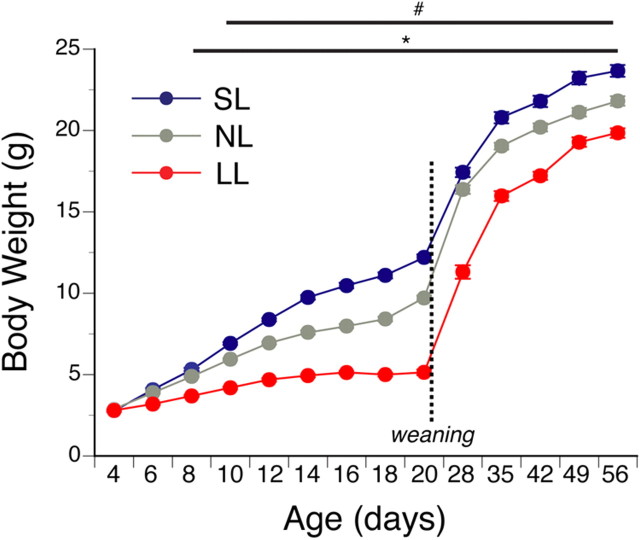
Figure 1.
Figure 1.
Body weight curves in postnatally overfed and underfed mice. Preweaning and postweaning body weight curves in FVB females raised in SL, NL, and LL (n ≥ 26 from at least 4 litters). Animals were allowed access to chow and water ad libitum after weaning. #p < 0.05, SL versus NL; *p < 0.05, SL and NL versus LL.
Figure 2.
Figure 2.
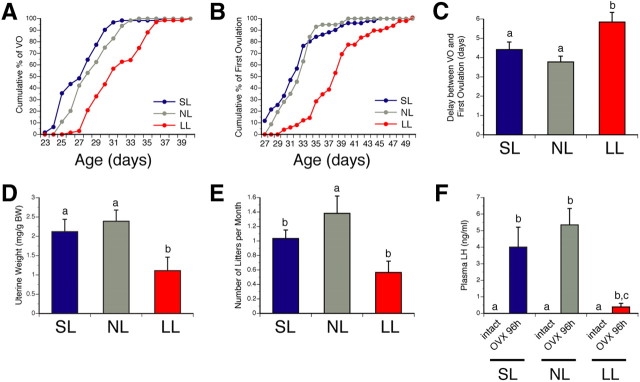
Onset of puberty and adult fertility in postnatally overfed and underfed mice. A, Cumulative percentage data for VO in females raised in SL, NL, and LL. B, Cumulative percentage data for first estrus in females raised in SL, NL, and LL. C, Interval between VO and first estrus in females raised in SL, NL, and LL. D, Mean uterine weight (mg/g BW) in P24 females raised in SL, NL, and LL. E, Mean number of litters per month (used as a fertility index) in females raised in SL, NL, and LL. F, Mean levels of LH at 96 h after OVX in P24 female mice raised in SL, NL, and LL. p < 0.05, a vs b, b vs c; n ≥ 4 from at least 4 litters.
Figure 3.
Figure 3.
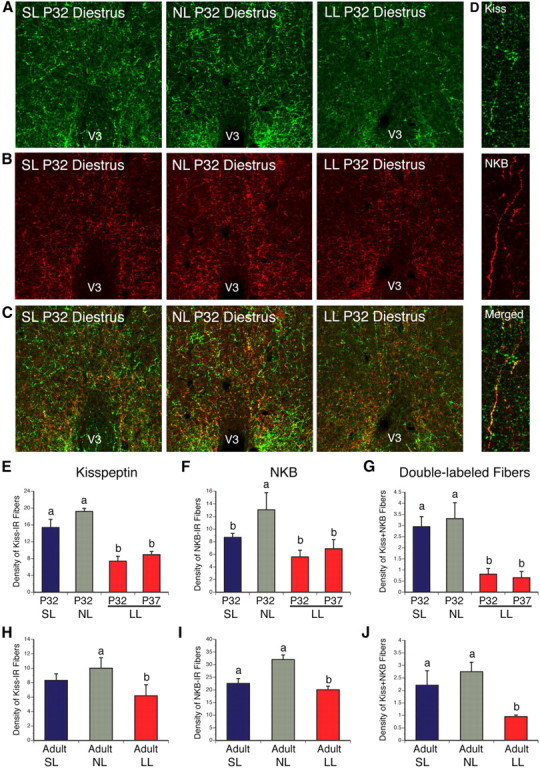
Kisspeptin fibers in postnatally overfed and underfed mice. A–C, Confocal images illustrating kisspeptin- (A), NKB- (B), and kisspeptin+NKB- (C) immunoreactivity in the MEPO of P32 diestrous females raised in SL, NL, and LL. D, Higher magnification images showing colocalization (yellow) of kisspeptin (green) NKB immunoreactivities in nerve fibers (red). E–J, Quantification of kisspeptin- (E, H), NKB- (F, I), and kisspeptin+NKB- (G, J) immunoreactive fibers in the MEPO of P32 (E–G) and adult (H–J) diestrous females raised in SL, NL, and LL as well as in P37 diestrous females raised in LL (E–G). V3, Third ventricle. p < 0.05, a vs b; n = 4–6 from 4 litters.
Figure 4.
Figure 4.
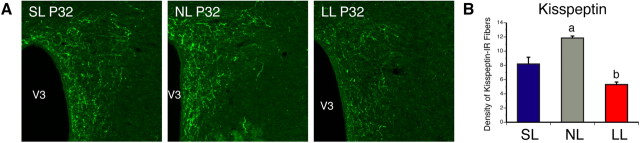
Density of kisspeptin-IR fibers in the PVH of postnatally overfed and underfed mice. A, B, Confocal images (A) and quantification (B) of kisspeptin-immunoreactive fibers in the PVH of P32 diestrous females that were raised in SL, NL, and LL. V3, Third ventricle. p < 0.05, a vs b; n = 4–6 from 4 litters.
Figure 5.
Figure 5.
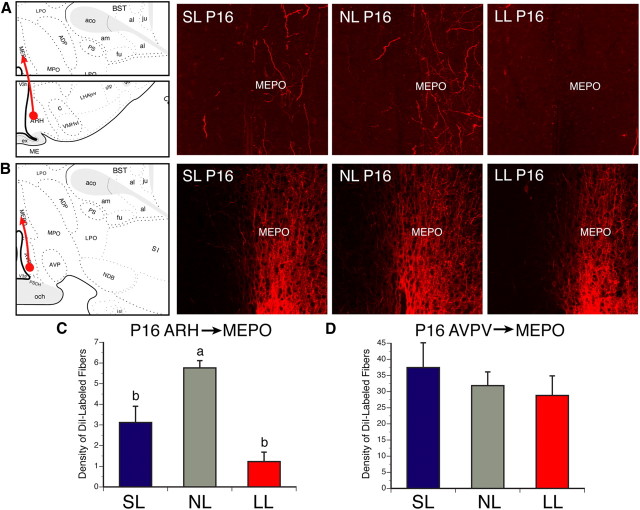
A–D, ARH→MEPO and AVPV→MEPO axonal projections in postnatally overfed and underfed mice. Confocal images and quantification of ARH (A, C) and AVPV (B, D) fibers labeled with the anterograde tracer DiI and innervating the MEPO of P16 mice raised in SL, NL, and LL. V3, Third ventricle. p < 0.05, a vs b; n = 4–6 from 4 litters.
Figure 6.
Figure 6.
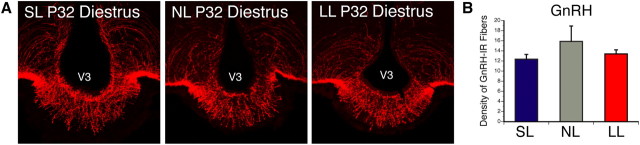
GnRH fibers in postnatally overfed and underfed mice. A, B, Confocal images (A) and quantification (B) of GnRH-immunoreactive fibers in the median eminence of P32 diestrous female mice raised in SL, NL, and LL. V3, Third ventricle. p < 0.05, a vs b; n = 4–6 from 4 litters.

References

    1. Ahima RS. Body fat, leptin, and hypothalamic amenorrhea. N Engl J Med. 2004;351:959–962. - PubMed
    1. Ahima RS, Flier JS. Leptin. Annu Rev Physiol. 2000;62:413–437. - PubMed
    1. Ahima RS, Dushay J, Flier SN, Prabakaran D, Flier JS. Leptin accelerates the onset of puberty in normal female mice. J Clin Invest. 1997;99:391–395. - PMC - PubMed
    1. Biro FM, Khoury P, Morrison JA. Influence of obesity on timing of puberty. Int J Androl. 2006;29:272–277. - PubMed
    1. Bouret SG, Draper SJ, Simerly RB. Formation of projection pathways from the arcuate nucleus of the hypothalamus to hypothalamic regions implicated in the neural control of feeding behavior in mice. J Neurosci. 2004a;24:2797–2805. - PMC - PubMed

Publication types

MeSH terms

LinkOut - more resources