


Equivalent weight loss with marked metabolic benefit observed in a matched cohort with and without type 2 diabetes 12 months following gastric bypass surgery
- PMID: 22895804
- PMCID: PMC4023564
- DOI: 10.1007/s11695-012-0719-8
Equivalent weight loss with marked metabolic benefit observed in a matched cohort with and without type 2 diabetes 12 months following gastric bypass surgery
Abstract
Background: Bariatric surgery results in dramatic weight loss and improves metabolic syndrome and type 2 diabetes (T2DM). However, previous studies have noted that morbidly obese patients with T2DM experience less weight loss benefits than non-diabetic patients following bariatric surgery. We sought to determine longitudinal effects of laparoscopic Roux-en-Y gastric bypass (LRYGB) on percent excess body mass index (BMI) loss (%EBMIL) and clinical metabolic syndrome parameters in patients with T2DM compared with appropriately matched cohort without T2DM.
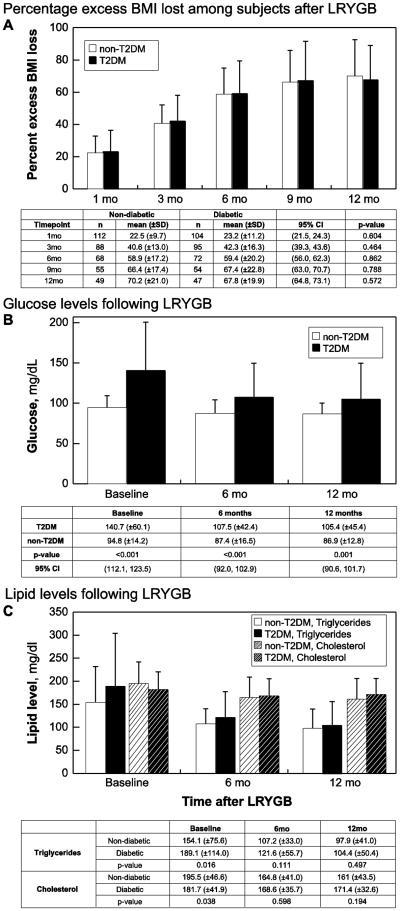
Methods: Retrospective cohort analysis of T2DM patients (n = 126) to non-T2DM patients (n = 126) matched on age (M = 48.1 ± 9.5), sex (81 % female), race (81 % Caucasian), and pre-surgical BMI (M = 49.3 ± 9.5). Lipids, glucose, hemoglobin A1c, blood pressure, co-morbidities of obesity, medications for co-morbidities, and T2DM medications were collected at baseline, 6 months and 12 months post-surgery. %EBMIL was collected at 1, 3, 6, 9, and 12 months post-surgery. One-way analyses of variance with effect sizes estimates were conducted to compare the two groups.
Results: As expected, T2DM subjects had significantly greater pre-surgical HbA1c, blood glucose, blood pressure, and lipid parameters at baseline vs. non-T2DM (all p values of<0.05). At 1, 3, 6, 9, and 12 months after LRYRB, both groups had similar reduction in %EBMIL (p > 0.10). At 6 months, there was a significant reduction in HbA1c, blood glucose, and lipid in the T2DM cohort compared with pre-surgical levels (p < 0.0001). At 12 months, these values were not different to that of the non-T2DM subjects (p > 0.10).
Conclusions: When matched on appropriate factors associated with weight loss outcomes, severely obese patients with T2DM have similar post-LRYGB weight loss outcomes in the first 12 months following surgery compared with non-T2DM patients. Furthermore, T2DM surgical patients achieved significant improvement in metabolic syndrome components.
Conflict of interest statement
Figures
References
-
- U.K. prospective diabetes study 16. Overview of 6 years' therapy of type II diabetes: a progressive disease. U.K. Prospective Diabetes Study Group. Diabetes. 1995;44:1249–58. - PubMed
-
- Cook MN, Girman CJ, Stein PP, et al. Glycemic control continues to deteriorate after sulfonylureas are added to metformin among patients with type 2 diabetes. Diabetes Care. 2005;28:995–1000. - PubMed
-
- Kahn SE, Haffner SM, Heise MA, et al. Glycemic durability of rosiglitazone, metformin, or glyburide monotherapy. N Engl J Med. 2006;355:2427–43. - PubMed
-
- Koro CE, Bowlin SJ, Bourgeois N, et al. Glycemic control from 1988 to 2000 among U.S. adults diagnosed with type 2 diabetes: a preliminary report. Diabetes Care. 2004;27:17–20. - PubMed
Publication types
MeSH terms
Substances
Grants and funding
LinkOut - more resources
Full Text Sources
Medical
Research Materials
