Factors affecting the processing of intensity in school-aged children
- PMID: 22896044
- PMCID: PMC3911822
- DOI: 10.1044/1092-4388(2012/12-0008)
Factors affecting the processing of intensity in school-aged children
Abstract
Purpose: Thresholds of school-aged children are elevated relative to those of adults for intensity discrimination and amplitude modulation (AM) detection. It is unclear how these findings are related or what role stimulus gating and dynamic envelope cues play in these results. Two experiments assessed the development of sensitivity to intensity increments in different stimulus contexts.
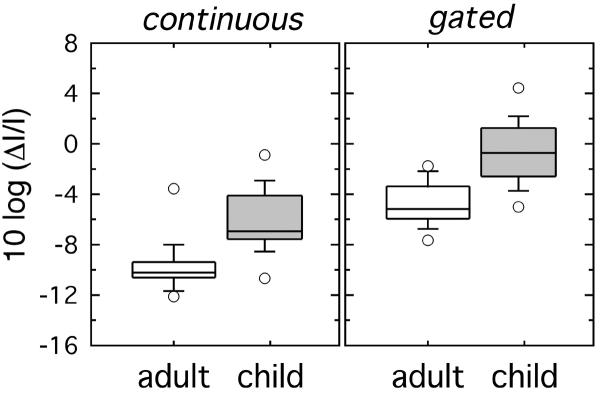
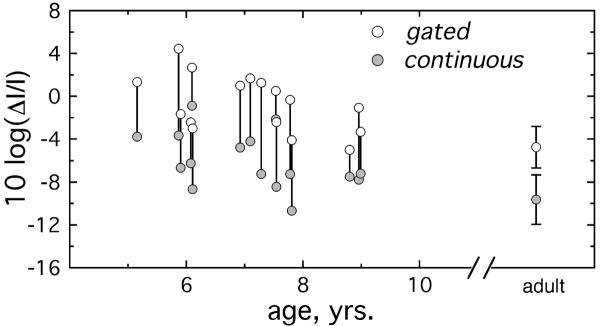
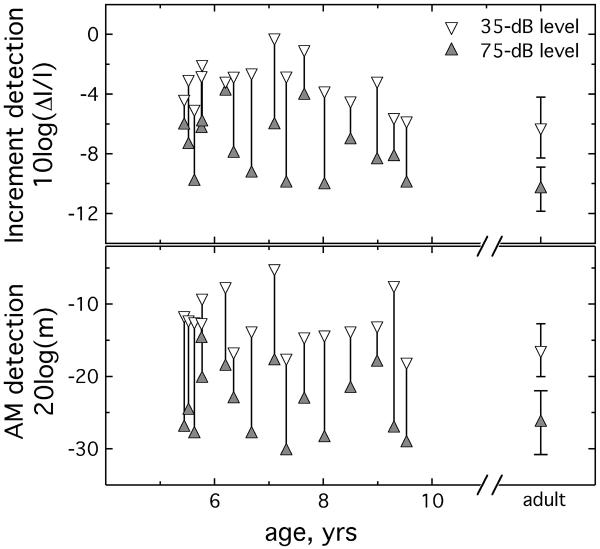
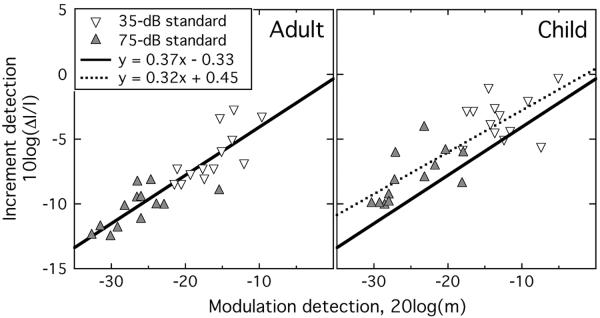
Method: Thresholds for detecting an increment in level were estimated for normal-hearing children (5- to 10-year-olds) and adults. Experiment 1 compared intensity discrimination for gated and continuous presentation of a 1-kHz tone, with a 65-dB-SPL standard level. Experiment 2 compared increment detection and 16-Hz AM detection introduced into a continuous 1-kHz tone, with either 35- or 75-dB-SPL standard levels.
Results: Children had higher thresholds than adults overall. All listeners were more sensitive to increments in the continuous than the gated stimulus and performed better at the 75- than at the 35-dB-SPL standard level. Both effects were comparable for children and adults. There was some evidence that children's AM detection was more adultlike than increment detection.
Conclusion: These results imply that memory for loudness across gated intervals is not responsible for children's poor performance but that multiple dynamic envelope cues may benefit children more than adults.
Figures
References
-
- ANSI . ANSI S3.6-2010, American National Standard Specification for Audiometers. American National Standards Institute; New York: 2010.
-
- Baruch C, Botte MC, Scharf B. Loudness adaptation in children. Audiol. 1993;32(1):36–48. - PubMed
-
- Berg KM, Boswell AE. Noise increment detection in children 1 to 3 years of age. Percept Psychophys. 2000;62(4):868–873. - PubMed
-
- Berliner JE, Durlach NI. Intensity perception. IV. Resolution in roving-level discrimination. J Acoust Soc Am. 1973;53(5):1270–1287. - PubMed
Publication types
MeSH terms
Grants and funding
LinkOut - more resources
Full Text Sources
Other Literature Sources
Medical
Miscellaneous