


Indirect commensalism promotes persistence of secondary consumer species
- PMID: 22896268
- PMCID: PMC3497121
- DOI: 10.1098/rsbl.2012.0572
Indirect commensalism promotes persistence of secondary consumer species
Abstract
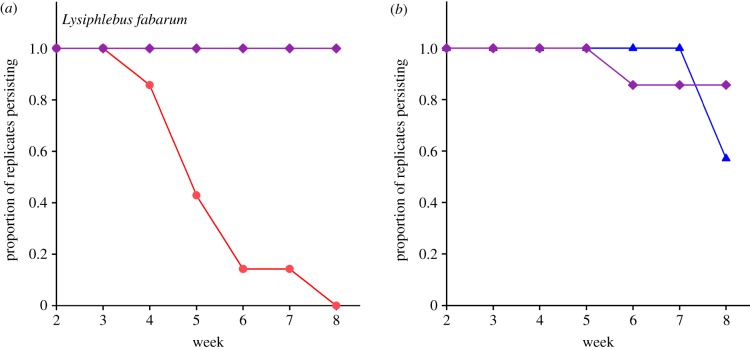
Local species extinctions may lead to, often unexpected, secondary extinctions. To predict these, we need to understand how indirect effects, within a network of interacting species, affect the ability of species to persist. It has been hypothesized that the persistence of some predators depends on other predator species that suppress competitively dominant prey to low levels, allowing a greater diversity of prey species, and their predators, to coexist. We show that, in experimental insect communities, the absence of one parasitoid wasp species does indeed lead to the extinction of another that is separated by four trophic links. These results highlight the importance of a holistic systems perspective to biodiversity conservation and the necessity to include indirect population dynamic effects in models for predicting cascading extinctions in networks of interacting species.
Figures

References
-
- Borrvall C., Ebenman B. 2006. Early onset of secondary extinctions in ecological communities following the loss of top predators. Ecol. Lett. 9, 435–442 10.1111/j.1461-0248.2006.00893.x (doi:10.1111/j.1461-0248.2006.00893.x) - DOI - PubMed
-
- Borrvall C., Ebenman B., Jonsson T. 2000. Biodiversity lessens the risk of cascading extinction in model food webs. Ecol. Lett. 3, 131–136 10.1046/j.1461-0248.2000.00130.x (doi:10.1046/j.1461-0248.2000.00130.x) - DOI
-
- Montoya J. M., Pimm S. L., Sole R. V. 2006. Ecological networks and their fragility. Nature 442, 259–264 10.1038/nature04927 (doi:10.1038/nature04927) - DOI - PubMed
-
- Paine R. T. 1966. Food web complexity and species diversity. Am. Nat. 100, 65–75 10.1086/282400 (doi:10.1086/282400) - DOI
-
- Ives A. R., Cardinale B. J. 2004. Food-web interactions govern the resistance of communities after non-random extinctions. Nature 429, 174–177 10.1038/nature02515 (doi:10.1038/nature02515) - DOI - PubMed
Publication types
MeSH terms
LinkOut - more resources
Full Text Sources
