


Comparative Study
doi: 10.1098/rsbl.2012.0519.
Epub 2012 Aug 15.
Theft in an ultimatum game: chimpanzees and bonobos are insensitive to unfairness
Affiliations
- PMID: 22896269
- PMCID: PMC3497113
- DOI: 10.1098/rsbl.2012.0519
Item in Clipboard
Comparative Study
Theft in an ultimatum game: chimpanzees and bonobos are insensitive to unfairness
Biol Lett.
.
Abstract
Humans, but not chimpanzees, punish unfair offers in ultimatum games, suggesting that fairness concerns evolved sometime after the split between the lineages that gave rise to Homo and Pan. However, nothing is known about fairness concerns in the other Pan species, bonobos. Furthermore, apes do not typically offer food to others, but they do react against theft. We presented a novel game, the ultimatum theft game, to both of our closest living relatives. Bonobos and chimpanzee 'proposers' consistently stole food from the responders' portions, but the responders did not reject any non-zero offer. These results support the interpretation that the human sense of fairness is a derived trait.
Figures
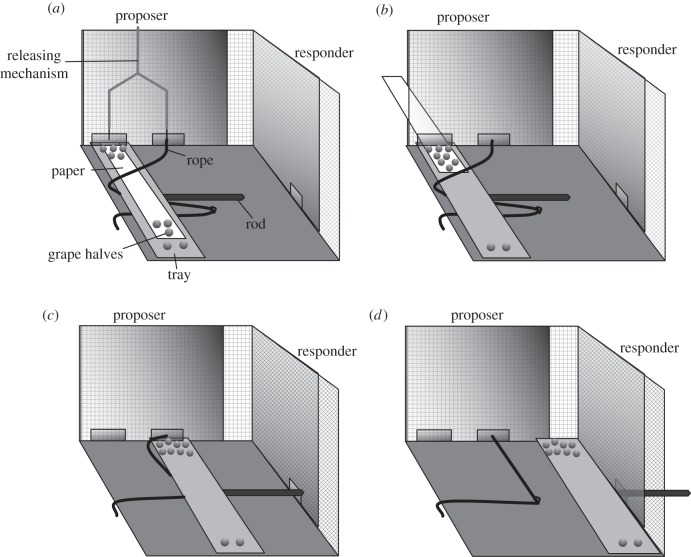
Illustration of the testing procedure using the 5/3;2 game as an example. (a) A paper strip and 10 grape halves are placed on a sliding tray by the experimenter. (b) Pulling the paper results in three of the grape halves that would have gone to the responder being added to the proposer's portion. (c) The proposer pulls the rope (which can be done without pulling the paper), bringing the rod within the responder's reach. (d) The responder can pull the rod, making the food accessible to both subjects. Failure to pull the rod within 1 min results in all the food being removed by the experimenter.
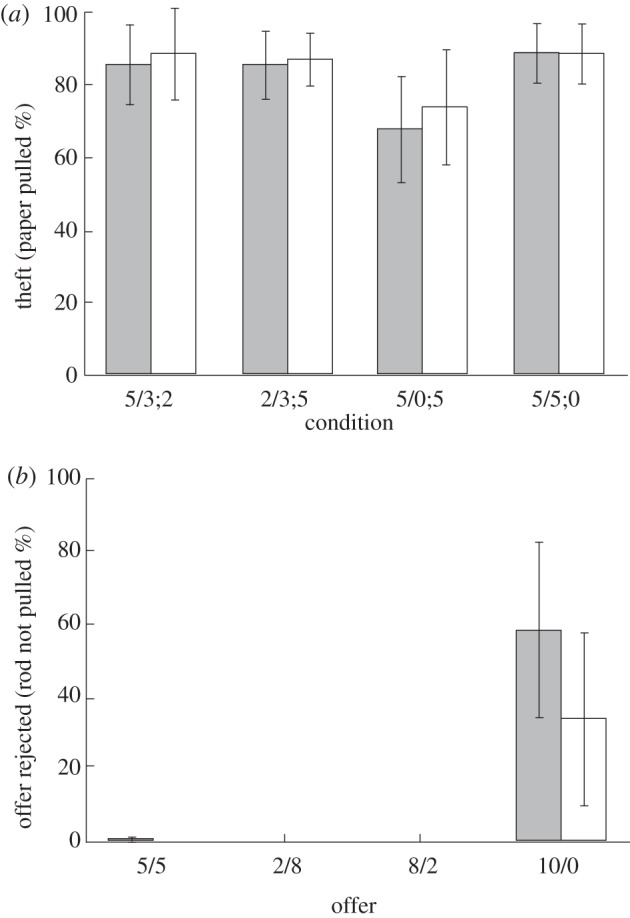
Mean percentage of trials (± 95% CI) in which (a) proposers pulled the paper in the four conditions (games) of the test (grey bars) and the non-social control (white bars) conditions and (b) responders rejected offers by failing to pull the rod for the different possible outcomes in the test and non-social control.
References
-
- Fehr E., Fischbacher U. 2003. The nature of human altruism. Nature 425, 785–791 10.1038/nature02043 (doi:10.1038/nature02043) - DOI - PubMed
-
- Brosnan S. F., de Waal F. B. M. 2003. Monkeys reject unequal pay. Nature 425, 297–299 10.1038/nature01963 (doi:10.1038/nature01963) - DOI - PubMed
-
- Brosnan S. F., Schiff H. C., de Waal F. B. M. 2005. Tolerance for inequity may increase with social closeness in chimpanzees. Proc. R. Soc. B 272, 253–258 10.1098/rspb.2004.2947 (doi:10.1098/rspb.2004.2947) - DOI - PMC - PubMed
-
- Bräuer J., Call J., Tomasello M. 2006. Are apes really inequity averse? Proc. R. Soc. B 273, 3123–3128 10.1098/rspb.2006.3693 (doi:10.1098/rspb.2006.3693) - DOI - PMC - PubMed
-
- Bräuer J., Call J., Tomasello M. 2009. Are apes inequity averse? New data on the token-exchange paradigm. Am. J. Primatol. 71, 175–181 10.1002/ajp.20639 (doi:10.1002/ajp.20639) - DOI - PubMed
Publication types
MeSH terms
LinkOut - more resources
Full Text Sources
