


Diversification rates and the latitudinal gradient of diversity in mammals
- PMID: 22896648
- PMCID: PMC3441078
- DOI: 10.1098/rspb.2012.1393
Diversification rates and the latitudinal gradient of diversity in mammals
Abstract
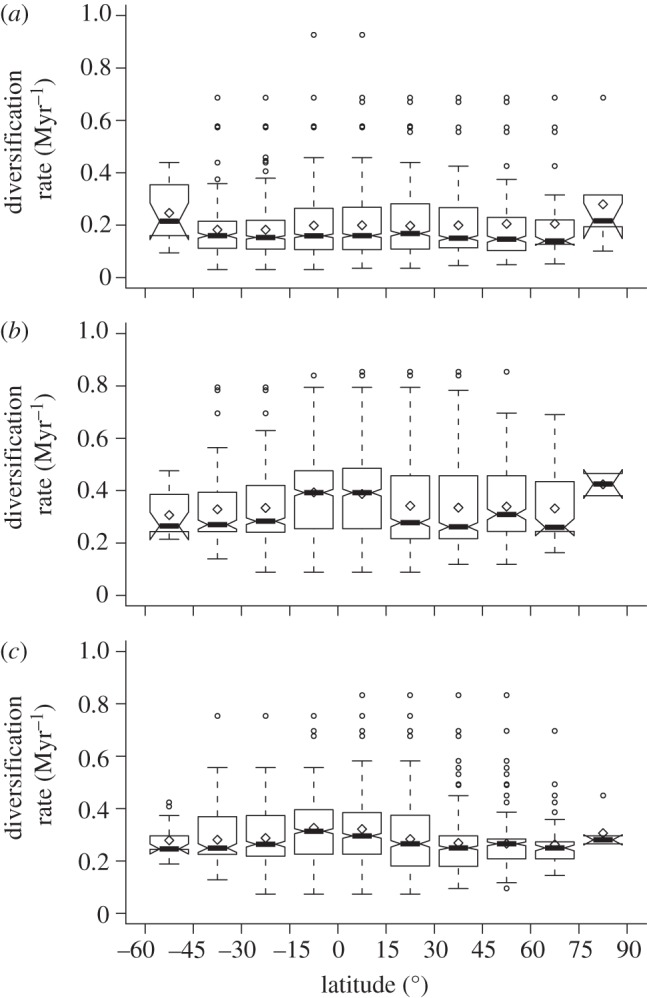
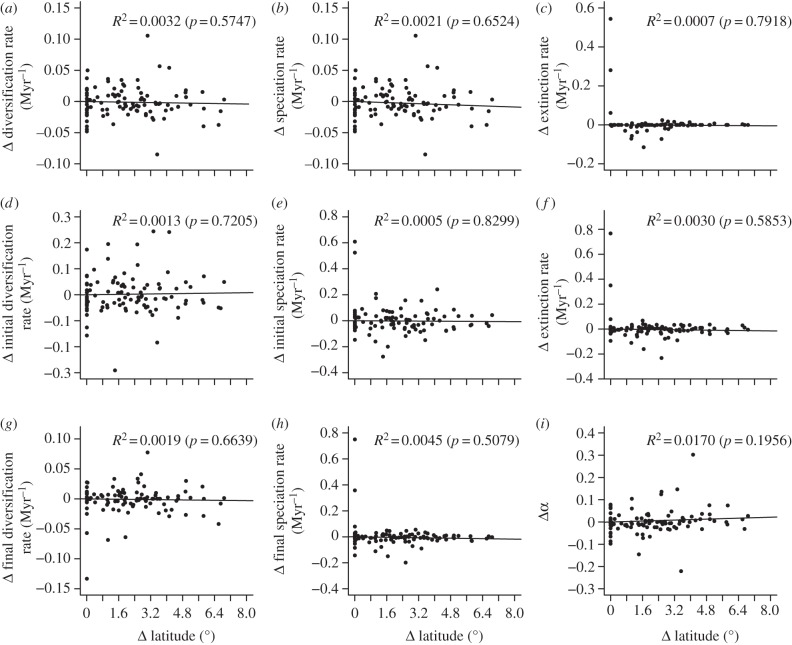
The latitudinal gradient of species richness has frequently been attributed to higher diversification rates of tropical groups. In order to test this hypothesis for mammals, we used a set of 232 genera taken from a mammalian supertree and, additionally, we reconstructed dated Bayesian phylogenetic trees of 100 genera. For each genus, diversification rate was estimated taking incomplete species sampling into account and latitude was assigned considering the heterogeneity in species distribution ranges. For both datasets, we found that the average diversification rate was similar among all latitudinal bands. Furthermore, when we used phylogenetically independent contrasts, we did not find any significant correlation between latitude and diversification parameters, including different estimates of speciation and extinction rates. Thus, other factors, such as the dynamics of dispersal through time, may be required to explain the latitudinal gradient of diversity in mammals.
Figures
References
-
- Gotelli N. J., et al. 2009. Patterns and causes of species richness: a general simulation model for macroecology. Ecol. Lett. 12, 873–88610.1111/j.1461-0248.2009.01353.x (doi:10.1111/j.1461-0248.2009.01353.x) - DOI - DOI - PubMed
-
- Hawkins B. A. 2001. Ecology's oldest pattern? Endeavour 25, 133.10.1016/S0160-9327(00)01369-7 (doi:10.1016/S0160-9327(00)01369-7) - DOI - DOI - PubMed
-
- Willig M. R., Kaufman D. M., Stevens R. D. 2003. Latitudinal gradients of biodiversity: pattern, process, scale, and synthesis. Annu. Rev. Ecol. Evol. Syst. 34, 273–30910.1146/annurev.ecolsys.34.012103.144032 (doi:10.1146/annurev.ecolsys.34.012103.144032) - DOI - DOI
-
- Pianka E. R. 1966. Latitudinal gradients in species diversity: a review of concepts. Am. Nat. 100, 33–4610.1086/282398 (doi:10.1086/282398) - DOI - DOI
-
- Rohde K. 1992. Latitudinal gradients in species diversity: the search for the primary cause. Oikos 65, 514–52710.2307/3545569 (doi:10.2307/3545569) - DOI - DOI
Publication types
MeSH terms
LinkOut - more resources
Full Text Sources
Other Literature Sources
