Review
. 2012 Aug 15;3(8):585-92.
doi: 10.1021/cn300041b. Epub 2012 Jun 6.

Genetically engineered fluorescent voltage reporters

Affiliations
Review

Genetically engineered fluorescent voltage reporters

Hiroki Mutoh et al. ACS Chem Neurosci. .

Abstract

Fluorescent membrane voltage indicators that enable optical imaging of neuronal circuit operations in the living mammalian brain are powerful tools for biology and particularly neuroscience. Classical voltage-sensitive dyes, typically low molecular-weight organic compounds, have been in widespread use for decades but are limited by issues related to optical noise, the lack of generally applicable procedures that enable staining of specific cell populations, and difficulties in performing imaging experiments over days and weeks. Genetically encoded voltage indicators (GEVIs) represent a newer alternative that overcomes several of the limitations inherent to classical voltage-sensitive dyes. We critically review the fundamental concepts of this approach, the variety of available probes and their state of development.


Figures

Figure 1
Figure 1
Designs for voltage-sensor domain-based voltage indicators: (a) Upper panel, schematic of FRET-based voltage-sensitive probes of the VSFP2 family. The voltage-sensor domain, consisting of four segments (S1–S4) crossing the plasma membrane (PM), is fused to a pair of fluorescent proteins (FP, D FRET donor; FP, A FRET acceptor). A change in membrane potential induces a rearrangement of the two fluorescent proteins that is optically reported as a change in the ratio between donor and acceptor fluorescence. Lower panels, example recording from cultured hippocampal cells showing spontaneous action potential firing. The three sweeps of optical recordings shown in black, red, and blue color correspond to the superimposed microelectrode recording traces of same color. (b) Single fluorescent protein probes of the VSFP3 family. (c) VSFPs incorporating a circularly permuted fluorescent protein. (d) FRET-based voltage sensitive probe of the VSFP-Butterfly family, where the voltage-sensor domain is sandwiched between two fluorescent proteins.
Figure 2
Figure 2
Cartoon of microbial rhodopsin-based voltage indicator Arch. A change in membrane potential induces increased fluorescence of the retinal molecule.
Figure 3
Figure 3
Evaluation of in vivo fluorescence output generated by Arch in comparison to VSFP2.3. Mice were electroporated in utero with plasmids expressing either VSFP2.3 or EGFP-tagged-Arch (kindly provided by Dr. Ed Boyden) and at adulthood prepared for imaging under a Nikon C1si/FN1 confocal microscope in spectral mode through the thinned bone overlying the somato-sensory cortex. (a) Fluorescence images obtained with a VSFP2.3-expressing mouse (444 nm excitation); from left to right, VSFP2.3 donor (cerulean) fluorescence, acceptor (citrine) fluorescence, and bright-field view of the mouse cortex in vivo. (b) Fluorescence images obtained from a mouse expressing an Arch-EGFP construct. EGFP fluorescence was readily detected in the green channel (middle, 488 nm excitation) while the red channel (543 nm excitation, > 600 nm emission) showed only scattered excitation light and nonspecific autofluorescence. Graph shows emission spectra obtained from the same preparation over targeted cortical areas. VSFP2.3 (black) and GFP (green) spectra were obtained with excitation at 440 nm. The red-line spectrum obtained with excitation at 543 nm is shown at expanded scale in the inset. Note that the spectrum lacks the peak expected at 687 nm for the Arch-based voltage indicator.
Figure 4
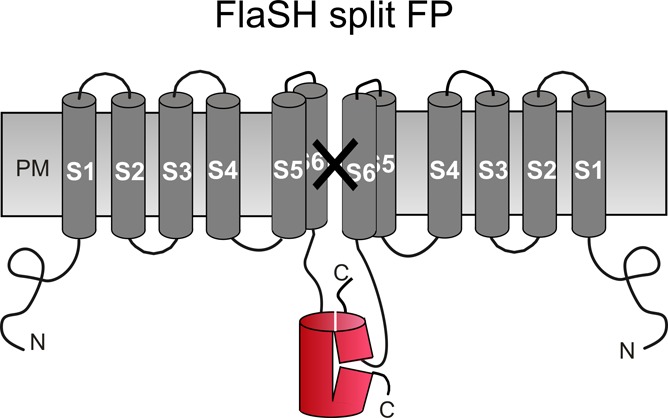
Figure 4
Schematic depiction of the most recent FlaSh-type voltage indicator. This protein incorporates fluorescent protein complementation, with subunits of the Shaker potassium channel fused to either the N- or C-terminal portion of a split fluorescent protein. Tetramerization of the Shaker subunits facilitates complementation of the two fluorescent protein portions to recover fluorescence, while misfolded subunits and monomers that do not traffic to the membrane remain uncomplemented and hence nonfluorescent. Modulation of FlaSh fluorescence is triggered by voltage-dependent rearrangement of the (nonconducting, as indicated by cross) Shaker potassium channel.
Figure 5
Figure 5
Schematic depiction of the hybrid voltage sensor hVOS. hVOS consists of a combination of a fluorescent protein (genetically encoded component) with dipicrylamine (DPA) (exogenous component). The fluorescent protein is anchored to the intracellular side of the plasma membrane by a prenylation motif. Positively charged DPA is partitioned in the membrane as a function of the membrane potential. With membrane depolarization, DPA moves within Förster distance of the fluorescent protein and quenches its fluorescence.

References

    1. Carandini M. (2012) From circuits to behavior: A bridge too far?. Nat. Neurosci. 15(4), 507–509. - PubMed
    1. London M.; Hausser M. (2005) Dendritic computation. Annu. Rev. Neurosci. 28, 503–532. - PubMed
    1. Buzsáki G.Rhythms of the brain; Oxford University Press: Oxford, U.K., 2006.
    1. Wu J. Y.; Huang X.; Zhang C. (2008) Propagating waves of activity in the neocortex: What they are, what they do. Neuroscientist 14(5), 487–502. - PMC - PubMed
    1. Buzsaki G. (2010) Neural syntax: Cell assemblies, synapsembles, and readers. Neuron 68(3), 362–385. - PMC - PubMed