


Electrically induced conformational change of peptides on metallic nanosurfaces
- PMID: 22897498
- PMCID: PMC3482133
- DOI: 10.1021/nn3027408
Electrically induced conformational change of peptides on metallic nanosurfaces
Abstract
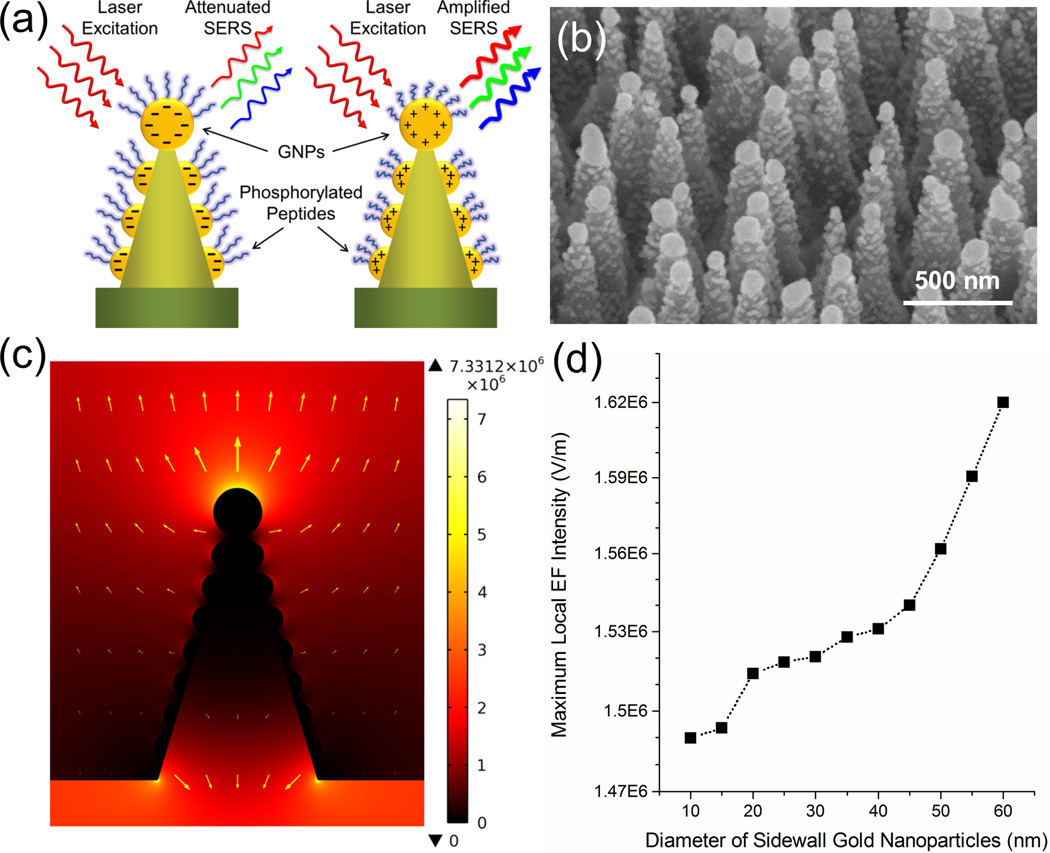
Surface immobilized biomolecular probes are used in many areas of biomedical research, such as genomics, proteomics, immunology, and pathology. Although the structural conformations of small DNA and peptide molecules in free solution are well studied both theoretically and experimentally, the conformation of small biomolecules bound on surfaces, especially under the influence of external electric fields, is poorly understood. Using a combination of molecular dynamics simulation and surface-enhanced Raman spectroscopy, we study the external electric field-induced conformational change of dodecapeptide probes tethered to a nanostructured metallic surface. Surface-tethered peptides with and without phosphorylated tyrosine residues are compared to show that peptide conformational change under electric field is sensitive to biochemical modification. Our study proposes a highly sensitive in vitro nanoscale electro-optical detection and manipulation method for biomolecule conformation and charge at bio-nano interfaces.
Figures



References
-
- Huang Z, Boulatov R. Chemomechanics: Chemical Kinetics for Multiscale Phenomena. Chem. Soc. Rev. 2011;40:2359–2384. - PubMed
-
- Tashiro R, Sugiyama H. Biomolecule-Based Switching Devices That Respond Inversely to Thermal Stimuli. J. Am. Chem. Soc. 2005;127:2094–2097. - PubMed
-
- Saha S, Stoddart JF. Photo-Driven Molecular Devices. Chem. Soc. Rev. 2007;36:77–92. - PubMed
-
- Heath JR. Molecular Electronics. Annu. Rev. Mater. Res. 2009;39:1–23.
-
- Ariga K, Mori T, Hill JP. Control of Nano/Molecular Systems by Application of Macroscopic Mechanical Stimuli. Chem. Sci. 2011;2:195–203.
Publication types
MeSH terms
Substances
Grants and funding
LinkOut - more resources
Full Text Sources
