


Reduced serum concentrations of 25-hydroxy vitamin D in children with autism: relation to autoimmunity
- PMID: 22898564
- PMCID: PMC3476426
- DOI: 10.1186/1742-2094-9-201
Reduced serum concentrations of 25-hydroxy vitamin D in children with autism: relation to autoimmunity
Abstract
Background: Aside from the skeletal health affection, vitamin D deficiency has been implicated as a potential environmental factor triggering for some autoimmune disorders. Vitamin D might play a role in the regulation of the production of auto-antibodies. Immunomodulatory effects of vitamin D may act not only through modulation of T-helper cell function, but also through induction of CD4(+)CD25(high) regulatory T-cells. We are the first to investigate the relationship between serum levels of 25-hydroxy vitamin D and anti-myelin-associated glycoprotein (anti-MAG) auto-antibodies in autistic children.
Methods: Serum levels of 25-hydroxy vitamin D and anti-MAG auto-antibodies were measured in 50 autistic children, aged between 5 and 12 years, and 30 healthy-matched children. Serum 25-hydroxy vitamin D levels 10-30 ng/mL and < 10 ng/mL were defined as vitamin D insufficiency and deficiency, respectively.
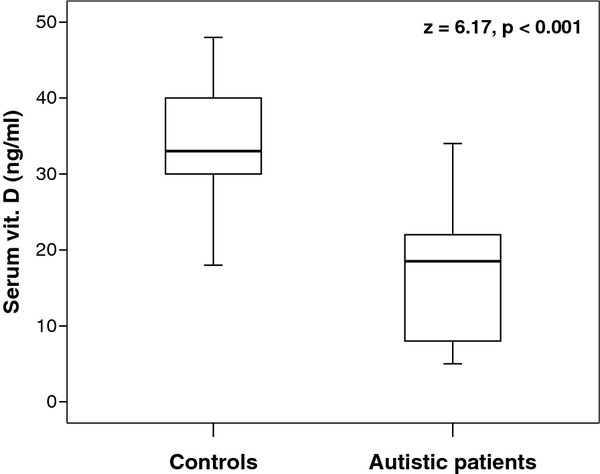
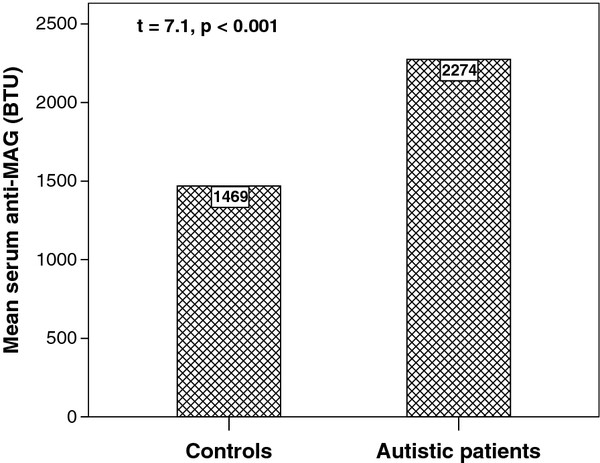
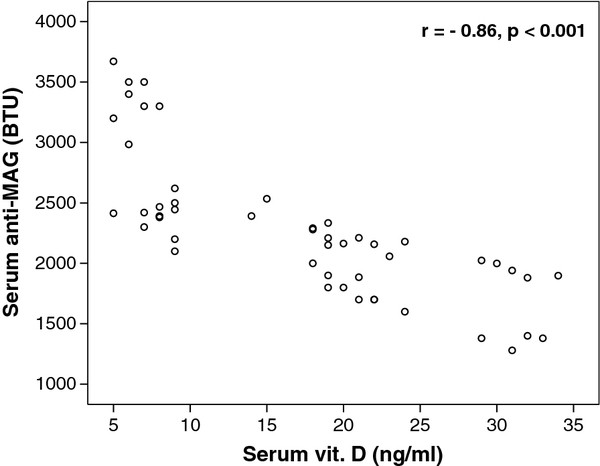
Results: Autistic children had significantly lower serum levels of 25-hydroxy vitamin D than healthy children (P < 0.001) with 40% and 48% being vitamin D deficient and insufficient, respectively. Serum 25-hydroxy vitamin D had significant negative correlations with Childhood Autism Rating Scale (P < 0.001). Increased levels of serum anti-MAG auto-antibodies were found in 70% of autistic patients. Serum 25-hydroxy vitamin D levels had significant negative correlations with serum levels of anti-MAG auto-antibodies (P < 0.001).
Conclusions: Vitamin D deficiency was found in some autistic children and this deficiency may contribute to the induction of the production of serum anti-MAG auto-antibodies in these children. However, future studies looking at a potential role of vitamin D in the pathophysiology and treatment of autism are warranted.
Figures
References
-
- Cantorna MT, Zhu Y, Froicu M, Wittke A. Vitamin D status, 1,25-dihydroxyvitamin D3, and the immune system. Am J Clin Nutr. 2004;80:1717S–1720S. - PubMed
Publication types
MeSH terms
Substances
LinkOut - more resources
Full Text Sources
Medical
Research Materials
