Review
. 2012 Nov;29(11):1277-87.
doi: 10.1039/c2np20064c.

Bioactive natural products from Lysobacter

Affiliations
Review

Bioactive natural products from Lysobacter

Yunxuan Xie et al. Nat Prod Rep. 2012 Nov.

Abstract

The gliding Gram-negative Lysobacter bacteria are emerging as a promising source of new bioactive natural products. These ubiquitous freshwater and soil microorganisms are fast growing, simple to use and maintain, and genetically amenable for biosynthetic engineering. This Highlight reviews a group of biologically active and structurally distinct natural products from the genus Lysobacter, with a focus on their biosyntheses. Although Lysobacter sp. are known as prolific producers of bioactive natural products, detailed molecular mechanistic studies of their enzymatic assembly have been surprisingly scarce. We hope to provide a snapshot of the important work done on the lysobacterial natural products and to provide useful information for future biosynthetic engineering of novel antibiotics in Lysobacter.


Figures
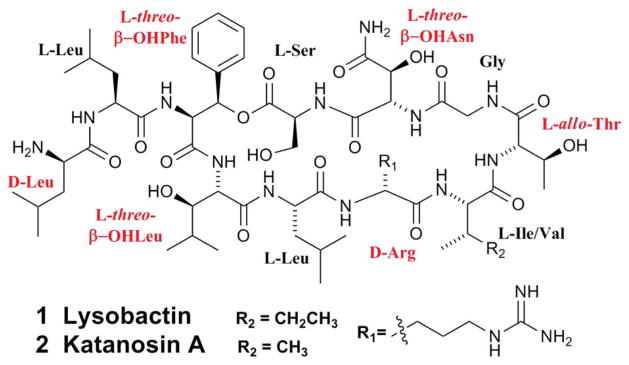
Fig. 1
Fig. 1
The structure of lysobactin (katanosin B) and katanosin A. Non-proteinogenic amino acid residues are highlighted.
Fig. 2
Fig. 2
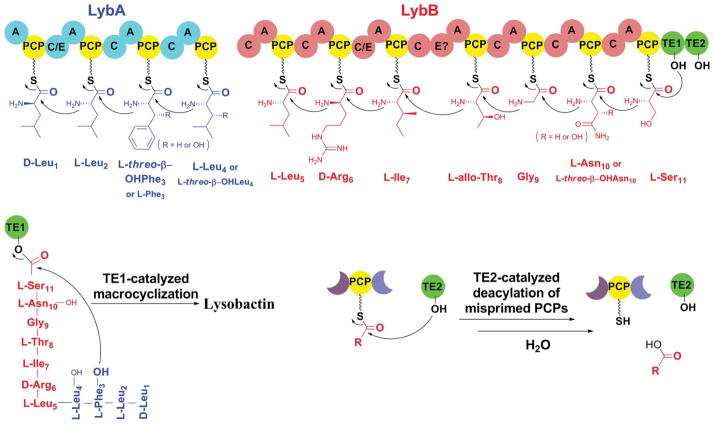
The biosynthetic assembly of lysobactin. A, adenylation domain; C, condensation domain; E, epimerase domain; C/E, dual function (condensation/epimerase) domain, PCP, peptidyl carrier protein; TE, thioesterase domain. The function of the two unusual tandem thioesterases (TE I and II) is also included.
Fig. 3
Fig. 3
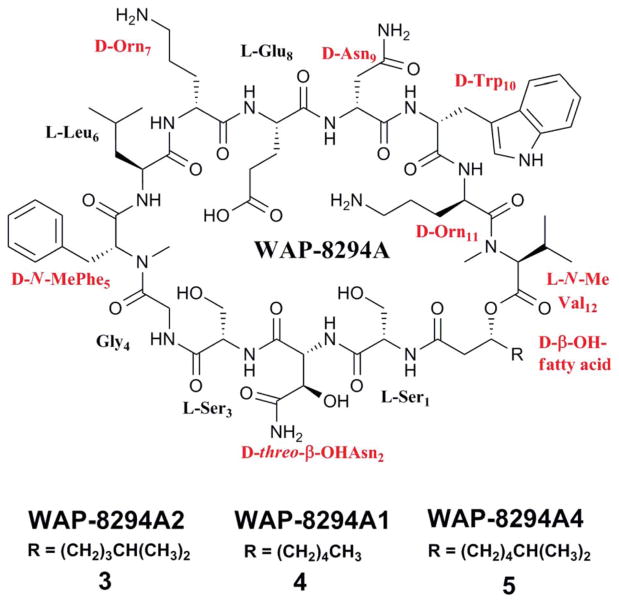
The structure of three members of the WAP-8294A family. Non-proteinogenic amino acid residues are highlighted.
Fig. 4
Fig. 4
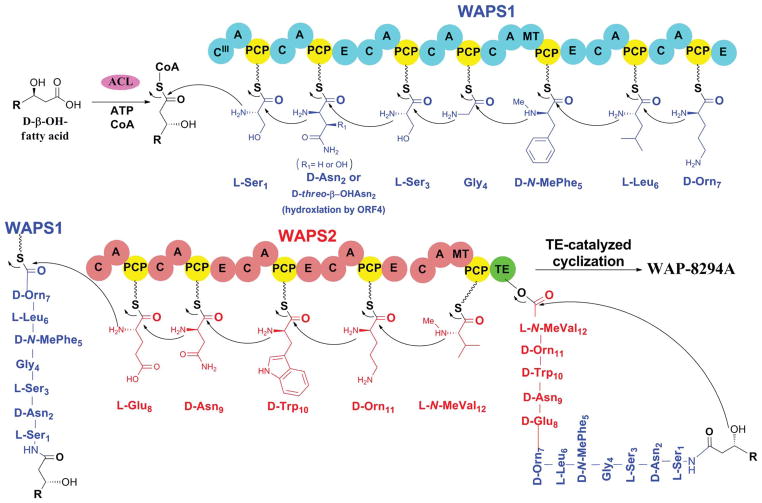
The biosynthetic assembly of WAP-8294A. A, adenylation domain; ACL, acyl-CoA ligase; C, condensation domain; CIII, type-III condensation domain; E, epimerase domain; MT, methyltransferase domain; PCP, peptidyl carrier protein; TE, thioesterase domain. Copyright © 2011, American Society for Microbiology. Antimicrobial Agents and Chemotherapy, Dec. 2011, pp. 5581–5589.
Fig. 5
Fig. 5
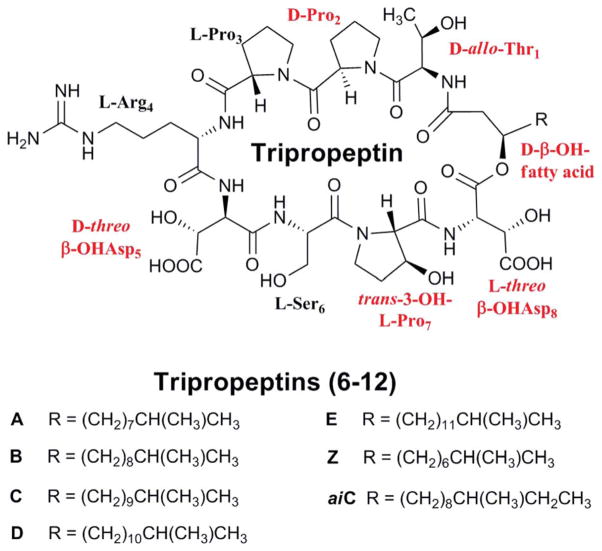
The structure of the tripropeptin family. Non-proteinogenic amino acid residues are highlighted.
Fig. 6
Fig. 6
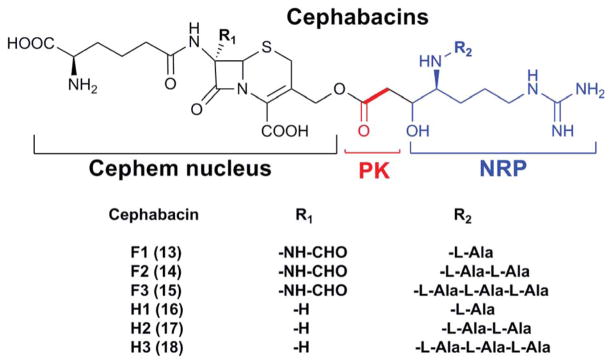
The structure of the cephabacin family. PK, polyketide; NRP, nonribosomal peptide.
Fig. 7
Fig. 7
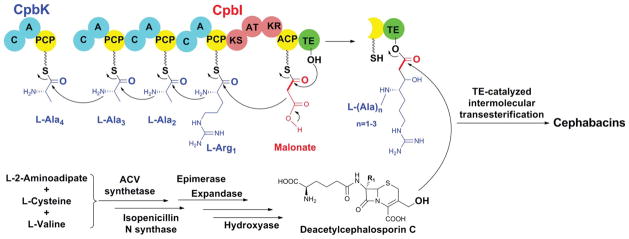
A proposed biosynthetic pathway to cephabacins. A, adenylation domain; ACP, acyl carrier protein; AT, acyltransferase domain; C, condensation domain; KR, ketoreductase domain; KS, ketosynthase domain; PCP, peptidyl carrier protein; TE, thioesterase domain.
Fig. 8
Fig. 8
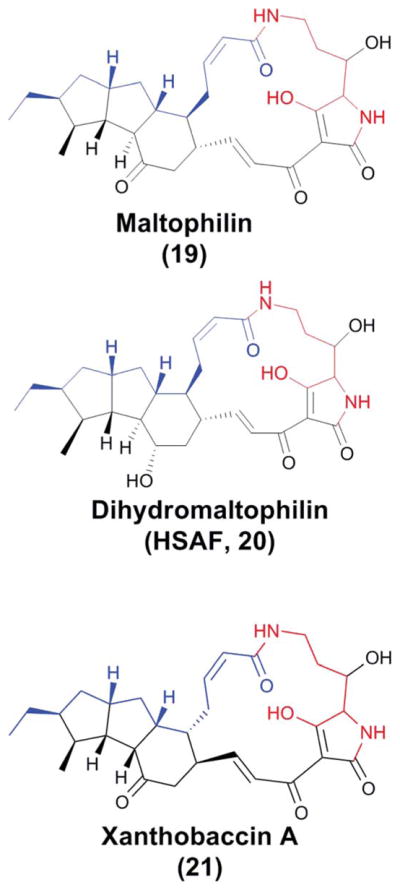
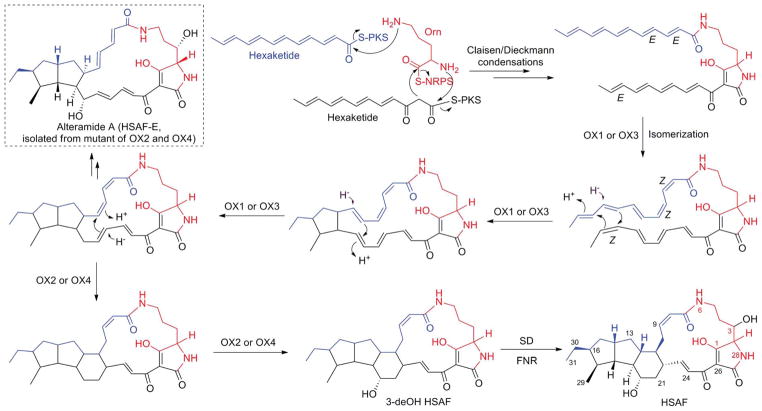
The structures of three members of the polycyclic tetramate macrolactam (PTM) family. Portions colored with blue and black represent the two separate hexaketide chains, and the red-colored region represents the ornithine-originated potion.
Fig. 9
Fig. 9
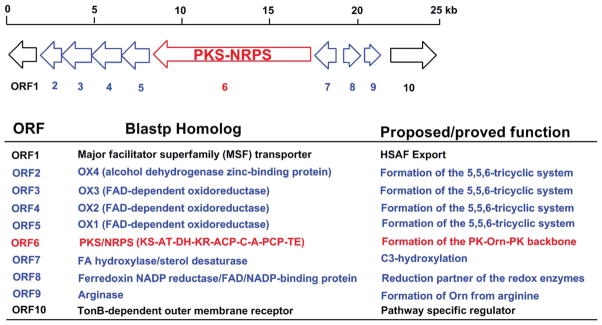
The HSAF biosynthetic gene cluster. KS, β-ketosynthase; AT, acyltransferase; DH, dehydratase; KR, β-ketoreductase; ACP, acyl carrier protein; C, condensation; A, adenylation; PCP, peptidyl carrier protein; TE, thioesterase.
Fig. 10
Fig. 10
A possible biosynthetic pathway to HSAF. Note that the sequence of the OX enzymes-catalyzed cyclizations could be different from the proposed here and similar pathways involving epoxide openings (carbocation chemistry) could also be possible.
Fig. 11
Fig. 11
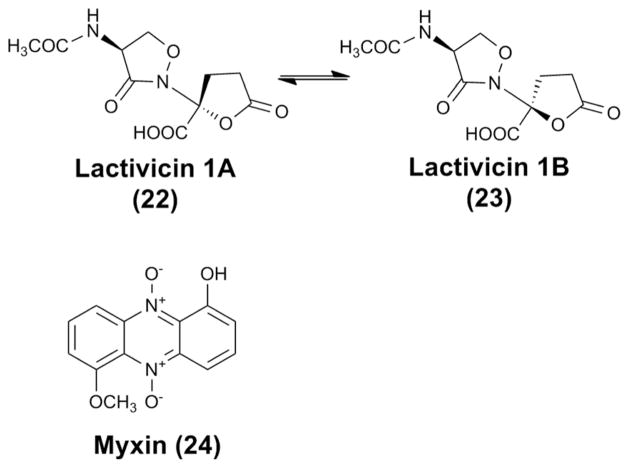
The structures of lactivicin and myxin. The two diasteromers of lactivicin are in equilibrium under aqueous conditions.

References

    1. Christensen P, Cook FD. Int J Syst Bacteriol. 1978;28:367–393.
    1. Reichenbach H. In: Prokaryotes. Dworkin M, Falkow S, Rosenberg E, Schleifer KH, Stackebrandt E, editors. Springer; New York: 2006. pp. 939–957.
    1. Nakayama T, Homma Y, Hashidoko Y, Mizutani J, Tahara S. Appl Environ Microbiol. 1999;65:4334–4339. - PMC - PubMed
    1. Islam MT, Hashidoko Y, Deora A, Ito T, Tahara S. Appl Environ Microbiol. 2005;71:3786–3796. - PMC - PubMed
    1. Sullivan RF, Holtman MA, Zylstra GJ, White JF, Kobayashi DY. J Appl Microbiol. 2003;94:1079–1086. - PubMed

Publication types

MeSH terms