


The effect of prolonged cold ischemia time on estrogen receptor immunohistochemistry in breast cancer
- PMID: 22899286
- PMCID: PMC3881416
- DOI: 10.1038/modpathol.2012.135
The effect of prolonged cold ischemia time on estrogen receptor immunohistochemistry in breast cancer
Abstract
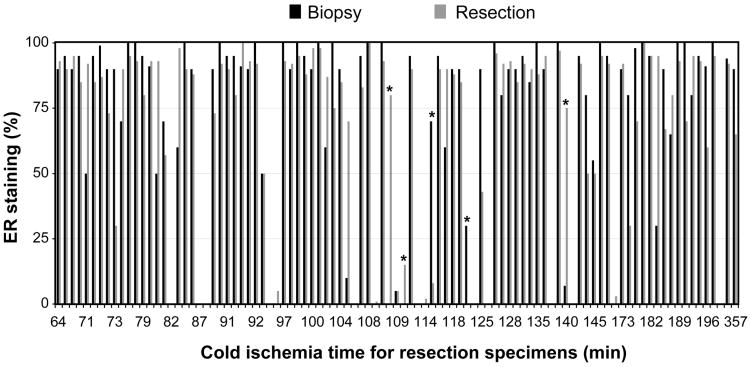
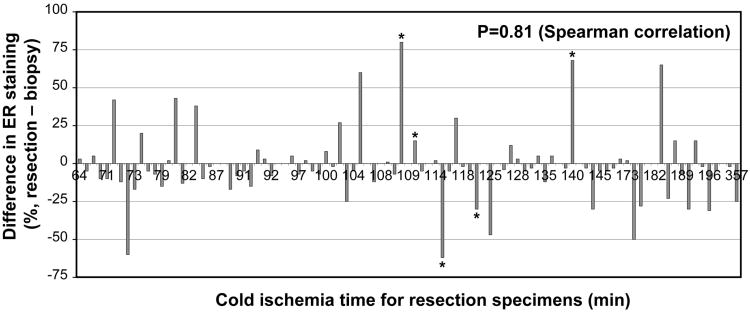
To facilitate accurate detection of estrogen receptor (ER) expression in breast tumors, the American Society of Clinical Oncology/College of American Pathologists recommends that cold ischemia time be kept under 1 h. However, data to address the upper threshold of cold ischemia time are limited. Although it is our routine practice to keep cold ischemia time under 1 h for breast core biopsy specimens, this is difficult for surgical specimens because of the comprehensive intraoperative assessment performed at our institution. In this retrospective study, we compared ER immunohistochemical staining results in paired breast tumor core biopsy specimens and resection specimens with cold ischemia times ranging from 64 to 357 min in 97 patients. The staining category (≥10%, positive; 1-9%, low positive; <1%, negative) between the core biopsy and resection specimens changed for five patients (5%). The weighted Kappa statistic for ER staining category between the two specimen types was 0.86 (95% confidence interval, 0.74-0.99), indicating good concordance. The difference in the percentage of ER staining between core biopsy and resection was not significantly associated with cold ischemia time (P=0.81, Spearman correlation). Although we did not observe significant associations between the difference in ER staining in the two specimen types and cold ischemia time after placing the patients in three groups of 'increase', 'decrease' and 'no change' using a difference of 25% in ER staining percentage as the cutoff, a trend of decreased ER staining with cold ischemia time >2 h was detected. No statistically significant association was found between the change of ER staining and the history of neoadjuvant chemotherapy. Our findings indicate that prolonged cold ischemia time up to 4 h (97% of our cohort) in the practice setting of our institution has minimal clinical impact on ER immunohistochemical expression in breast tumors.
Figures
References
-
- Fitzgibbons PL, Page DL, Weaver D, et al. Prognostic factors in breast cancer. College of American Pathologists Consensus Statement 1999. Arch Pathol Lab Med. 2000;124:966–78. Review. - PubMed
-
- Harvey JM, Clark GM, Osborne CK, Allred DC. Estrogen receptor status by immunohistochemistry is superior to the ligand-binding assay for predicting response to adjuvant endocrine therapy in breast cancer. J Clin Oncol. 1999;17:1474–81. - PubMed
-
- Mann GB, Fahey VD, Feleppa F, et al. Reliance on hormone receptor assays of surgical specimens may compromise outcome in patients with breast cancer. J Clin Oncol. 2005;23:5148–54. - PubMed
Publication types
MeSH terms
Substances
Grants and funding
LinkOut - more resources
Full Text Sources
Medical
Miscellaneous
