


Fine Tuning of Redox Networks on Multiheme Cytochromes from Geobacter sulfurreducens Drives Physiological Electron/Proton Energy Transduction
- PMID: 22899897
- PMCID: PMC3415244
- DOI: 10.1155/2012/298739
Fine Tuning of Redox Networks on Multiheme Cytochromes from Geobacter sulfurreducens Drives Physiological Electron/Proton Energy Transduction
Abstract
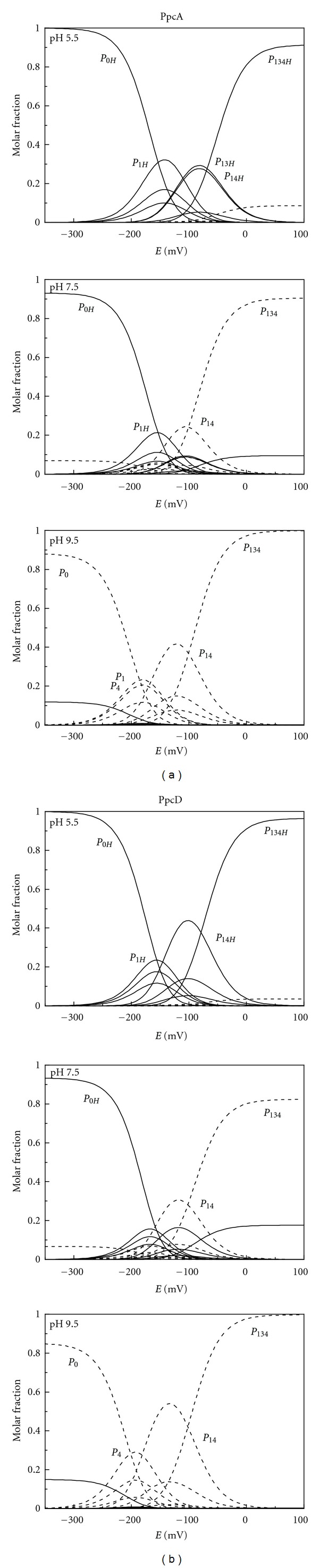
The bacterium Geobacter sulfurreducens (Gs) can grow in the presence of extracellular terminal acceptors, a property that is currently explored to harvest electricity from aquatic sediments and waste organic matter into microbial fuel cells. A family composed of five triheme cytochromes (PpcA-E) was identified in Gs. These cytochromes play a crucial role by bridging the electron transfer from oxidation of cytoplasmic donors to the cell exterior and assisting the reduction of extracellular terminal acceptors. The detailed thermodynamic characterization of such proteins showed that PpcA and PpcD have an important redox-Bohr effect that might implicate these proteins in the e(-)/H(+) coupling mechanisms to sustain cellular growth. The physiological relevance of the redox-Bohr effect in these proteins was studied by determining the fractional contribution of each individual redox-microstate at different pH values. For both proteins, oxidation progresses from a particular protonated microstate to a particular deprotonated one, over specific pH ranges. The preferred e(-)/H(+) transfer pathway established by the selected microstates indicates that both proteins are functionally designed to couple e(-)/H(+) transfer at the physiological pH range for cellular growth.
Figures

References
-
- Lovley DR. Fe(lII) and Mn(lV) reduction. In: Press A, editor. Environmental Microbe-Metal Interactions. Washington, DC, USA: ASM Press; 2000.
-
- Lovley DR, Ueki T, Zhang T, et al. Geobacter. The microbe electric's physiology, ecology, and practical applications. Advances in Microbial Physiology. 2011;59:1–100. - PubMed
LinkOut - more resources
Full Text Sources
