


Lysosomal instability and cathepsin B release during acetaminophen hepatotoxicity
- PMID: 22900545
- PMCID: PMC3501614
- DOI: 10.1111/j.1742-7843.2012.00931.x
Lysosomal instability and cathepsin B release during acetaminophen hepatotoxicity
Abstract
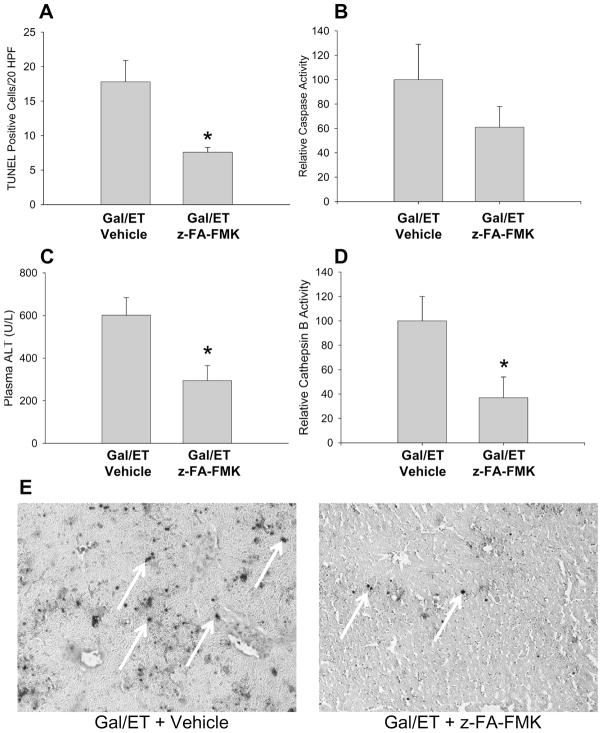
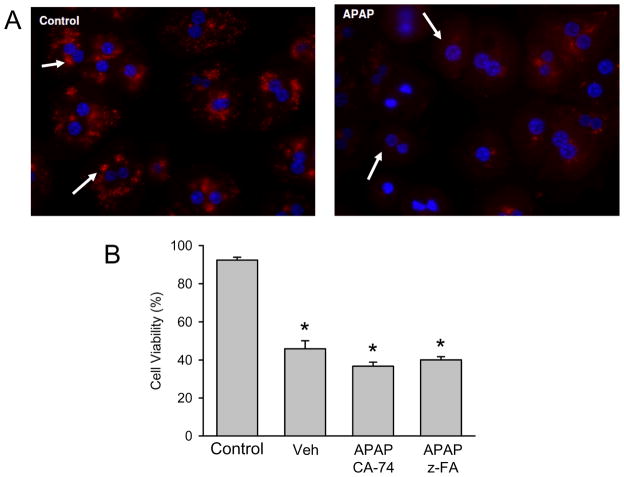
Acetaminophen (APAP) overdose is currently the most frequent cause of drug-induced liver failure in the United States. Recently, it was shown that lysosomal iron translocates to mitochondria where it contributes to the collapse of the mitochondrial membrane potential. Therefore, the purpose of this study was to investigate whether cathepsin B, a lysosomal protease, is involved in APAP-induced hepatotoxicity. Cathepsin B activity was measured in subcellular liver fractions of C57Bl/6 mice 3 hr after 300 mg/kg APAP treatment. There was a significant increase in cytoplasmic cathepsin activity, concurrent with a decrease in microsomal activity, indicative of lysosomal cathepsin B release. To investigate the effect of cathepsin B on hepatotoxicity, the cathepsin inhibitor AC-LVK-CHO was given 1 hr prior to 300 mg/kg APAP treatment along with vehicle control. There was no difference between groups in serum alanine aminotransferase (ALT) values, or by histological evaluation of necrosis, although cathepsin B activity was inhibited by 70-80% compared with controls. These findings were confirmed with a different inhibitor (z-FA-fmk) in vivo and in vitro. Hepatocytes were exposed to 5 mM acetaminophen. Lysotracker staining confirmed lysosomal instability and cathepsin B release, but there was no reduction in cell death after treatment with cathepsin B inhibitors. Finally, cathepsin B release was measured in clinical samples from patients with APAP-induced liver injury. Low levels of cathepsin B were released into plasma from overdose patients. APAP overdose causes lysosomal instability and release of cathepsin B into the cytosol but does not contribute to liver injury under these conditions.
© 2012 The Authors Basic & Clinical Pharmacology & Toxicology © 2012 Nordic Pharmacological Society.
Figures


References
-
- Mitchell JR, Jollow DJ, Potter WZ, Gillette JR, Brodie BB. Acetaminophen-induced hepatic necrosis. IV. Protective role of glutathione. J Pharmacol Exp Ther. 1973;187:211–7. - PubMed
-
- Larson AM, Polson J, Fontana RJ, Davern TJ, Lalani E, Hynan LS, et al. Acetaminophen-induced acute liver failure: results of a United States multicenter, prospective study. Hepatology. 2005;42:1364–72. - PubMed
-
- Hinson JA, Reid AB, McCullough SS, James LP. Acetaminophen- induced hepatotoxicity: role of metabolic activation, reactive oxygen nitrogen species, and mitochondrial permeability transition. Drug Metab Rev. 2004;36:805–22. - PubMed
-
- Cohen SD, Pumford NR, Khairallah EA, Boekelheide K, Pohl LR, Amouzadeh HR, et al. Selective protein covalent binding and target organ toxicity. Toxicol Appl Pharmacol. 1997;143:1–12. - PubMed
-
- Tirmenstein MA, Nelson SD. Subcellular binding and effects on calcium homeostasis produced by acetaminophen and a nonhepatotoxic regioisomer, 3′-hydroxyacetanilide, in mouse liver. J Biol Chem. 1989;264:9814–9. - PubMed
Publication types
MeSH terms
Substances
Grants and funding
LinkOut - more resources
Full Text Sources
Medical
