


Direct cost associated with acquired brain injury in Ontario
- PMID: 22901094
- PMCID: PMC3518141
- DOI: 10.1186/1471-2377-12-76
Direct cost associated with acquired brain injury in Ontario
Abstract
Background: Acquired Brain Injury (ABI) from traumatic and non traumatic causes is a leading cause of disability worldwide yet there is limited research summarizing the health system economic burden associated with ABI. The objective of this study was to determine the direct cost of publicly funded health care services from the initial hospitalization to three years post-injury for individuals with traumatic (TBI) and non-traumatic brain injury (nTBI) in Ontario Canada.
Methods: A population-based cohort of patients discharged from acute hospital with an ABI code in any diagnosis position in 2004 through 2007 in Ontario was identified from administrative data. Publicly funded health care utilization was obtained from several Ontario administrative healthcare databases. Patients were stratified according to traumatic and non-traumatic causes of brain injury and whether or not they were discharged to an inpatient rehabilitation center. Health system costs were calculated across a continuum of institutional and community settings for up to three years after initial discharge. The continuum of settings included acute care emergency departments inpatient rehabilitation (IR) complex continuing care home care services and physician visits. All costs were calculated retrospectively assuming the government payer's perspective.
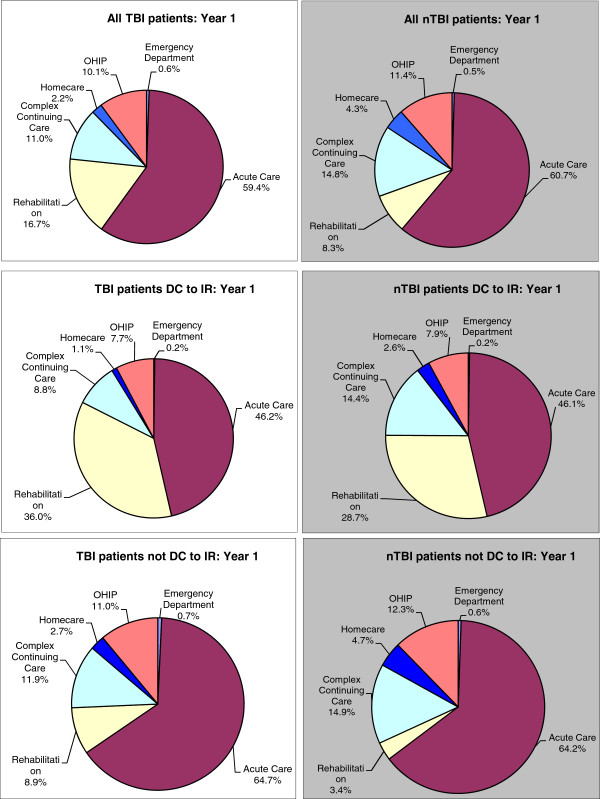
Results: Direct medical costs in an ABI population are substantial with mean cost in the first year post-injury per TBI and nTBI patient being $32132 and $38018 respectively. Among both TBI and nTBI patients those discharged to IR had significantly higher treatment costs than those not discharged to IR across all institutional and community settings. This tendency remained during the entire three-year follow-up period. Annual medical costs of patients hospitalized with a brain injury in Ontario in the first follow-up year were approximately $120.7 million for TBI and $368.7 million for nTBI. Acute care cost accounted for 46-65% of the total treatment cost in the first year overwhelming all other cost components.
Conclusions: The main finding of this study is that direct medical costs in ABI population are substantial and vary considerably by the injury cause. Although most expenses occur in the first follow-up year ABI patients continue to use variety of medical services in the second and third year with emphasis shifting over time from acute care and inpatient rehabilitation towards homecare physician services and long-term institutional care. More research is needed to capture economic costs for ABI patients not admitted to acute care.
Figures
References
-
- Greenwald BD DM Burnett Miller MA. Congenital and Acquired Brain Injury. Brain Injury: Epidemiology and Pathophysiology. Arch Phys Med Rehabil. 2003;84(3 Suppl 1):S3–7. - PubMed
-
- World Health Organization. Neurological Disorders. Geneva: Public Health Challenges; 2006.
-
- ABI Network. Definition of “Acquired Brain Injury”. http://www.abinetwork.ca/downloads/abidefinition.pdf. Accessed: June 15 2012.
-
- Centers for Disease Control and Prevention, National Center for Injury Prevention and Control. Traumatic brain injury in the United States: A report to Congress. 1999. [ http://www.cdc.gov/traumaticbraininjury/tbi_report_to_congress.html] Accessed April 5 2011.
-
- Centers for Disease Control and Prevention, National Center for Injury Prevention and Control. Traumatic Brain Injury in the United States: Emergency Departments Visits Hospitalizations and Deaths 2002–2006. 2010. [ http://www.cdc.gov/traumaticbraininjury/pdf/blue_book.pdf] Accessed April 5 2011.
Publication types
MeSH terms
LinkOut - more resources
Full Text Sources
