. 2012 Dec;27(12):2301-9.
doi: 10.1007/s00467-012-2254-1. Epub 2012 Aug 18.

Treatment of critically ill children with kidney injury by sustained low-efficiency daily diafiltration

Affiliations

Treatment of critically ill children with kidney injury by sustained low-efficiency daily diafiltration

Chia-Ying Lee et al. Pediatr Nephrol. 2012 Dec.

Abstract

Background: Continuous renal replacement therapy (CRRT) and intermittent hemodialysis (IHD) offer diverse benefits and drawbacks for critically ill children with acute kidney injury (AKI). Sustained low-efficiency daily diafiltration (SLEDD-f) involves a conceptual and technical hybrid of CRRT and IHD. We report our SLEDD-f application to critically ill children in the pediatric intensive care unit (PICU).

Methods: SLEDD-f was delivered by the new Fresenius 5008 therapy system with blood flow 5 ml/kg/min, dialysate flow 260 ml/min, hemofiltration 35 ml/kg/h for 8-10 h daily. Changes in blood pressure, blood gas, electrolyte, hemoglobulin (Hb), and hematocrit (Hct) were closely monitored.

Results: From February 2010 to June 2011, 14 critical patients with a total of 60 SLEDD-f sessions were studied retrospectively. Heparin was used in 46 sessions (76.6%) with no bleeding complications. Hypertension above 135 mmHg returned to normal, hypotension below 90 mmHg showed no drop. Metabolic acidosis and hyperkalemia normalized. Elevated Hb, Hct, and their ratio revealed improving hemodilution. Three episodes of intradialytic hypotension (5.0%) and one of circuit clotting (1.7%) led to premature termination. The 28-day survival rate was 71.4%.

Conclusions: This pilot investigation demonstrates that SLEDD-f provides good hemodynamic tolerance and correction of fluid overload, pH, and electrolyte imbalance for critically ill children with AKI.


Figures

Fig. 1
Fig. 1
Changes in blood pressure (BP) in hypertensive (systolic BP > 145 mmHg) and hypotensive (systolic BP < 90 mmHg) patients before, during, and after sustained low-efficiency daily diafiltration (SLEDD-f) therapy. Boxes and bars represent the interquartile range and the median value respectively. The middle number represents the median value. In a hypotensive group, the comparison did not reach statistical significance
Fig. 2
Fig. 2
Changes in hemodilution before and after sustained low-efficiency daily diafiltration (SLEDD-f) therapy. Boxes and bars represent interquartile range and median value respectively. The middle number represents the median value. None of these comparisons reached statistical significance
Fig. 3
Fig. 3
Changes in pulmonary edema before and after sustained low-efficiency daily diafiltration (SLEDD-f) therapy. a Significant lung marking, blunting costophrenic angle, and cardiomegaly before SLEDD-f. b Condition improved after SLEDD-f therapy
Fig. 4
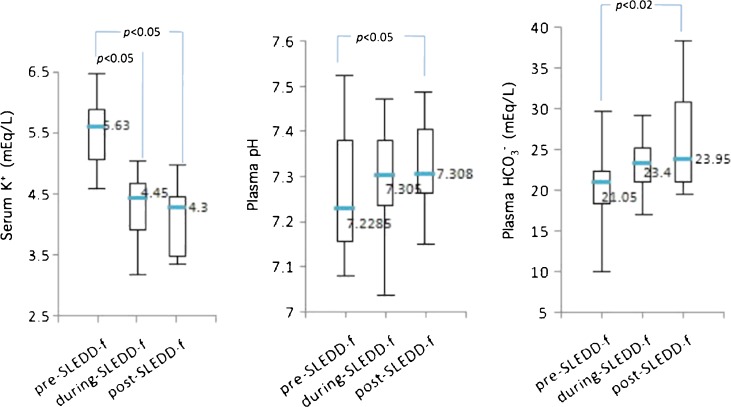
Fig. 4
Changes in serum potassium and metabolic acidosis before and after sustained low-efficiency daily diafiltration (SLEDD-f) therapy. Boxes and bars represent interquartile range and the median value respectively. The middle number represents the median value. Differences between pre- and post-SLEDD-f therapy were statistically significant
Fig. 5
Fig. 5
Changes in quality of life before and after sustained low-efficiency daily diafiltration (SLEDD-f) therapy. Asterisk represents p < 0.05

References

    1. Vanholder R, Van Biesen W, Lameire N. What is the renal replacement method of first choice for intensive care patients? J Am Soc Nephrol. 2001;12:S40–S43. - PubMed
    1. Goldstein SL. Overview of pediatric renal replacement therapy in acute kidney injury. Semin Dial. 2009;22:180–184. doi: 10.1111/j.1525-139X.2008.00551.x. - DOI - PubMed
    1. Strazdins V, Watson AR, Harvey B. European Pediatric Peritoneal Dialysis Working Group. Renal replacement therapy for acute renal failure in children: European guidelines. Pediatr Nephrol. 2004;19:199–207. doi: 10.1007/s00467-003-1342-7. - DOI - PMC - PubMed
    1. Walters S, Porter C, Brophy PD. Dialysis and pediatric acute kidney injury: choice of renal support modality. Pediatr Nephrol. 2009;24:37–48. doi: 10.1007/s00467-008-0826-x. - DOI - PMC - PubMed
    1. Santiago MJ, López-Herce J, Urbano J, Solana MJ, del Castillo J, Ballestero Y, Botrán M, Bellón JM. Complications of continuous renal replacement therapy in critically ill children: a prospective observational evaluation study. Crit Care. 2009;13:R184. doi: 10.1186/cc8172. - DOI - PMC - PubMed

LinkOut - more resources