Review
. 2012 Dec;13(4):437-50.
doi: 10.1007/s11864-012-0208-2.

The spectrum of vaccine therapies for patients with glioblastoma multiforme

Affiliations
Review

The spectrum of vaccine therapies for patients with glioblastoma multiforme

Laura K Aguilar et al. Curr Treat Options Oncol. 2012 Dec.

Abstract

Glioblastoma multiforme (GBM) is the most common primary malignant tumor of the central nervous system (CNS) and one of the most lethal cancers in adults and children. Despite aggressive treatment with surgery, radiation, and chemotherapy, median survival is less than 15 months and overall survival is less than 10 % at 5 years. Development of therapeutics for malignant gliomas has been hampered by their natural complexity as well as protective mechanisms unique to the CNS. Better understanding of the pathogenesis of GBM is opening the path to novel, specific-targeted therapies. Recently, multiple immunotherapy approaches have been acquiring substantial indication of therapeutic efficacy with a very safe profile. Examples of the leading clinical approaches for GBM will be discussed in detail in this review.


Figures
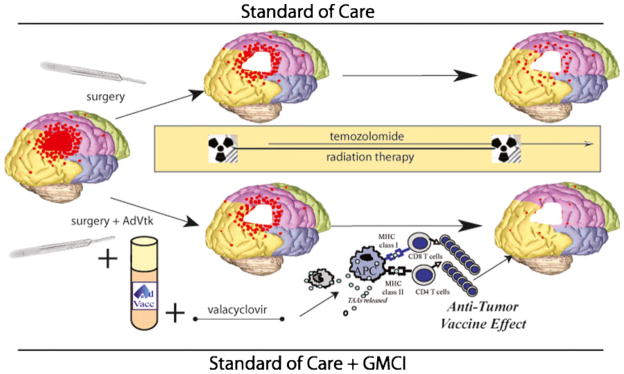
Figure 1
Figure 1. Residual infiltrating tumor cells after standard of care treatments may be eliminated by tumor-specific T cells stimulated by immunotherapies, such as gene-mediated cytotoxic immunotherapy (GMCI)
Standard of care treatment for newly diagnosed GBM includes surgical resection followed by radiation and temozolomide chemotherapy. However, progression occurs in more than two thirds of patients within 1 year due to growth of residual, infiltrating tumor cells. Immunotherapies may increase the efficacy of the immune system to fight against this minimal residual disease. GMCI involves injection of AdV-tk to the tumor bed at the time of surgery followed by oral valacyclovir prodrug administration to induce immunogenic tumor cell death. Surgery, radiation, and the viral vector stimulate infiltration of antigen-presenting cells (APC). Tumor-associated antigens (TAA) are presented by MHC class I and II molecules on APCs stimulating tumor-specific CD4 and CD8 T cells. The HSV-tk protein expressed from the AdV-tk vector has a superantigen-like effect that further stimulates proliferation of T cells. Thus, the approach generates an antitumor vaccine effect that may compliment standard of care to improve outcomes for patients with GBM.

References

    1. Hess KR, Broglio KR, Bondy ML. Adult glioma incidence trends in the United States, 1977–2000. Cancer. 2004;101:2293–9. - PubMed
    1. Kohler B, et al. Annual report to the nation on the status of cancer, 1975–2007, featuring tumors of the brain and other nervous system. J Natl Canc Inst. 2011;103:714–36. - PMC - PubMed
    1. Louis DN, et al. The 2007 WHO classification of tumours of the central nervous system. Acta Neuropathol. 2007;114:97–109. - PMC - PubMed
    1. Charles NA, Holland EC, Gilbertson R, Glass R, Kettenmann H. The brain tumor microenvironment. Glia. 2011;59:1169–80. - PubMed
    1. Jackson C, Ruzevick J, Phallen J, Belcaid Z, Lim M. Challenges in immunotherapy presented by the glioblastoma multiforme microenvironment. Clin Dev Immunol. 2011;2011:732413. - PMC - PubMed

MeSH terms

LinkOut - more resources
