. 2012 Oct;78(20):7455-66.
doi: 10.1128/AEM.01594-12. Epub 2012 Aug 17.

Predatory bacteria as natural modulators of Vibrio parahaemolyticus and Vibrio vulnificus in seawater and oysters

Affiliations

Predatory bacteria as natural modulators of Vibrio parahaemolyticus and Vibrio vulnificus in seawater and oysters

Gary P Richards et al. Appl Environ Microbiol. 2012 Oct.

Abstract

This study shows that naturally occurring Vibrio predatory bacteria (VPB) exert a major role in controlling pathogenic vibrios in seawater and shellfish. The growth and persistence of Vibrio parahaemolyticus and Vibrio vulnificus were assessed in natural seawater and in the Eastern oyster, Crassostrea virginica. The pathogens examined were V. vulnificus strain VV1003, V. parahaemolyticus O1:KUT (KUT stands for K untypeable), and V. parahaemolyticus O3:K6 and corresponding O3:K6 mutants deficient in the toxRS virulence regulatory gene or the rpoS alternative stress response sigma factor gene. Vibrios were selected for streptomycin resistance, which facilitated their enumeration. In natural seawater, oysters bioconcentrated each Vibrio strain for 24 h at 22°C; however, counts rapidly declined to near negligible levels by 72 h. In natural seawater with or without oysters, vibrios decreased more than 3 log units to near negligible levels within 72 h. Neither toxRS nor rpoS had a significant effect on Vibrio levels. In autoclaved seawater, V. parahaemolyticus O3:K6 counts increased 1,000-fold over 72 h. Failure of the vibrios to persist in natural seawater and oysters led to screening of the water samples for VPB on lawns of V. parahaemolyticus O3:K6 host cells. Many VPB, including Bdellovibrio and like organisms (BALOs; Bdellovibrio bacteriovorus and Bacteriovorax stolpii) and Micavibrio aeruginosavorus-like predators, were detected by plaque assay and electron microscopic analysis of plaque-purified isolates from Atlantic, Gulf Coast, and Hawaiian seawater. When V. parahaemolyticus O3:K6 was added to natural seawater containing trace amounts of VPB, Vibrio counts diminished 3 log units to nondetectable levels, while VPB increased 3 log units within 48 h. We propose a new paradigm that VPB are important modulators of pathogenic vibrios in seawater and oysters.


Figures
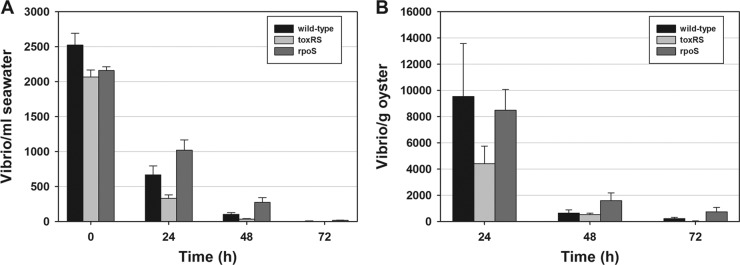
Fig 1
Fig 1
Levels of viable vibrios in seawater and shellfish and their persistence over time. (A and B) Counts of wild-type Vibrio parahaemolyticus O3:K6, toxRS deletion mutants, and rpoS deletion mutants in seawater (A) or in oysters maintained in tanks of seawater (B). The error bars in panel A indicate the standard errors of the means (SEM) of three independent experiments, each performed three times in triplicate (n = 27), while the error bars in panel B represent the SEM of three independent experiments each performed in triplicate (n = 9).
Fig 2
Fig 2
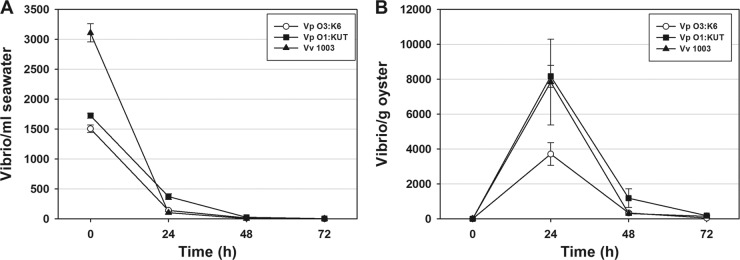
Comparison of the levels of V. parahaemolyticus (Vp) O3:K6, V. parahaemolyticus (Vp) O1:KUT, and V. vulnificus VV1003 (Vv 1003) in seawater (A) and oysters (B) over 72 h. The error bars in panel A indicate the SEM of three independent experiments with three subsamplings per time point with assays performed in triplicate (n = 27), while the error bars in panel B indicate the SEM of three independent experiments each performed in triplicate (n = 9).
Fig 3
Fig 3
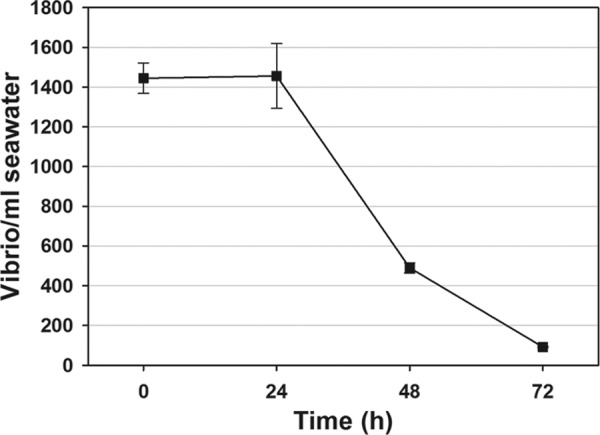
Reduction of V. parahaemolyticus O3:K6 in natural seawater without oysters. The error bars represent SEM of three independent experiments performed in triplicate (n = 9).
Fig 4
Fig 4
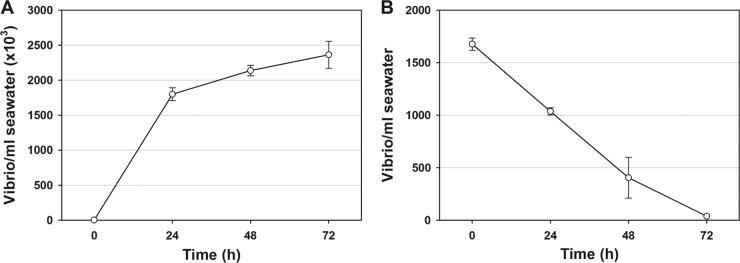
Comparison of streptomycin-resistant V. parahaemolyticus O3:K6 counts in autoclaved seawater (A) and natural seawater (B) over 72 h. Note the different scales of the y axes and that the mean starting levels of vibrios in panels A and B were approximately the same (1.5 × 10³ vibrios/ml). The error bars represent SEM of three samples tested in triplicate (n = 9).
Fig 5
Fig 5
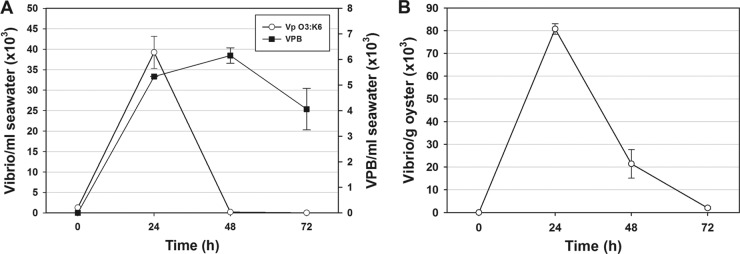
Comparison of mean counts of V. parahaemolyticus (Vp) O3:K6 and Vibrio predatory bacteria (VPB) (■) over time. (A) Vibrio and VPB counts in natural seawater and (B) Vibrio counts in oysters. Two experiments were performed in triplicate (n = 9). The error bars represent SEM.
Fig 6
Fig 6
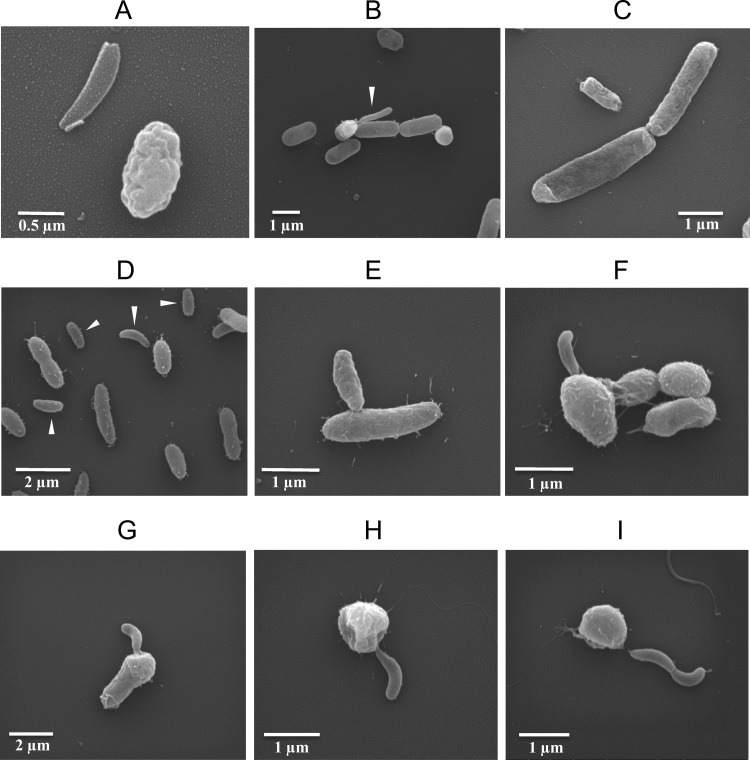
Representative scanning electron micrographs of plaque-purified predatory bacteria. (A to C) Bdellovibrio bacteriovorus (ATCC 15143) propagated in E. coli host cells. (A) An immature Bd. bacteriovorus (left) and an attack phase Bd. bacteriovorus (right). (B) Bd. bacteriovorus (white arrowhead) emerging from a host E. coli. (C) Attack phase Bd. bacteriovorus (flagellum visible) approaching a somewhat elongated E. coli. (D to I) Plaque-purified isolates cultured from 0.45-μm-filtered seawater in V. parahaemolyticus O3:K6. (D) Bdellovibrio and like organisms (BALOs) (white arrowheads) amid a background of larger V. parahaemolyticus O3:K6 host cells. (E) Attack phase BALO entering a V. parahaemolyticus host cell. (F to G) Immature BALOs exiting swollen V. parahaemolyticus host cells. (H) Immature BALO exiting spent V. parahaemolyticus. (I) Conjoined BALOs exiting a spent V. parahaemolyticus.
Fig 7
Fig 7
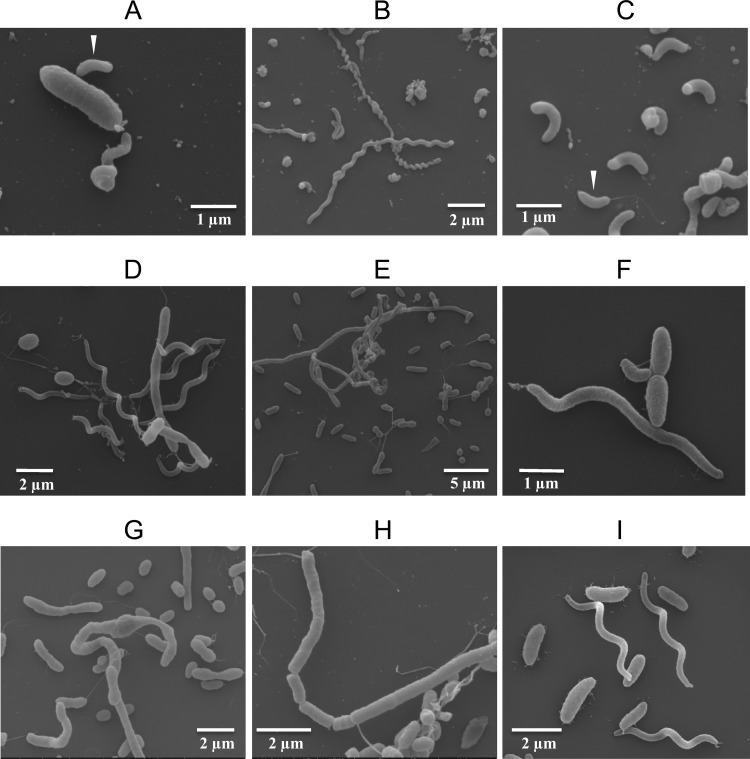
(A to C) Scanning electron micrographs of stock culture of Bacteriovorax stolpii (ATCC 27052) showing their small, attack phase form (white arrowhead) infecting a host E. coli (A), host-independent spiral filaments (B), and short forms with bulbous ends (C). A typical, flagellated, attack phase form (white arrowhead) is also s in panel C. (D to I) Isolates of plaque-purified Ba. stolpii-like organisms cultured in V. parahaemolyticus from 0.45-μm-filtered seawater.

References

    1. Beltrametti F, Kresse AU, Guzman CA. 1999. Transcriptional regulation of the esp genes of enterohemorrhagic Escherichia coli. J. Bacteriol. 181:3409–3418 - PMC - PubMed
    1. Boyd EF, et al. 2008. Molecular analysis of the emergence of pandemic Vibrio parahaemolyticus. BMC Microbiol. 8:110 doi: - DOI - PMC - PubMed
    1. Burnham JC, Hashimoto T, Conti SF. 1968. Electron microscopic observations on the penetration of Bdellovibrio bacteriovorus into gram-negative bacterial hosts. J. Bacteriol. 96:1366–1381 - PMC - PubMed
    1. Centers for Disease Control and Prevention 1999. Outbreak of Vibrio parahaemolyticus infection associated with eating raw oysters and clams harvested from Long Island Sound - Connecticut, New Jersey, and New York, 1998. MMWR Morb. Mortal. Wkly. Rep. 48:48–51 - PubMed
    1. Chen H, Athar R, Zheng G, Williams HN. 2011. Prey bacteria shape community structure of their predators. ISME J. 5:1314–1342 - PMC - PubMed

Publication types

LinkOut - more resources