doi: 10.1371/journal.pbio.1001377.
Epub 2012 Aug 14.
The Human Microbiome Project: a community resource for the healthy human microbiome
Affiliations
- PMID: 22904687
- PMCID: PMC3419203
- DOI: 10.1371/journal.pbio.1001377
Item in Clipboard
The Human Microbiome Project: a community resource for the healthy human microbiome
PLoS Biol.
2012.
Abstract
This manuscript describes the NIH Human Microbiome Project, including a brief review of human microbiome research, a history of the project, and a comprehensive overview of the consortium's recent collection of publications analyzing the human microbiome.
Conflict of interest statement
The authors have declared that no competing interests exist.
Figures
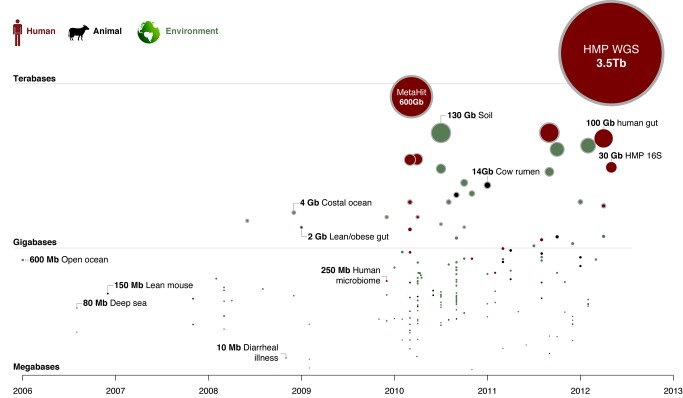
Each circle represents a high-throughput sequence-based 16S or shotgun metagenomic bioproject in NCBI (May 2012), indicating the amount of sequence data produced for each project (circle area and y-coordinate) at the time of publication/registration (x-coordinate). Projects are grouped by human-associated (red), other animal (black), or environmental (green) communities, and shotgun metagenomic projects are marked with a grey band. Selected representative projects are labeled: open ocean , deep sea , lean mouse , diarrheal illness , costal ocean , lean/obese gut , human microbiome , MetaHIT (gut) , cow rumen , soil (NCBI BioProject PRJNA50473), and human gut . Note that HMP has deposited a total of 7.44 terabases of shotgun data in SRA, of which 49% is host DNA derived data that was filtered and only available through protected access in dbGaP project phs000228.
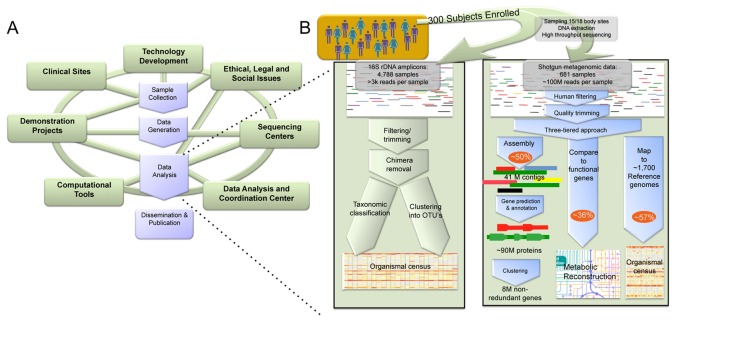
(A) Initiatives within the HMP coordinated to isolate samples, generate data, perform analysis, and publish results. Technology development was employed to develop novel bacterial culture and DNA isolation techniques. Ethical Legal and Social Implications (ELSI) work anticipated societal implications and guided policies associated with human subject microbiomes. Clinical sites were collected samples from large cohorts of healthy individuals, with nucleotide sequence information derived at four sequencing centers at the Baylor College of Medicine (BCM), the Broad Institute, the J. Craig Venter Institute (JCVI), and the Washington University Genome Institute (WUGI). Additional demonstration projects assessed primarily microbiome alterations related to disease. In addition to analysis throughout the HMP consortium, computational tools were funded to address, for example, genome assembly, microbial ecology, and statistical modeling. A data analysis and coordination center provided a portal to all data generated. (B) Overview of the analysis approaches that were the ultimate product of the HMP consortium, corresponding to data products and protocols available at http://hmpdacc.org .
References
-
- Relman DA, Falkow S (2001) The meaning and impact of the human genome sequence for microbiology. Trends Microbiol 9: 206–208. - PubMed
-
- Davies J (2001) In a map for human life, count the microbes, too. Science 291: 2316. - PubMed
-
- Stahl DA, Lane DJ, Olsen GJ, Pace NR (1984) Analysis of hydrothermal vent-associated symbionts by ribosomal RNA sequences. Science 224: 409–411. - PubMed
Publication types
MeSH terms
Substances
Grants and funding
- U54 HG004973/HG/NHGRI NIH HHS/United States
- U54HG004969/HG/NHGRI NIH HHS/United States
- U54 HG003067/HG/NHGRI NIH HHS/United States
- P30 DK043351/DK/NIDDK NIH HHS/United States
- R01HG004872/HG/NHGRI NIH HHS/United States
- U54 AI084844/AI/NIAID NIH HHS/United States
- U54HG004973/HG/NHGRI NIH HHS/United States
- R01 HG004872/HG/NHGRI NIH HHS/United States
- R01 HG005969/HG/NHGRI NIH HHS/United States
- U54 HG004969/HG/NHGRI NIH HHS/United States
- R01HG005969/HG/NHGRI NIH HHS/United States
- HHMI/Howard Hughes Medical Institute/United States
- U01HG004866/HG/NHGRI NIH HHS/United States
- U01 HG004866/HG/NHGRI NIH HHS/United States
- U54AI084844/AI/NIAID NIH HHS/United States