Spatial clustering during memory search
- PMID: 22905933
- PMCID: PMC8409224
- DOI: 10.1037/a0029684
Spatial clustering during memory search
Abstract
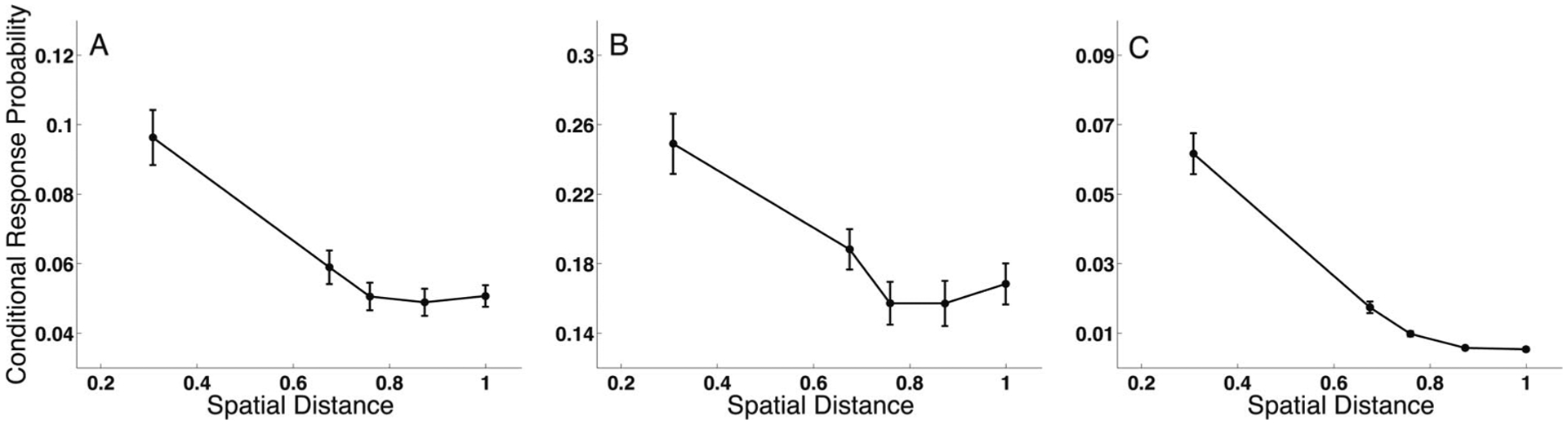
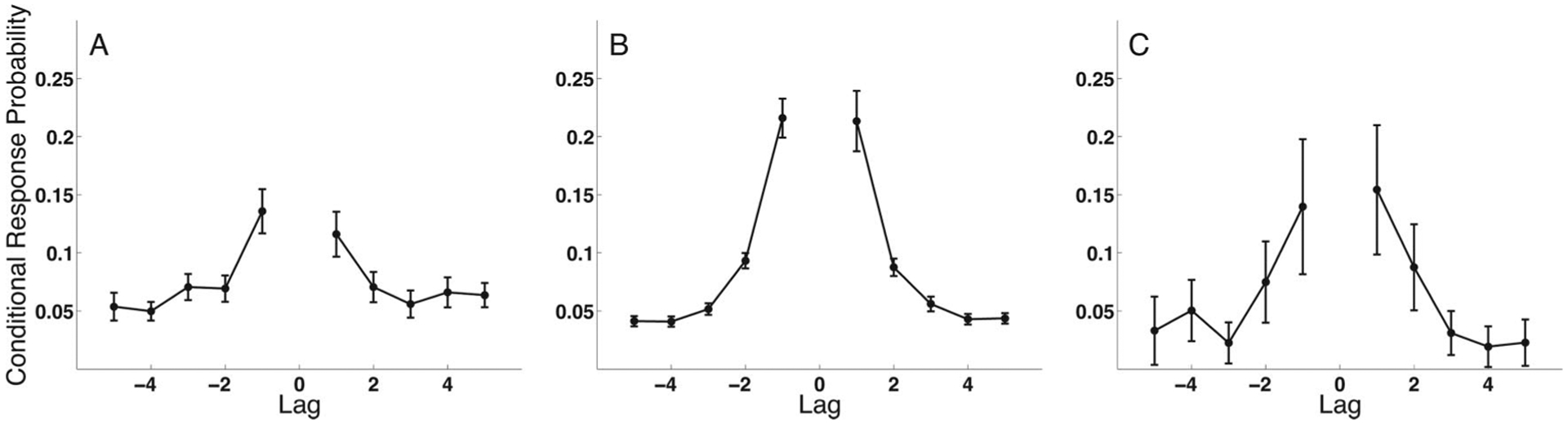
In recalling a list of previously experienced items, participants are known to organize their responses on the basis of the items' semantic and temporal similarities. Here, we examine how spatial information influences the organization of responses in free recall. In Experiment 1, participants studied and subsequently recalled lists of landmarks. In Experiment 2, participants played a game in which they delivered objects to landmarks in a virtual environment and later recalled the delivered objects. Participants in both experiments were simply asked to recall as many items as they could remember in any order. By analyzing the conditional probabilities of recall transitions, we demonstrate strong spatial and temporal organization of studied items in both experiments.
Figures



References
-
- Bousfield WA, & Sedgewick CHW (1944). An analysis of sequences of restricted associative responses. Journal of General Psychology, 30, 149–165.
-
- Clayton K, & Chattin D (1989). Spatial and semantic priming effects in tests of spatial knowledge. Journal of Experimental Psychology: Learning, Memory, and Cognition, 15, 495–506. doi:10.1037/0278-7393.15.3.495 - DOI
-
- Craik FIM (1970). The fate of primary memory items in free recall. Journal of Verbal Learning & Verbal Behavior, 9, 143–148. doi:10.1016/S0022-5371(70)80042-1 - DOI
-
- Curiel JM, & Radvansky GA (1998). Mental organization of maps. Journal of Experimental Psychology: Learning, Memory, and Cognition, 24, 202–214. doi:10.1037/0278-7393.24.1.202 - DOI
Publication types
MeSH terms
Grants and funding
LinkOut - more resources
Full Text Sources
Other Literature Sources